Department of Mathematics, Siena College, Loudonville, NY.
Laboratory of Malaria Immunology and Vaccinology, National Institute of Allergy and Infectious Diseases, National Institutes of Health, Rockville, MD.
J Acquir Immune Defic Syndr. 2018 Oct 1;79(2):249-254. doi: 10.1097/QAI.0000000000001783.
We previously used mathematical modeling to predict reduced malaria incidence in children with protease inhibitor (PI)-, compared with nonnucleoside reverse transcriptase inhibitor-, based highly active antiretroviral therapy (HAART), in moderate to high malaria transmission areas. These effects were accounted for, in part, by pharmacokinetic (PK) interactions between PIs and artemether-lumefantrine (AL).
Because of potentially reduced malaria transmission reservoirs in HIV-infected children due to PI/AL PK interactions impacting non-HIV-infected children, we estimate the antimalarial benefit of PI-based HAART in all children, and in HIV-infected children only residing in low to moderate malaria transmission areas.
A dynamic model of malaria transmission was developed to evaluate the PK interaction of PI-based HAART with the antimalarial, AL for preventing malaria.
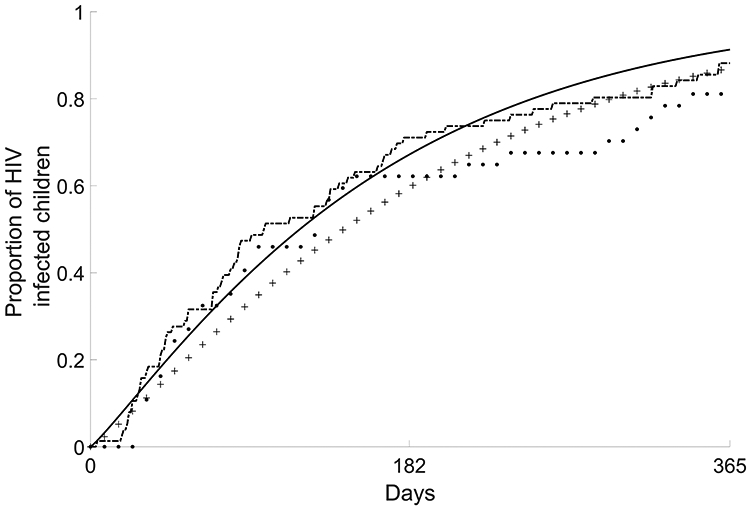
To evaluate the benefit of HIV PI-based HAART on malaria incidence, a malaria transmission model with varying degrees of HIV newborn prevalence was developed using recent pediatric clinical trial data in Lilongwe, Malawi.
Comparing situations of low to high HIV newborn prevalence, and low to moderate malaria transmission intensities, our model predicts the combination of PI-based HAART with AL-treated malaria prevents 0.04-24.8 and 0.05-34.5 annual incidences of malaria overall per 1000 children, and saves 0.003-1.66 and 0.003-2.30 disability-adjusted life years per 1000 children, respectively. When incorporating seasonality, 0.01-7.3 and 0.01-5.9 annual incidences of malaria overall per 1000 children, and 0.0-0.5 and 0.001-0.41 disability-adjusted life years per 100 children, are prevented, respectively.
In low to moderate malaria transmission intensity areas, PI-based HAART may reduce malaria events in children when AL is used.
我们之前曾使用数学模型预测,与非核苷类逆转录酶抑制剂(NNRTI)相比,基于蛋白酶抑制剂(PI)的高效抗逆转录病毒治疗(HAART)会降低中度至高度疟疾传播地区儿童的疟疾发病率。这些效果部分归因于 PI 和青蒿素-本芴醇(AL)之间的药代动力学(PK)相互作用。
由于 PI/AL PK 相互作用对未感染 HIV 的儿童产生影响,从而减少了 HIV 感染儿童中的疟疾传播储备,因此我们评估了所有儿童以及仅居住在中低疟疾传播地区的 HIV 感染儿童中基于 PI 的 HAART 的抗疟益处。
开发了一种疟疾传播的动态模型,以评估基于 PI 的 HAART 与抗疟药 AL 之间的 PK 相互作用,从而预防疟疾。
为了评估 HIV 基于 PI 的 HAART 对疟疾发病率的影响,我们使用马拉维利隆圭最近的儿科临床试验数据,针对不同程度的新生儿 HIV 流行率,开发了一种疟疾传播模型。
比较低至高 HIV 新生儿流行率和低至高疟疾传播强度的情况,我们的模型预测,PI 基 HAART 联合 AL 治疗疟疾可预防 0.04-24.8 和 0.05-34.5 例/1000 名儿童的年疟疾总发病率,并分别挽救 0.003-1.66 和 0.003-2.30 个残疾调整生命年/1000 名儿童。当纳入季节性因素时,0.01-7.3 和 0.01-5.9 例/1000 名儿童的年疟疾总发病率和 0.0-0.5 和 0.001-0.41 个残疾调整生命年/1000 名儿童的发病率得到预防。
在中低疟疾传播强度地区,当使用 AL 时,基于 PI 的 HAART 可能会降低儿童的疟疾事件。