Department of Cardiology, Wuhan Asia Heart Hospital, Wuhan University of Science and Technology, Wuhan, Hubei, China (mainland).
Laboratory of Molecular Cardiology, Wuhan Asia Heart Hospital, Wuhan University of Science and Technology, Wuhan, Hubei, China (mainland).
Med Sci Monit. 2018 Sep 13;24:6431-6437. doi: 10.12659/MSM.909469.
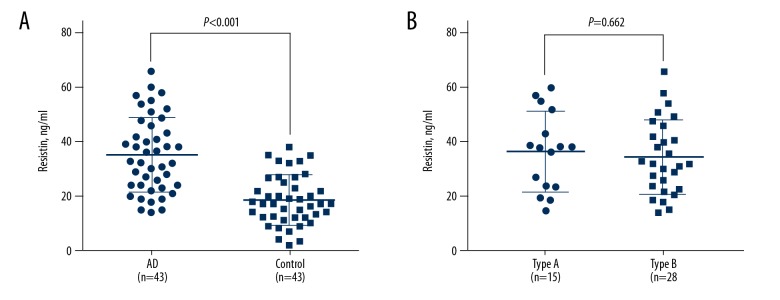
BACKGROUND The aim of this observational case-control study was to compare the levels of plasma resistin between patients with acute aortic dissection and matched controls, and to use propensity score matching (PSM) to reduce case selection bias and clinical confounders. MATERIAL AND METHODS With the use of PSM, this study included 43 pairs of patients with acute aortic dissection (type-A and type-B dissection) and matched controls. Plasma resistin levels and other laboratory parameters were compared between the two groups, including white blood cell (WBC) count, glucose, high sensitivity C-reactive protein (hs-CRP), interleukin-6 (IL-6), tumor necrosis factor-α (TNF-α), and D-dimer. The correlations between resistin and other laboratory parameters were evaluated in patients with acute aortic dissection. RESULTS Following PSM adjustment for clinical variables, including age, sex, body mass index, smoking, alcohol drinking, hypertension, diabetes mellitus, coronary heart disease and stroke, plasma resistin levels were significantly increased in patients with acute aortic dissection when compared with controls (35.2±13.8 vs. 18.4±9.1 ng/ml) (p<0.001). WBC counts, and levels of glucose, hs-CRP, IL-6, TNF-α and D-dimer were also significantly increased in the patients with aortic dissection compared with the control group. After adjustment for these variables, the association between plasma resistin levels and acute aortic dissection remained significant (OR, 1.114; 95% CI, 1.036-1.224) (p<0.001). Plasma resistin levels was positively correlated with WBC count (r=0.368, p=0.015), hs-CRP (r=0.359, p=0.022), IL-6 (r=0.306, p=0.046) and TNF-α levels (r=0.315, p=0.040) in patients with acute aortic dissection. CONCLUSIONS Acute aortic dissection is associated with elevated levels of plasma resistin and other pro-inflammatory cytokines. Plasma resistin levels is positively associated with other pro-inflammatory cytokines in acute aortic dissection.
本观察性病例对照研究旨在比较急性主动脉夹层患者与匹配对照者的血浆抵抗素水平,并采用倾向评分匹配(PSM)减少病例选择偏倚和临床混杂因素。
采用 PSM 法,本研究纳入了 43 对急性主动脉夹层(A型和 B 型夹层)患者和匹配对照者。比较两组患者的血浆抵抗素水平及其他实验室参数,包括白细胞计数、血糖、高敏 C 反应蛋白(hs-CRP)、白细胞介素-6(IL-6)、肿瘤坏死因子-α(TNF-α)和 D-二聚体。评估急性主动脉夹层患者中抵抗素与其他实验室参数的相关性。
经过 PSM 调整临床变量(年龄、性别、体重指数、吸烟、饮酒、高血压、糖尿病、冠心病和脑卒中)后,与对照组相比,急性主动脉夹层患者的血浆抵抗素水平显著升高(35.2±13.8 vs. 18.4±9.1 ng/ml)(p<0.001)。白细胞计数以及血糖、hs-CRP、IL-6、TNF-α和 D-二聚体水平在主动脉夹层患者中也显著高于对照组。在校正这些变量后,血浆抵抗素水平与急性主动脉夹层之间的相关性仍然显著(OR,1.114;95%CI,1.036-1.224)(p<0.001)。血浆抵抗素水平与白细胞计数呈正相关(r=0.368,p=0.015)、hs-CRP(r=0.359,p=0.022)、IL-6(r=0.306,p=0.046)和 TNF-α水平(r=0.315,p=0.040)在急性主动脉夹层患者中。
急性主动脉夹层与血浆抵抗素和其他促炎细胞因子水平升高有关。血浆抵抗素水平与急性主动脉夹层中的其他促炎细胞因子呈正相关。