Università degli Studi di Palermo, Dipartimento di Biomedicina Sperimentale e Neuroscienze Cliniche (BioNeC), Sezione di Otorinolaringoiatria, Palermo, Italy.
Università degli Studi di Palermo, Dipartimento di Biomedicina Sperimentale e Neuroscienze Cliniche (BioNeC), Sezione di Otorinolaringoiatria, Palermo, Italy.
Braz J Otorhinolaryngol. 2019 Sep-Oct;85(5):603-610. doi: 10.1016/j.bjorl.2018.04.012. Epub 2018 Jun 2.
The treatment of laryngeal squamous cell carcinoma needs accurate risk stratification, in order to choose the most suitable therapy. The prognostic significance of resection margin is still highly debated, considering the contradictory results obtained in several studies regarding the survival rate of patients with a positive resection margin.
To evaluate the prognostic role of resection margin in terms of survival and risk of recurrence of primary tumour through survival analysis.
Between 2007 and 2014, 139 patients affected by laryngeal squamous cell carcinoma underwent partial or total laryngectomy and were followed for mean of 59.44±28.65 months. Resection margin status and other variables such as sex, age, tumour grading, pT, pN, surgical technique adopted, and post-operative radio- and/or chemotherapy were investigated as prognostic factors.
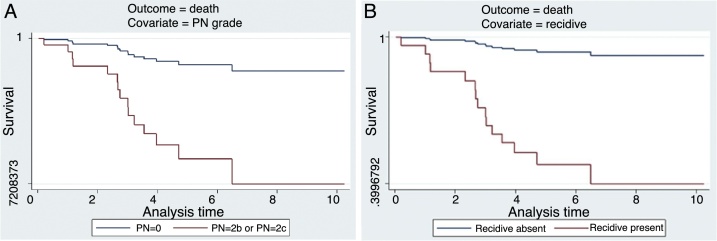
45.32% of patients underwent total laryngectomy, while the remaining subjects in the cohort underwent partial laryngectomy. Resection margins in 73.39% of samples were free of disease, while in 21 patients (15.1%) anatomo-pathological evaluation found one of the margins to be close; in 16 subjects (11.51%) an involved resection margin was found. Only 6 patients (4.31%) had a recurrence, which occurred in 83.33% of these patients within the first year of follow-up. Disease specific survival was 99.24% after 1 year, 92.4% after 3 years, and 85.91% at 5 years. The multivariate analysis of all covariates showed an increased mortality rate only with regard to pN (HR=5.043; p=0.015) and recurrence (HR=11.586; p=0.012). Resection margin did not result an independent predictor (HR=0.757; p=0.653).
Our study did not recognize resection margin as an independent prognostic factor; most previously published papers lack unanimous, methodological choices, and the cohorts of patients analyzed are not easy to compare. To reach a unanimous agreement regarding the prognostic value of resection margins, it would be necessary to carry out meta-analyses on studies sharing definition of resection margin, methodology and post-operative therapeutic choices.
治疗喉鳞状细胞癌需要进行准确的风险分层,以便选择最合适的治疗方法。由于在几项研究中获得了关于切缘阳性患者生存率的相互矛盾的结果,因此切缘的预后意义仍存在很大争议。
通过生存分析评估切缘在生存率和肿瘤复发风险方面的预后作用。
2007 年至 2014 年间,139 例喉鳞状细胞癌患者接受了部分或全喉切除术,并进行了平均 59.44±28.65 个月的随访。调查了切缘状态和其他变量,如性别、年龄、肿瘤分级、pT、pN、采用的手术技术以及术后放化疗,作为预后因素。
45.32%的患者接受了全喉切除术,而队列中的其余患者接受了部分喉切除术。73.39%的样本切缘无疾病,21 例(15.1%)的病理评估发现其中一条切缘接近;16 例(11.51%)发现受累切缘。只有 6 例(4.31%)患者出现复发,这些患者中有 83.33%在随访的第一年复发。第 1 年疾病特异性生存率为 99.24%,第 3 年为 92.4%,第 5 年为 85.91%。对所有协变量的多变量分析显示,仅 pN(HR=5.043;p=0.015)和复发(HR=11.586;p=0.012)与死亡率增加相关。切缘不是独立的预后因素(HR=0.757;p=0.653)。
本研究未将切缘视为独立的预后因素;大多数先前发表的论文缺乏一致的方法学选择,并且分析的患者队列难以比较。为了就切缘的预后价值达成一致意见,有必要对具有切缘定义、方法学和术后治疗选择的研究进行荟萃分析。