Liu Anxin, Zhu Weiwei, Sun Lirui, Han Guangming, Liu Huiping, Chen Zhaoyu, Zhuang Li, Jiang Wen, Xue Xia
Healthcare Ward, Rizhao Hospital of TCM, Rizhao, Shandong 276000, P.R. China.
Department of Pharmacy, Yantai Yuhuangding Hospital Affiliated to Qingdao University, Yantai, Shandong 264000, P.R. China.
Exp Ther Med. 2018 Oct;16(4):3020-3026. doi: 10.3892/etm.2018.6523. Epub 2018 Jul 26.
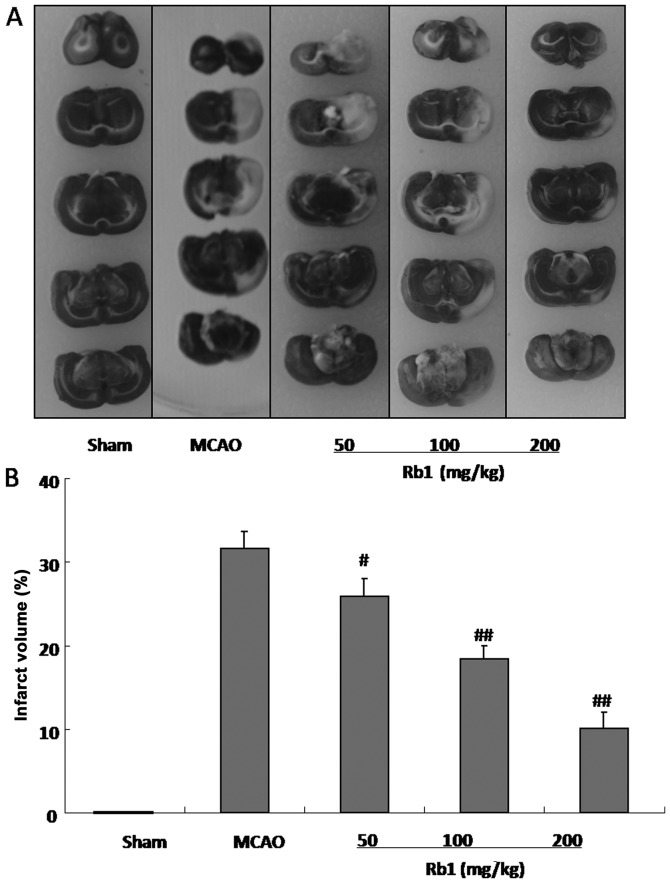
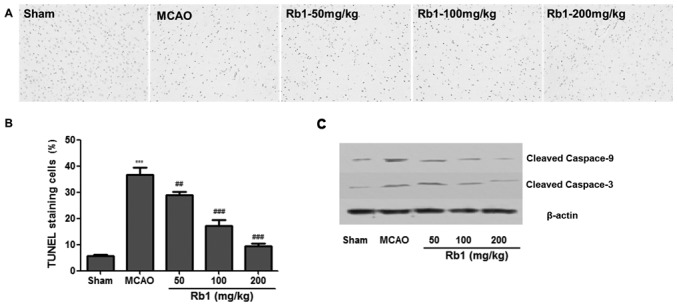
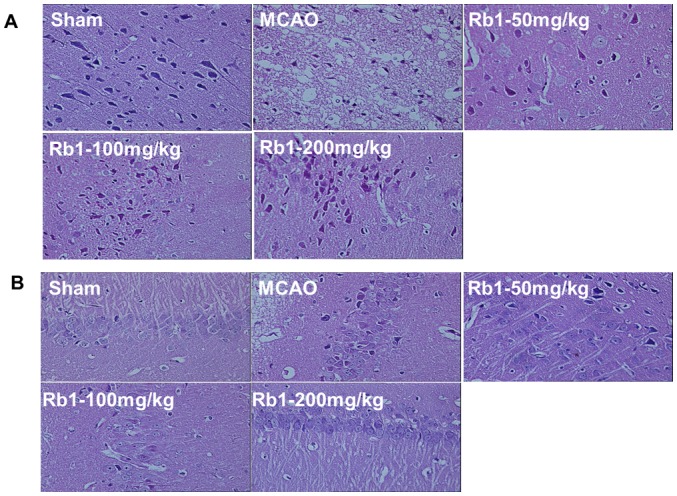
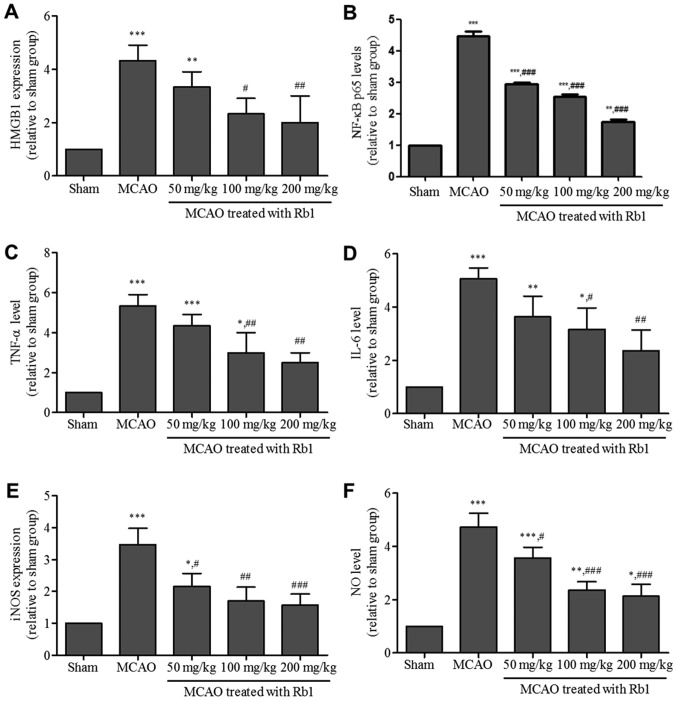
High-mobility group box 1 (HMGB1) is released after focal cerebral ischemia/reperfusion (I/R), and aggravates brain tissue damage. Ginsenoside Rb1 (Rb1), isolated from , has been reported to inhibit I/R-induced cell death in the brain. The present study aimed to investigate the protective ability of GRb1 on focal cerebral I/R rats and to explore its further mechanisms. A middle cerebral artery occlusion (MCAO) rat model was established and treated with different doses of Rb1. The neurological deficits were examined after reperfusion, and TTC staining was applied to assess the infarct volume. Histology and TUNEL staining were performed to evaluate pathological changes and neuronal cell apoptosis in brain tissues. HMGB1 and levels of inflammatory factors and proteins, were examined by ELISA or western blotting. Rb1 treatment notably improved the neurological deficits in an MCAO model, accompanied by decreased infarct volume in the brain tissues. Histological examination revealed that the necrotic tissue area in MCAO rats was also diminished by Rb1 treatment. Apoptosis induced by cerebral I/R was also attenuated by Rb1 treatment via downregulation of cleaved caspase-3 and caspase-9 levels. HMGB1 release was inhibited by Rb1 treatment in MCAO rats, and the levels of nuclear factor-κB, tumor necrosis factor-α, interleukin-6, inducible nitric oxide synthase and nitric oxide were also decreased. The present study suggests that Rb1 serves a protective role in I/R-induced cerebral-neuron injury, due to the decreased cerebral infarct volume of brain tissue. The mechanisms underlying these effects may be associated with the inhibition of HMGB1 inflammatory signals.
高迁移率族蛋白B1(HMGB1)在局灶性脑缺血/再灌注(I/R)后释放,并加重脑组织损伤。从[具体来源未给出]中分离出的人参皂苷Rb1(Rb1),据报道可抑制I/R诱导的脑内细胞死亡。本研究旨在探讨GRb1对局灶性脑I/R大鼠的保护作用,并探究其进一步的机制。建立大脑中动脉闭塞(MCAO)大鼠模型,并用不同剂量的Rb1进行治疗。再灌注后检查神经功能缺损情况,并应用TTC染色评估梗死体积。进行组织学和TUNEL染色以评估脑组织中的病理变化和神经元细胞凋亡。通过ELISA或蛋白质印迹法检测HMGB1以及炎症因子和蛋白质的水平。Rb1治疗显著改善了MCAO模型中的神经功能缺损,同时伴有脑组织梗死体积减小。组织学检查显示,Rb1治疗也减少了MCAO大鼠的坏死组织面积。Rb1治疗还通过下调裂解的caspase-3和caspase-9水平减轻了脑I/R诱导的细胞凋亡。Rb1治疗抑制了MCAO大鼠中HMGB1的释放,并且核因子-κB、肿瘤坏死因子-α、白细胞介素-6、诱导型一氧化氮合酶和一氧化氮的水平也降低。本研究表明,由于脑组织脑梗死体积减小,Rb1在I/R诱导的脑神经元损伤中发挥保护作用。这些作用的潜在机制可能与抑制HMGB1炎症信号有关。