Simmonds Gregory, Woods Andy T, Spence Charles
Crossmodal Research Laboratory, Department of Experimental Psychology, University of Oxford, Anna Watts Building, Radcliffe Observatory Quarter Woodstock Road, OX2 6GG Oxford, UK.
Foods. 2018 Sep 13;7(9):151. doi: 10.3390/foods7090151.
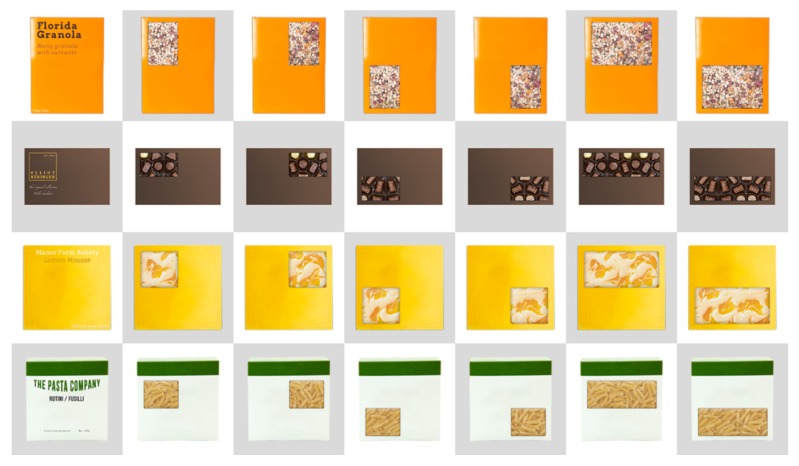
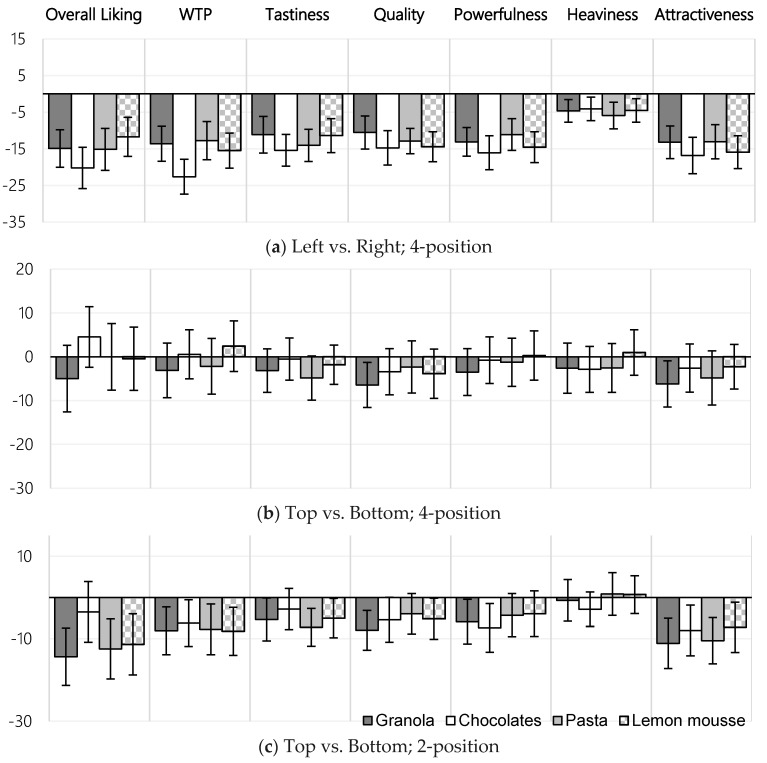
The position of design elements on product packaging has been shown to exert a measurable impact on consumer perception across a number of different studies and product categories. Design elements previously found to influence the consumer through their positioning on the front of pack include product imagery, brand logos, text-based claims, and basic shapes. However, as yet, no empirical research has focused specifically on the relative position of transparent windows; despite the latter being an increasingly prevalent element of many modern packaging designs. This exploratory online study details an experimental investigation of how manipulating the position of a transparent window on a range of visually-presented, novel packaging designs influences consumer evaluations and judgements of the product seen within. Specifically, 110 participants rated 24 different packaging designs (across four product categories: granola, boxed chocolates, pasta, and lemon mousse; each with six window positions: in one of the four quadrants, the top half, or the bottom half) in a within-participants experimental design. Analyses were conducted using Friedman's tests and Hochberg procedure-adjusted Wilcoxon Signed-Rank Tests. Window position was found to be a non-trivial element of design, with a general preference for windows on the right-hand side being evidenced. Significantly higher scores for expected product tastiness and design attractiveness were consistently identified across all product categories when windows were positioned on the right- vs. left-hand side of the packaging. Effects on the perception of powerfulness, overall liking, quality, and willingness to purchase were identified, but were inconsistent across the different product categories. Very few effects of window verticality were identified, with expected weight of the product not being significantly influenced by window position. The implications of these findings for academics, designers, and brand managers are discussed, with future research directions highlighted.
在许多不同的研究和产品类别中,产品包装上设计元素的位置已被证明会对消费者认知产生可衡量的影响。先前发现,通过其在包装正面的位置影响消费者的设计元素包括产品图像、品牌标识、文字声明和基本形状。然而,迄今为止,尚无实证研究专门关注透明窗口的相对位置;尽管透明窗口在许多现代包装设计中越来越普遍。这项探索性在线研究详细介绍了一项实验调查,该调查研究了在一系列视觉呈现的新颖包装设计上操纵透明窗口的位置如何影响消费者对其中所见产品的评价和判断。具体而言,110名参与者在参与者内实验设计中对24种不同的包装设计(涵盖四种产品类别:格兰诺拉麦片、盒装巧克力、意大利面和柠檬慕斯;每种有六个窗口位置:四个象限之一、上半部分或下半部分)进行了评分。使用弗里德曼检验和霍奇伯格程序调整的威尔科克森符号秩检验进行分析。发现窗口位置是一个重要的设计元素,有证据表明人们普遍偏好右侧的窗口。当窗口位于包装的右侧而非左侧时,在所有产品类别中一致发现预期产品美味度和设计吸引力的得分显著更高。确定了对力量感、总体喜好、质量和购买意愿的感知有影响,但在不同产品类别中并不一致。几乎没有发现窗口垂直性的影响,产品的预期重量不受窗口位置的显著影响。讨论了这些发现对学者、设计师和品牌经理的启示,并强调了未来的研究方向。