Population Council, One Dag Hammarskjold Plaza, New York, NY, 10017, USA.
Department of Biostatistics, University of Washington, Seattle, WA, USA.
AIDS Behav. 2019 Feb;23(2):504-512. doi: 10.1007/s10461-018-2261-8.
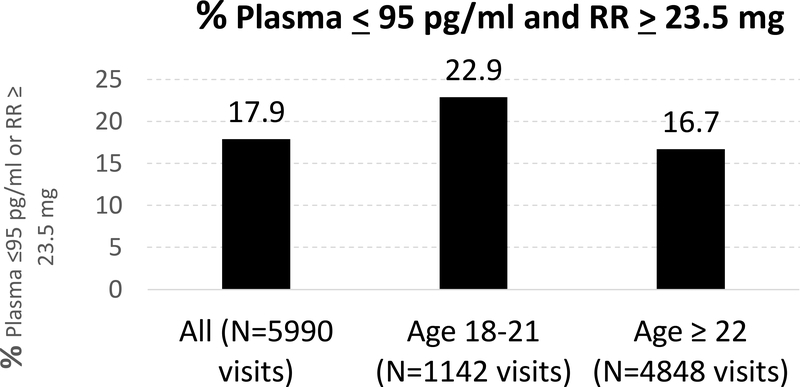
This analysis compares self-reports of product use with objective measures of non-adherence-quarterly plasma dapivirine levels and monthly residual dapivirine (DPV) levels in used rings-in MTN-020/ASPIRE, a phase 3 trial of a monthly DPV vaginal ring among women aged 18-45 years in Malawi, South Africa, Uganda and Zimbabwe. For participants on active product (N = 1211) we assessed self-reported monthly non-adherence, as measured by (1) whether the ring was ever out, and out for ≥ 12 h in the previous month and, (2) by a self-rating scale assessing ability to keep the vaginal ring inserted, and compared the self-reports to two biomarkers of non-use separately and as a composite measure. For this analysis, a plasma DPV value ≤ 95 pg/ml and residual ring ≥ 23.5 mg were used to classify non-adherence (i.e. the ring never being in the vagina the previous month). Compared to self-reports, non-adherence was found to be substantially higher for the composite measure as well as its two components, an indication that ring removal was likely underreported in the trial. The discrepancy between the self-report measure of ring outage and the composite indicator was greater for those aged 18-21 than for those older, evidence that younger women are more likely to underreport non-adherence. Despite underreporting of non-adherence, self-reports of the ring never being out were significant in predicting the composite objective measure. Furthermore, the association between the self-rating scale and the objective measure was in the expected direction and significant, although 11% of those 18-21 and 7% of those 22+ who rated their ability to keep the ring inserted as good, very good or excellent in the 4 weeks prior to exit were considered non-adherent according to the objective measure. This analysis indicates that while self-reports are significantly associated with objective measures of adherence in the ASPIRE trial, they were inflated-more so by those younger-and therefore may have limited utility identifying those who have challenges using products as directed. ClinicalTrials.gov number NCT01617096.
本分析比较了自我报告的产品使用情况与客观的不依从性指标——MTN-020/ASPIRE 研究中每季度的血浆双夫定水平和每月使用过的双夫定(DPV)残留水平,这是一项在马拉维、南非、乌干达和津巴布韦年龄在 18-45 岁的女性中使用每月 DPV 阴道环的 3 期试验。对于正在使用产品的参与者(N=1211),我们评估了自我报告的每月不依从性,方法是(1)环是否曾经取出,以及在上个月是否取出超过 12 小时,(2)通过自我评估量表评估保持阴道环插入的能力,并将自我报告与两种非使用生物标志物分别进行比较,并作为复合测量指标进行比较。在这项分析中,使用血浆 DPV 值≤95pg/ml 和残留环≥23.5mg 来分类不依从(即上个月阴道内从未有环)。与自我报告相比,复合测量指标及其两个组成部分的不依从率明显更高,这表明试验中对环的取出可能报告不足。对于年龄在 18-21 岁的参与者,与自我报告的环停用相比,复合指标的差异更大,这表明年轻女性更有可能少报不依从。尽管不依从的自我报告有所遗漏,但从未报告过环脱落的情况对复合客观指标的预测仍然具有重要意义。此外,自我评估量表与客观测量之间的关联呈预期方向且具有统计学意义,尽管根据客观测量,有 11%的 18-21 岁的参与者和 7%的 22 岁以上的参与者在退出前的 4 周内自我评估保持环插入的能力为好、很好或优秀,但被认为不依从。这项分析表明,尽管在 ASPIRE 试验中,自我报告与依从性的客观测量显著相关,但自我报告被夸大了——尤其是对年轻参与者而言,因此,它们可能在识别那些按照指示使用产品有困难的人方面的作用有限。临床试验注册编号 NCT01617096。