Department of Public and Occupational Health, Amsterdam Public Health Research Institute, Amsterdam UMC, Vrije Universiteit Amsterdam, Van der Boechorststraat 7, NL-1081 BT Amsterdam, The Netherlands.
Arbo Unie OHS, Diakenhuisweg 25, 2033 AP Haarlem, The Netherlands.
Int J Environ Res Public Health. 2018 Sep 15;15(9):2019. doi: 10.3390/ijerph15092019.
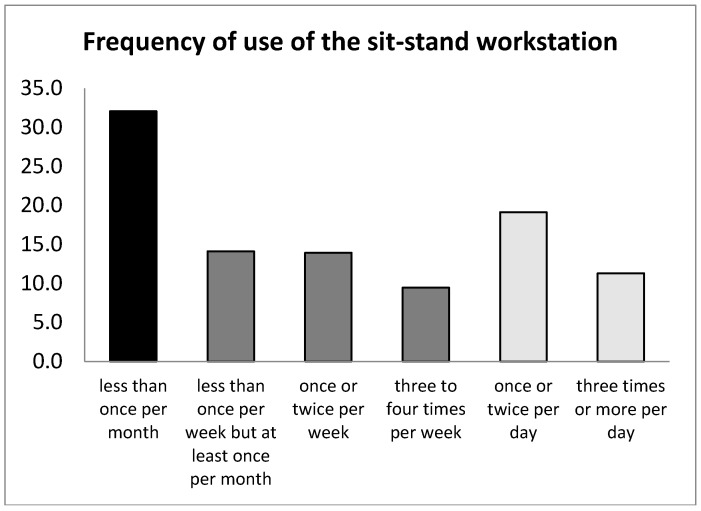
: To decrease the detrimental health effects of prolonged sitting, the implementation of sit-stand workstations is a commonly used intervention for office workers. Most studies on this topic evaluated the effects of newly introduced sit-stand workstations. The objective of this study was to determine how often and how long the standing option is used and how the use of sit-stand workstations is perceived in office workers with long-term access to these workstations. : Using an online survey, 1098 office employees responded to questions about frequency of usage of the sit-stand workstation, sitting time, physical activity, and positive and negative perceptions of the use of the sit-stand workstations. : Based on the frequency of use, three user groups were identified: non-users (32.1%), monthly/weekly users (37.5%) and daily users (30.4%). Non-users reported to sit more, stand less and have longer bouts of sitting, compared to monthly/weekly users, and these differences were even larger compared to daily users. A higher proportion of daily users perceived the use of the sit-stand workstation as being more healthy and appealing and making them more productive and energetic compared to the non-users. A higher proportion of the non-users perceived it as being uncomfortable, distracting, and unpractical, compared to the other user groups. : The differences between the three identified user groups with respect to sitting, standing and perceptions of sit-stand workstations, might be helpful in tailoring future interventions to reduce occupational sitting time, to increase the reach, effectiveness and sustainability.
为了降低长时间坐着对健康的不利影响,使用可坐可站的工作站是一种常用于办公室工作人员的干预措施。大多数关于这个主题的研究都评估了新引入的可坐可站工作站的效果。本研究的目的是确定长期使用这些工作站的办公室工作人员经常使用和使用多长时间的站立选项,以及他们如何看待可坐可站工作站的使用。
通过在线调查,1098 名办公室员工回答了关于使用可坐可站工作站的频率、坐着时间、身体活动以及对使用可坐可站工作站的积极和消极看法的问题。
基于使用频率,确定了三个用户组:非使用者(32.1%)、每月/每周使用者(37.5%)和每日使用者(30.4%)。与每月/每周使用者相比,非使用者报告说他们坐的时间更多,站的时间更少,坐着的时间更长,与每日使用者相比,这些差异更大。与非使用者相比,更多的每日使用者认为使用可坐可站工作站更健康、更吸引人,使他们更有生产力和精力。与其他用户群体相比,更多的非使用者认为它不舒服、分散注意力且不切实际。
这三个确定的用户组在坐姿、站姿和对可坐可站工作站的看法方面存在差异,这可能有助于针对减少职业性久坐时间、提高可及性、有效性和可持续性来定制未来的干预措施。