Research Triangle Institute (RTI) International, Oasis building, Patan Dhoka, Lalitpur, 401, Nepal.
Faculty of Social Sciences (Health Sciences), University of Tampere, FI-33014, Tampere, Finland.
BMC Pregnancy Childbirth. 2018 Sep 17;18(1):376. doi: 10.1186/s12884-018-2011-y.
Abortion is one of the leading causes of maternal death in low- and middle-income countries. In Nepal, abortion is reported to be the third leading cause of maternal death. We aimed to investigate the prevalence and factors associated with abortion and unsafe abortion in Nepal.
This study is based on a nationally representative sample of the Nepal Demographic and Health Survey 2011. Women who had ever had a terminated pregnancy (n = 2395) were studied. The survey elicited information on the most recent abortion. Unsafe abortion was defined according to the providers of abortion services. Binary logistic regression was used to calculate odds ratios (ORs) and 95% Confidence Intervals (CIs) of abortions and unsafe abortions due to demographic, socio-economic and lifestyle-related characteristics. The interaction of the reason for abortion with age and educational status in predicting unsafe abortion was calculated using the predictive margins and their 95% CI.
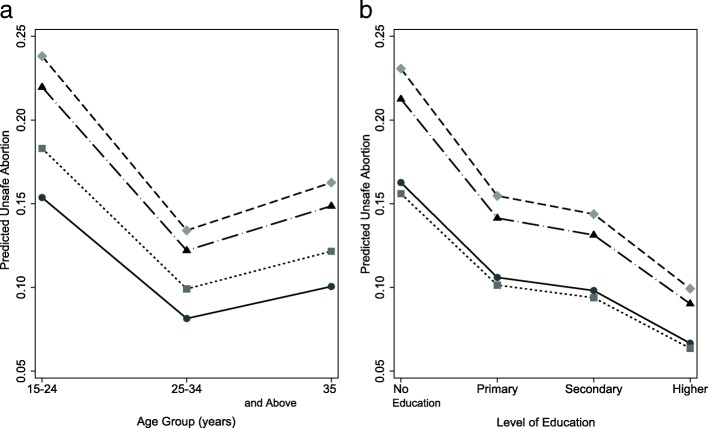
The five-year prevalence of abortion was 21.1% among women of reproductive age who ever had a terminated pregnancy and 16.0% of total abortions were unsafe. Women of Buddhist religion (OR 2.15; 95% CI 1.04, 4.44), those who were literate (secondary level education OR 1.69; 95% CI 1.22, 2.34), those who knew about legal abortion (OR 1.88; 95% CI 1.41, 2.52) and those who were aware of safe places for abortion services (OR 4.96; 95% CI 3.04, 8.09) were more likely to undergo an abortion. Likewise, women in age group 25-34 years (OR 0.43; 95% CI 0.19, 0.97) and those who were in the richest wealth quintile (OR 0.10; 95% CI 0.04, 0.25) were less likely to undergo an unsafe abortion. Educated women of 25-34 years reporting "health risk" as the reason for abortion had a decidedly lower probability (< 10.0%) than the others of going through the unsafe abortion.
The prevalence of abortion in Nepal remains high. Education, religion, age, knowledge about legal abortion and safe places to undergo abortion were the major decisive factors associated with abortion. Young, poorest and uneducated women were more likely to undergo unsafe abortions. Therefore, intervention studies among these target groups are warranted.
堕胎是中低收入国家孕产妇死亡的主要原因之一。在尼泊尔,堕胎据报道是导致孕产妇死亡的第三大原因。我们旨在调查尼泊尔堕胎和不安全堕胎的流行情况及其相关因素。
本研究基于 2011 年尼泊尔全国人口与健康调查的代表性样本。研究了曾有终止妊娠的妇女(n=2395 人)。该调查收集了最近一次堕胎的信息。根据堕胎服务提供者的情况,将不安全堕胎定义为堕胎。采用二项逻辑回归计算因人口统计学、社会经济和生活方式相关特征而导致的堕胎和不安全堕胎的比值比(OR)和 95%置信区间(CI)。使用预测边缘及其 95%CI 计算因堕胎原因与年龄和教育程度相互作用而导致不安全堕胎的可能性。
在曾有终止妊娠的育龄妇女中,五年堕胎率为 21.1%,其中 16.0%的堕胎为不安全堕胎。佛教信仰的妇女(OR 2.15;95%CI 1.04,4.44)、受过教育的妇女(中学教育水平 OR 1.69;95%CI 1.22,2.34)、了解合法堕胎的妇女(OR 1.88;95%CI 1.41,2.52)和知晓安全堕胎服务场所的妇女(OR 4.96;95%CI 3.04,8.09)更有可能进行堕胎。同样,25-34 岁年龄组的妇女(OR 0.43;95%CI 0.19,0.97)和最富裕的五分之一财富阶层的妇女(OR 0.10;95%CI 0.04,0.25)不太可能进行不安全堕胎。报告“健康风险”为堕胎原因的 25-34 岁受教育妇女进行不安全堕胎的可能性明显较低(<10.0%)。
尼泊尔的堕胎率仍然很高。教育、宗教、年龄、对合法堕胎和安全堕胎场所的了解是与堕胎相关的主要决定因素。年轻、最贫穷和未受教育的妇女更有可能进行不安全堕胎。因此,有必要在这些目标群体中开展干预研究。