Independent researcher, Southampton, Hants, UK.
BMJ Open. 2013 May 14;3(5):e002612. doi: 10.1136/bmjopen-2013-002612.
To quantify trends in changing sex ratios of births before and after the legalisation of abortion in Nepal. While sex-selective abortion is common in some Asian countries, it is not clear whether the legal status of abortion is associated with the prevalence of sex-selection when sex-selection is illegal. In this context, Nepal provides an interesting case study. Abortion was legalised in 2002 and prior to that, there was no evidence of sex-selective abortion. Changes in the sex ratio at birth since legalisation would suggest an association with legalisation, even though sex-selection is expressly prohibited.
Analysis of data from four Demographic and Health Surveys, conducted in 1996, 2001, 2006 and 2011.
Nepal.
31 842 women aged 15-49.
Conditional sex ratios (CSRs) were calculated, specifically the CSR for second-born children where the first-born was female. This CSR is where the evidence of sex-selective abortion will be most visible. CSRs were looked at over time to assess the impact of legalisation as well as for population sub-groups in order to identify characteristics of women using sex-selection.
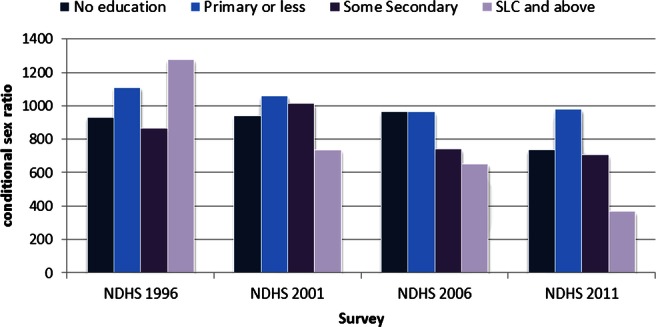
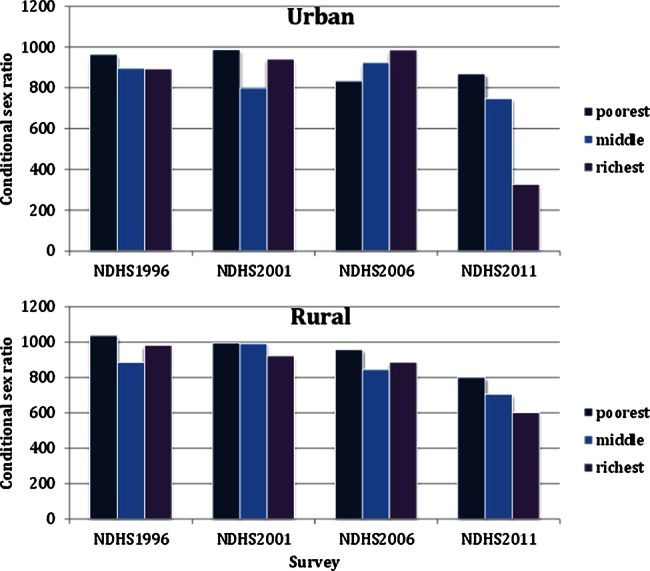
From 2007 to 2010, the CSR for second-order births where the first-born was a girl was found to be 742 girls per 1000 boys (95% CI 599 to 913). Prior to legalisation of abortion (1998-2000), the same CSR was 1021 (906-1150). After legalisation, it dropped most among educated and richer women, especially in urban areas. Just 325 girls were born for every 1000 boys among the richest urban women.
The fall in CSRs witnessed post-legalisation indicates that sex-selective abortion is becoming more common. This change is very likely driven by both supply and demand factors. Falling fertility has intensified the need to bear a son sooner, while legal abortion services have reduced the costs and risks associated with obtaining an abortion.
量化尼泊尔堕胎合法化前后出生性别比变化的趋势。虽然在一些亚洲国家,性别选择性堕胎很常见,但在性别选择非法的情况下,堕胎的合法地位是否与性别选择的流行程度有关尚不清楚。在这种情况下,尼泊尔提供了一个有趣的案例研究。2002 年堕胎合法化,在此之前,没有性别选择性堕胎的证据。自合法化以来,出生性别比的变化表明与合法化有关,尽管性别选择被明确禁止。
对 1996 年、2001 年、2006 年和 2011 年进行的四次人口与健康调查的数据进行分析。
尼泊尔。
31842 名年龄在 15-49 岁的妇女。
计算了条件性别比(CSR),特别是第一胎是女孩的第二胎的 CSR。这个 CSR 是性别选择性堕胎最明显的证据。随着时间的推移,CSR 被观察到,以评估合法化的影响,以及人口亚组,以确定使用性别选择的妇女的特征。
从 2007 年到 2010 年,第一胎是女孩的第二胎的 CSR 被发现为每 1000 名男孩有 742 名女孩(95%CI599-913)。在堕胎合法化之前(1998-2000 年),同样的 CSR 是 1021(906-1150)。合法化后,这种情况在受教育程度较高和较富裕的妇女中,特别是在城市地区,下降最为明显。最富裕的城市妇女中,每 1000 名男孩出生的女孩只有 325 名。
合法化后 CSRs 的下降表明性别选择性堕胎变得更加普遍。这种变化很可能是由供需因素共同驱动的。生育率的下降加剧了更早生育儿子的需求,而合法的堕胎服务则降低了获得堕胎的成本和风险。