Center for Research and Development, Surkhet, Nepal.
Ujyalo Nepal, Ratnanagar Municipality, Chitwan, Nepal.
PLoS One. 2019 Oct 9;14(10):e0223385. doi: 10.1371/journal.pone.0223385. eCollection 2019.
Unsafe abortion contributes to maternal morbidities, mortalities as well as social and financial costs to women, families, and the health system. This study aimed to examine the factors associated with unsafe abortion practices in Nepal.
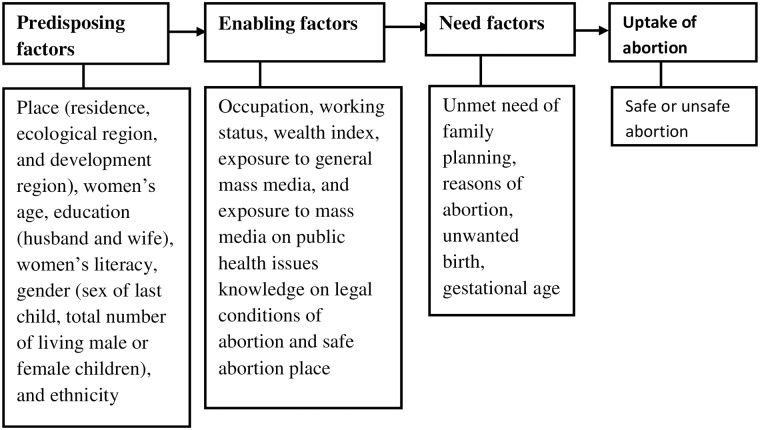
Data were derived from the 2011 and 2016 Nepal Demographic and Health Surveys (NDHS). A total of 911 women aged 15-49 years who aborted five years prior to surveys were included in the analysis. The multivariate logistic regression analysis was employed to determine factors associated with unsafe abortion.
Unsafe abortion rate was seven per 1000 women aged 15-49 years. This research found that women living in the Mountains (adjusted Odds Ratio (aOR) 2.36; 95% CI 1.21, 4.60), or those who were urban residents (aOR 2.11; 95% CI 1.37, 3.24) were more likely to have unsafe abortion. The odds of unsafe abortion were higher amongst women of poor households (aOR 2.16; 95% CI 1.18, 3.94); Dalit women (aOR 1.89; 95% CI 1.02, 3.52), husband with no education background (aOR 2.12; 95%CI 1.06, 4.22), or women who reported agriculture occupation (aOR 1.82; 95% CI 1.16, 2.86) compared to their reference's group. Regardless of knowledge on legal conditions of abortion, the probability of having unsafe abortion was significantly higher (aOR 5.13; 95% CI 2.64, 9.98) amongst women who did not know the location of safe abortion sites. Finally, women who wanted to delay or space childbirth (aOR 2.71; 95% CI 1.39, 5.28) or those who reported unwanted birth (aOR = 2.33; 95% CI 1.19, 4.56) were at higher risk of unsafe abortion.
Going forward, increasing the availability of safe abortion facilities and strengthening family planning services can help reduce unsafe abortion in Nepal. These programmatic efforts should be targeted to women of poor households, disadvantaged ethnicities, and those who reside in mountainous region.
不安全堕胎会导致产妇发病率和死亡率上升,同时也会给妇女、家庭和卫生系统带来社会和经济成本。本研究旨在探讨尼泊尔不安全堕胎行为的相关因素。
数据来自 2011 年和 2016 年的尼泊尔人口与健康调查(NDHS)。共有 911 名年龄在 15-49 岁之间的女性在调查前五年堕胎,纳入分析。采用多变量逻辑回归分析确定与不安全堕胎相关的因素。
不安全堕胎率为每 1000 名 15-49 岁妇女中有 7 例。研究发现,居住在山区的妇女(调整后的优势比(aOR)2.36;95%置信区间(CI)1.21-4.60)或城市居民(aOR 2.11;95%CI 1.37-3.24)更有可能进行不安全堕胎。贫困家庭的妇女(aOR 2.16;95%CI 1.18-3.94);达利特妇女(aOR 1.89;95%CI 1.02-3.52);丈夫没有教育背景的妇女(aOR 2.12;95%CI 1.06-4.22);或从事农业工作的妇女(aOR 1.82;95%CI 1.16-2.86)与参照组相比,不安全堕胎的可能性更高。无论对堕胎合法条件的了解程度如何,不知道安全堕胎地点的妇女发生不安全堕胎的可能性显著更高(aOR 5.13;95%CI 2.64-9.98)。最后,希望延迟或间隔生育的妇女(aOR 2.71;95%CI 1.39-5.28)或报告不想要生育的妇女(aOR=2.33;95%CI 1.19-4.56)发生不安全堕胎的风险更高。
未来,增加安全堕胎设施的可及性并加强计划生育服务可以帮助减少尼泊尔的不安全堕胎。这些方案应针对贫困家庭的妇女、弱势群体和居住在山区的妇女。