Laan Andres, Iglesias-Julios Marta, de Polavieja Gonzalo G
Champalimaud Neuroscience Programme, Champalimaud Center for the Unknown, Lisbon, Portugal.
R Soc Open Sci. 2018 Aug 15;5(8):180679. doi: 10.1098/rsos.180679. eCollection 2018 Aug.
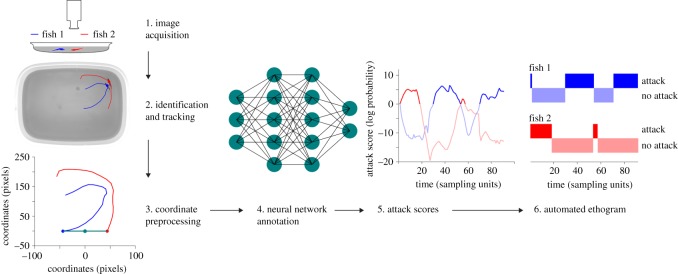
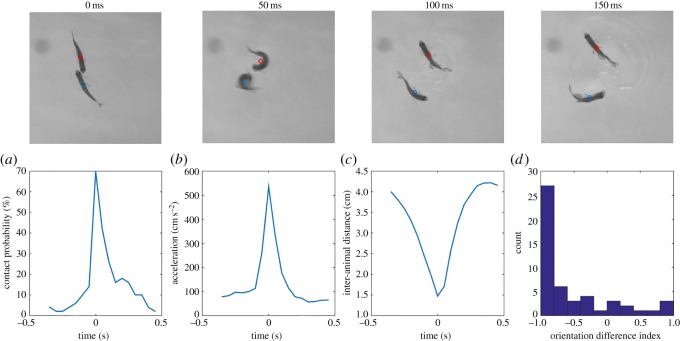
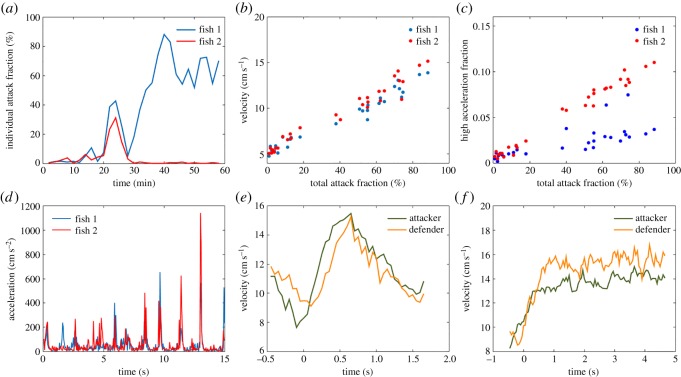
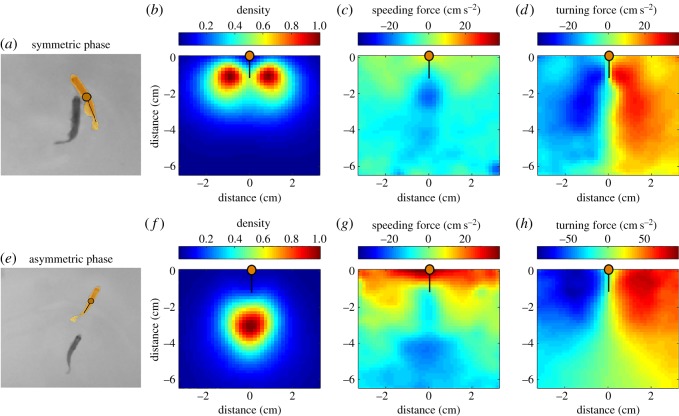
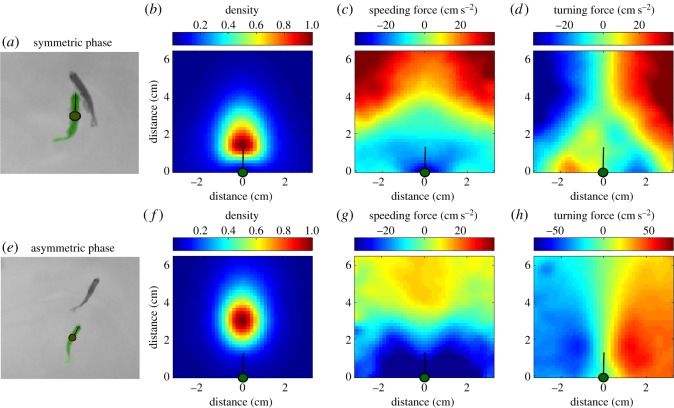
Most animals fight by repeating complex stereotypic behaviours, yet the internal structure of these behaviours has rarely been dissected in detail. We characterized the internal structure of fighting behaviours by developing a machine learning pipeline that measures and classifies the behaviour of individual unmarked animals on a sub-second time scale. This allowed us to quantify several previously hidden features of zebrafish fighting strategies. We found strong correlations between the velocity of the attacker and the defender, indicating a dynamic matching of approach and avoidance efforts. While velocity matching was ubiquitous, the spatial dynamics of attacks showed phase-specific differences. Contest-phase attacks were characterized by a paradoxical sideways attraction of the retreating animal towards the attacker, suggesting that the defender combines avoidance manoeuvres with display-like manoeuvres. Post-resolution attacks lacked display-like features and the defender was avoidance focused. From the perspective of the winner, game-theory modelling further suggested that highly energetically costly post-resolution attacks occurred because the winner was trying to increase its relative dominance over the loser. Overall, the rich structure of zebrafish motor coordination during fighting indicates a greater complexity and layering of strategies than has previously been recognized.
大多数动物通过重复复杂的刻板行为进行战斗,然而这些行为的内部结构很少被详细剖析。我们通过开发一种机器学习流程来表征战斗行为的内部结构,该流程能在亚秒级时间尺度上测量和分类未标记个体动物的行为。这使我们能够量化斑马鱼战斗策略中几个先前隐藏的特征。我们发现攻击者和防御者的速度之间存在很强的相关性,表明接近和躲避努力之间存在动态匹配。虽然速度匹配很普遍,但攻击的空间动态显示出阶段特异性差异。竞争阶段的攻击特点是撤退的动物对攻击者有一种矛盾的侧向吸引力,这表明防御者将躲避动作与类似展示的动作结合起来。解决冲突后的攻击缺乏类似展示的特征,防御者专注于躲避。从获胜者的角度来看,博弈论模型进一步表明,解决冲突后高能量消耗的攻击之所以发生,是因为获胜者试图增加其相对于失败者的相对优势。总体而言,斑马鱼战斗期间丰富的运动协调结构表明,其策略比以前认识到的更加复杂和分层。