Division of Neural Signaling, National Institute for Physiological Sciences, Okazaki 444-8787, Japan.
SOKENDAI (The Graduate University for Advanced Studies), Okazaki 444-8787, Japan.
eNeuro. 2018 Aug 21;5(4). doi: 10.1523/ENEURO.0133-18.2018. eCollection 2018 Jul-Aug.
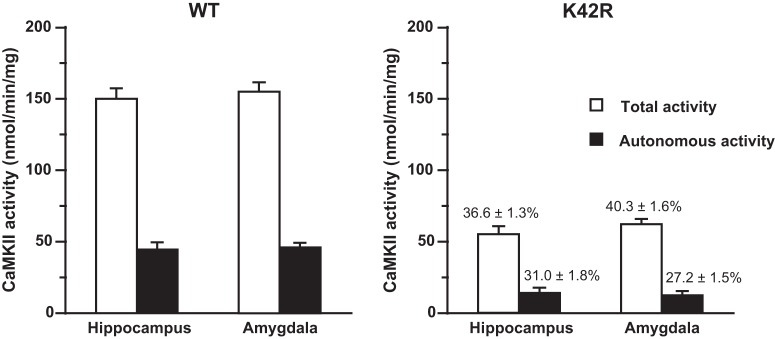
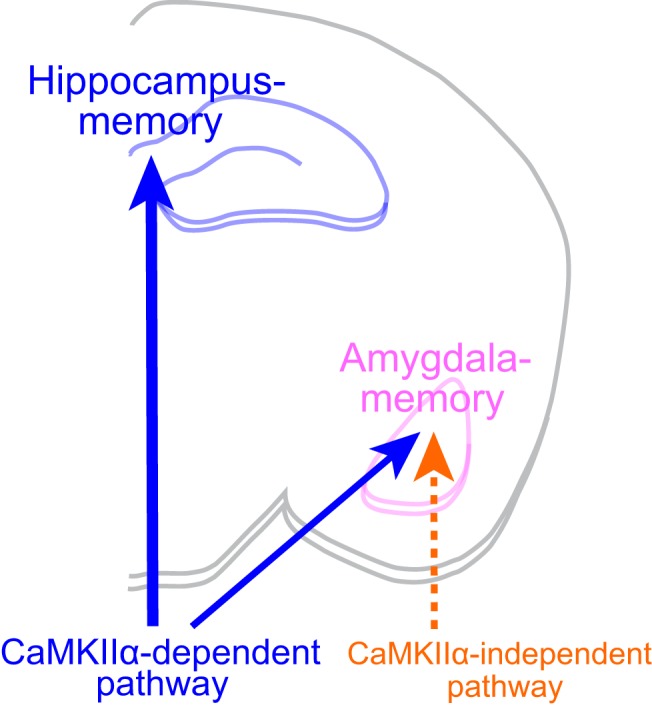
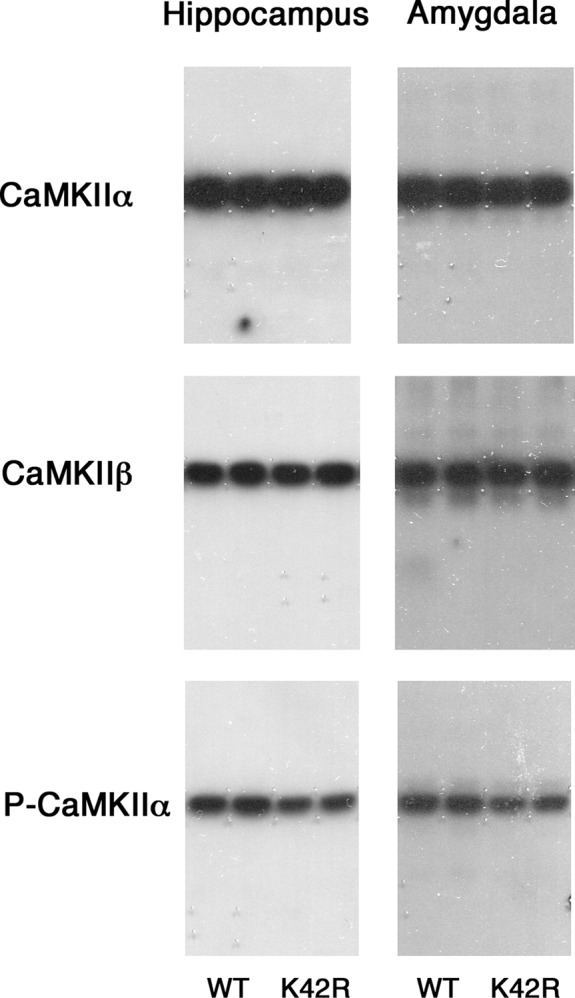
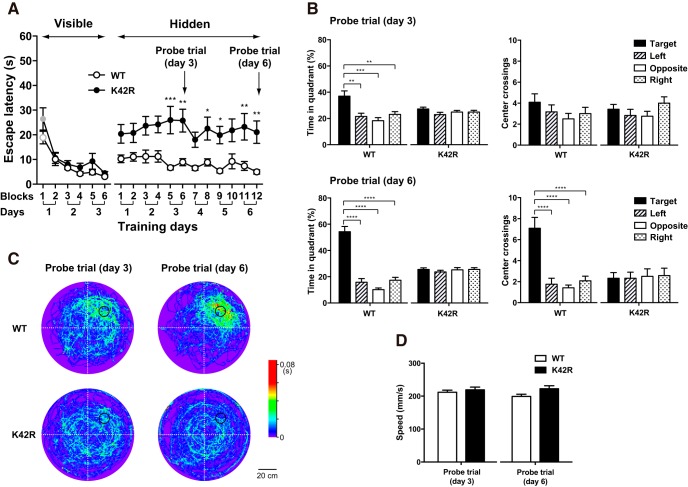
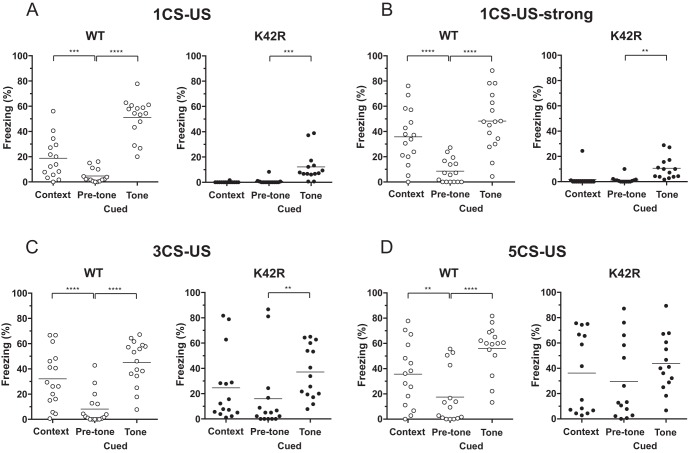
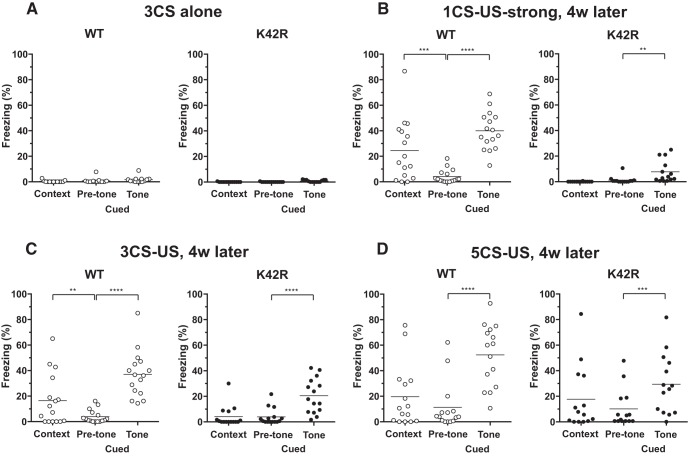
Ca/calmodulin-dependent protein kinase IIα (CaMKIIα) is a key mediator of activity-dependent neuronal modifications and has been implicated in the molecular mechanisms of learning and memory. Indeed, several types of CaMKIIα knock-in (KI) and knock-out (KO) mice revealed impairments in hippocampal synaptic plasticity and behavioral learning. On the other hand, a similar role for CaMKIIα has been implicated in amygdala-dependent memory, but detailed analyses have not much been performed yet. To better understand its involvement in amygdala-dependent memory as compared to hippocampus-dependent memory, here we performed biochemical analyses and behavioral memory tests using the kinase-dead CaMKIIα (K42R)-KI mouse. In the Morris water maze tasks, homozygous mutants performed well in the visible platform trials, while they failed to form spatial memory in the hippocampus-dependent hidden platform trials. In fear conditioning, these mice were impaired but showed a certain level of amygdala-dependent cued fear memory, which lasted four weeks, while they showed virtually no hippocampus-dependent context discrimination. Neither stronger stimulation nor repetitive stimulation compensated for their memory deficits. The differential outcome of hippocampus- and amygdala-dependent memory in the mutant mouse was not due to differential expression of CaMKIIα between the hippocampus and the amygdala, because biochemical analyses revealed that both kinase activity and protein levels of CaMKII were indistinguishable between the two brain regions. These results indicate that kinase activity of CaMKIIα is indispensable for hippocampus-dependent memory, but not necessarily for amygdala-dependent memory. There may be a secondary, CaMKIIα activity-independent pathway, in addition to the CaMKIIα activity-dependent pathway, in the acquisition of amygdala-dependent memory.
钙/钙调蛋白依赖性蛋白激酶 IIα(CaMKIIα)是活性依赖性神经元修饰的关键介质,并且与学习和记忆的分子机制有关。事实上,几种类型的 CaMKIIα 敲入(KI)和敲除(KO)小鼠显示出海马突触可塑性和行为学习受损。另一方面,CaMKIIα 在杏仁核依赖性记忆中也具有类似的作用,但尚未进行详细分析。为了更好地理解它在杏仁核依赖性记忆中的作用与海马依赖性记忆中的作用相比,我们在这里使用激酶失活的 CaMKIIα(K42R)-KI 小鼠进行了生化分析和行为记忆测试。在 Morris 水迷宫任务中,纯合突变体在可见平台试验中表现良好,而在海马依赖性隐藏平台试验中它们无法形成空间记忆。在恐惧条件反射中,这些小鼠受损,但表现出一定程度的杏仁核依赖性线索恐惧记忆,这种记忆持续了四周,而它们几乎没有表现出海马依赖性的上下文辨别。更强的刺激或重复刺激都不能弥补它们的记忆缺陷。突变小鼠在海马体和杏仁核依赖性记忆方面的不同结果不是由于海马体和杏仁核之间 CaMKIIα 的表达差异引起的,因为生化分析表明,两种脑区的激酶活性和 CaMKII 蛋白水平均无差异。这些结果表明,CaMKIIα 的激酶活性对于海马体依赖性记忆是必不可少的,但对于杏仁核依赖性记忆并非必需。在获得杏仁核依赖性记忆时,除了 CaMKIIα 活性依赖性途径之外,可能还有第二种 CaMKIIα 活性非依赖性途径。