Hosadurg Nisha, Bogle Brittany M, Joodi Golsa, Sadaf Murrium I, Pursell Irion, Mendys Philip M, Mounsey John P, Simpson Ross J
Department of Internal Medicine, Tufts University School of Medicine, Boston, MA.
Department of Epidemiology, Gillings School of Public Health, University of North Carolina at Chapel Hill, Chapel Hill, NC.
Mayo Clin Proc Innov Qual Outcomes. 2018 Aug 24;2(3):257-266. doi: 10.1016/j.mayocpiqo.2018.06.010. eCollection 2018 Sep.
To determine the association between serum lipid measurements and the occurrence of out-of-hospital sudden unexpected death (OHSUD).
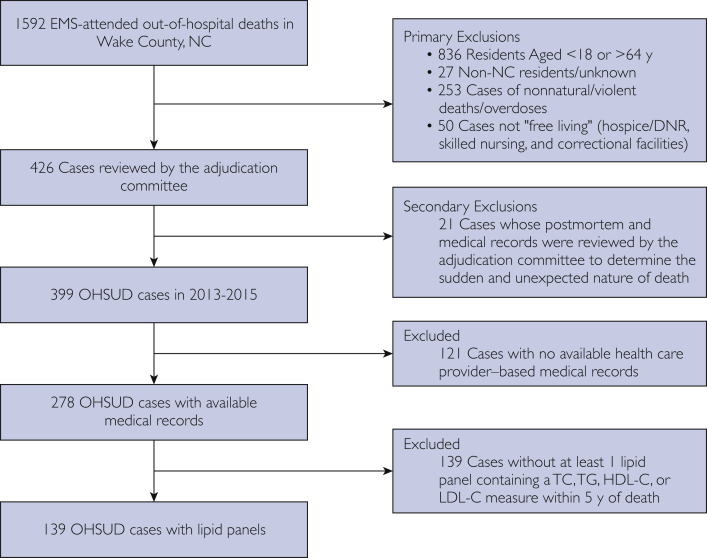
We compared 139 OHSUD cases (43 female patients [30.9%]) and 968 controls (539 female patients [55.7%]) from Wake County, North Carolina, from March 1, 2013, through February 28, 2015. Individuals were included if they were aged 18 to 64 years and had lipid measurements in the 5 years before their death (cases) or the most recent health care encounter (controls). Covariates were abstracted from medical records for all subjects, and those with triglyceride (TG) levels greater than 400 mg/dL (to convert to mmol/L, multiply by 0.0259) were excluded for low-density lipoprotein (LDL)-related analyses.
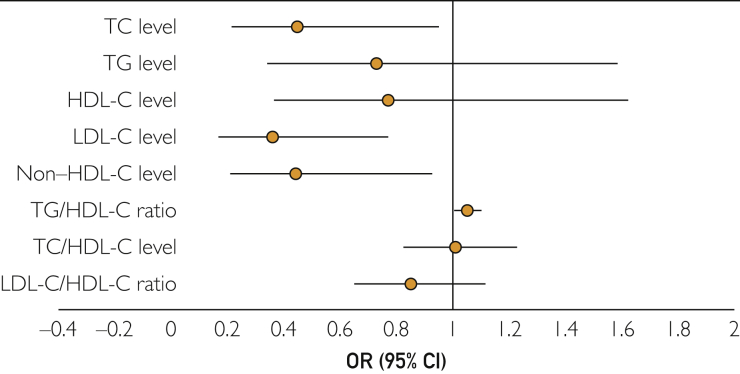
By linear regression using age- and sex-adjusted models, cases of OHSUD had lower adjusted mean total cholesterol (170.3±52.2 mg/dL vs 188.9±39.7 mg/dL; <.001), LDL cholesterol (90.9±39.6 mg/dL vs 109.6±35.2 mg/dL; <.001), and non-high-density lipoprotein (HDL) (121.6±49.8 mg/dL vs 134.3±39.6 mg/dL; <.001) levels and a higher adjusted TG/HDL-C ratio (4.7±7 vs 3±2.7; <.001) than did controls. By logistic regression using age- and sex-adjusted models, the odds of OHSUD were elevated per unit increase in TG/HDL-C ratio (1.08; 95% CI, 1.03-1.12).
Out-of-hospital sudden unexpected death cases had more favorable levels of total cholesterol, LDL cholesterol, and non-HDL, possibly indicating a lack of association between traditional lipid cardiovascular risk factors and sudden unexpected death. A comparatively elevated TG/HDL-C ratio in cases may corroborate an evolving hypothesis of how vasoactive and prothrombotic remnant-like lipoprotein particles contribute to sudden unexpected death.
确定血清脂质测量值与院外突发意外死亡(OHSUD)发生之间的关联。
我们比较了2013年3月1日至2015年2月28日期间来自北卡罗来纳州维克县的139例OHSUD病例(43例女性患者[30.9%])和968例对照(539例女性患者[55.7%])。纳入年龄在18至64岁之间且在死亡前5年(病例组)或最近一次医疗就诊时(对照组)进行过脂质测量的个体。从所有受试者的病历中提取协变量,对于低密度脂蛋白(LDL)相关分析,排除甘油三酯(TG)水平大于400mg/dL(换算为mmol/L时,乘以0.0259)的个体。
通过使用年龄和性别调整模型的线性回归分析,OHSUD病例组的调整后平均总胆固醇水平较低(170.3±52.2mg/dL vs 188.9±39.7mg/dL;<.001),LDL胆固醇水平较低(90.9±39.6mg/dL vs 109.6±35.2mg/dL;<.001),非高密度脂蛋白(HDL)水平较低(121.6±49.8mg/dL vs 134.3±39.6mg/dL;<.001),而TG/HDL-C比值较高(4.7±7 vs 3±2.7;<.001)。通过使用年龄和性别调整模型的逻辑回归分析,TG/HDL-C比值每增加一个单位,OHSUD的发生几率就会升高(1.08;95%CI,1.03 - 1.12)。
院外突发意外死亡病例的总胆固醇、LDL胆固醇和非HDL水平更为有利,这可能表明传统脂质心血管危险因素与突发意外死亡之间缺乏关联。病例组中相对较高的TG/HDL-C比值可能证实了一个正在发展的假说,即血管活性和促血栓形成的残余样脂蛋白颗粒如何导致突发意外死亡。