Department of Molecular Biosciences, School of Veterinary Medicine, University of California-Davis, 1089 Veterinary Medicine Drive, Davis, CA, 95616, USA.
Arch Toxicol. 2018 Nov;92(11):3337-3345. doi: 10.1007/s00204-018-2307-8. Epub 2018 Sep 17.
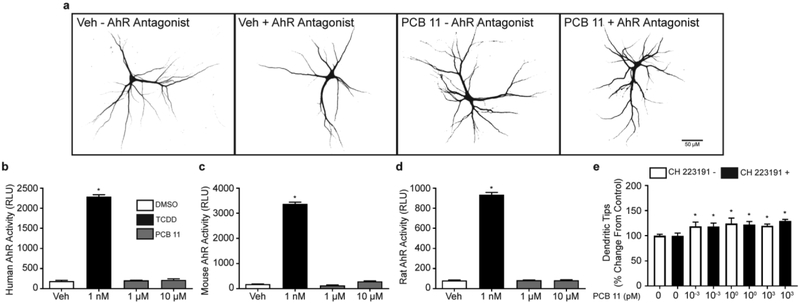
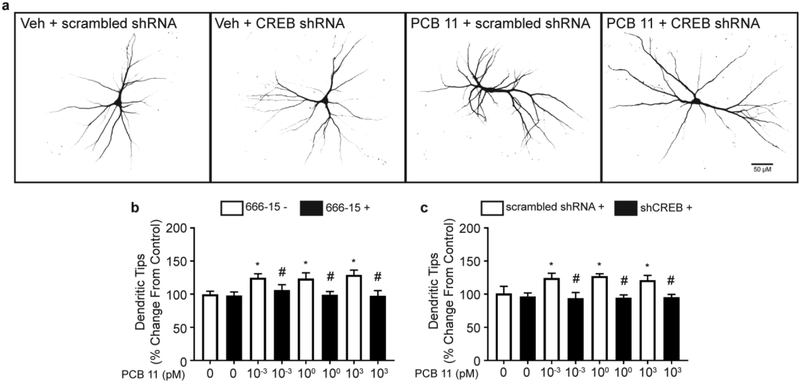
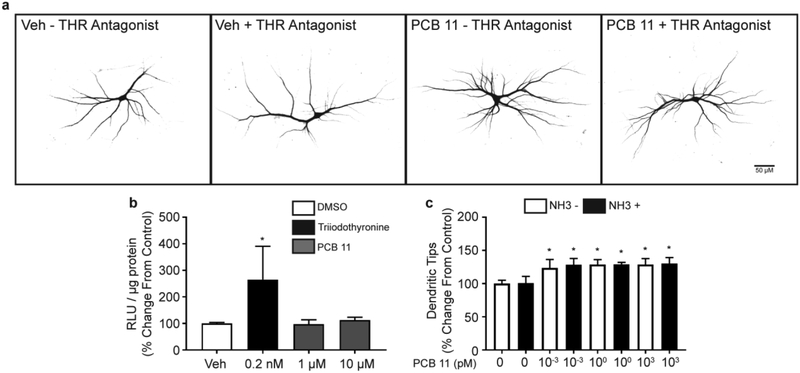
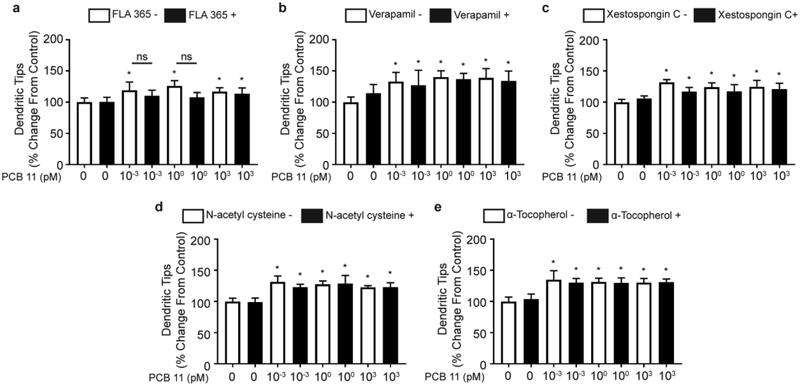
PCB 11 (3,3'-dichlorobiphenyl), a contemporary congener produced as a byproduct of current pigment production processes, has recently emerged as a prevalent worldwide pollutant. We recently demonstrated that exposure to PCB 11 increases dendritic arborization in vitro, but the mechanism(s) mediating this effect remain unknown. To address this data gap, primary cortical neuron-glia co-cultures derived from neonatal Sprague-Dawley rats were exposed for 48 h to either vehicle (0.1% DMSO) or PCB 11 at concentrations ranging from 1 fM to 1 nM in the absence or presence of pharmacologic antagonists of established molecular targets of higher chlorinated PCBs. Reporter cell lines were used to test activity of PCB 11 at the aryl hydrocarbon receptor (AhR) and thyroid hormone receptor (THR). PCB 11 lacked activity at the AhR and THR, and antagonism of these receptors had no effect on the dendrite-promoting activity of PCB 11. Pharmacologic antagonism of various calcium channels or treatment with antioxidants also did not alter PCB 11-induced dendritic arborization. In contrast, pharmacologic blockade or shRNA knockdown of cAMP response element-binding protein (CREB) significantly decreased dendritic growth in PCB 11-exposed cultures, suggesting PCB 11 promotes dendritic growth via CREB-mediated mechanisms. Since CREB signaling is crucial for normal neurodevelopment, and perturbations of CREB signaling have been associated with neurodevelopmental disorders, our findings suggest that this contemporary pollutant poses a threat to the developing brain, particularly in individuals with heritable mutations that promote CREB signaling.
PCB 11(3,3'-二氯联苯)是当前颜料生产过程中产生的一种当代同系物,最近已成为一种普遍存在的全球性污染物。我们最近证明,暴露于 PCB 11 会增加体外树突分支,但其介导此效应的机制尚不清楚。为了解决这一数据空白,我们使用来自新生 Sprague-Dawley 大鼠的原代皮质神经元-神经胶质共培养物,在不存在或存在已建立的高氯化 PCB 分子靶标药理学拮抗剂的情况下,将其暴露于 1 fM 至 1 nM 浓度的 PCB 11 48 小时。报告细胞系用于测试 PCB 11 在芳烃受体(AhR)和甲状腺激素受体(THR)中的活性。PCB 11 在 AhR 和 THR 中没有活性,并且这些受体的拮抗作用对 PCB 11 促进树突的活性没有影响。各种钙通道的药理学拮抗作用或抗氧化剂处理也不会改变 PCB 11 诱导的树突分支。相比之下,cAMP 反应元件结合蛋白(CREB)的药理学阻断或 shRNA 敲低显著降低了 PCB 11 暴露培养物中的树突生长,这表明 PCB 11 通过 CREB 介导的机制促进树突生长。由于 CREB 信号传导对于正常的神经发育至关重要,并且 CREB 信号传导的干扰与神经发育障碍有关,因此我们的研究结果表明,这种当代污染物对发育中的大脑构成威胁,特别是在那些具有促进 CREB 信号传导的遗传突变的个体中。