Baldauf Michaela C, Gerke Julia S, Kirschner Andreas, Blaeschke Franziska, Effenberger Manuel, Schober Kilian, Rubio Rebeca Alba, Kanaseki Takayuki, Kiran Merve M, Dallmayer Marlene, Musa Julian, Akpolat Nurset, Akatli Ayse N, Rosman Fernando C, Özen Özlem, Sugita Shintaro, Hasegawa Tadashi, Sugimura Haruhiko, Baumhoer Daniel, Knott Maximilian M L, Sannino Giuseppina, Marchetto Aruna, Li Jing, Busch Dirk H, Feuchtinger Tobias, Ohmura Shunya, Orth Martin F, Thiel Uwe, Kirchner Thomas, Grünewald Thomas G P
Faculty of Medicine, Max-Eder Research Group for Pediatric Sarcoma Biology, Institute of Pathology, LMU Munich, Munich, Germany.
Children's Cancer Research Center, Technische Universität München (TUM), Munich, Germany.
Oncoimmunology. 2018 Jul 23;7(9):e1481558. doi: 10.1080/2162402X.2018.1481558. eCollection 2018.
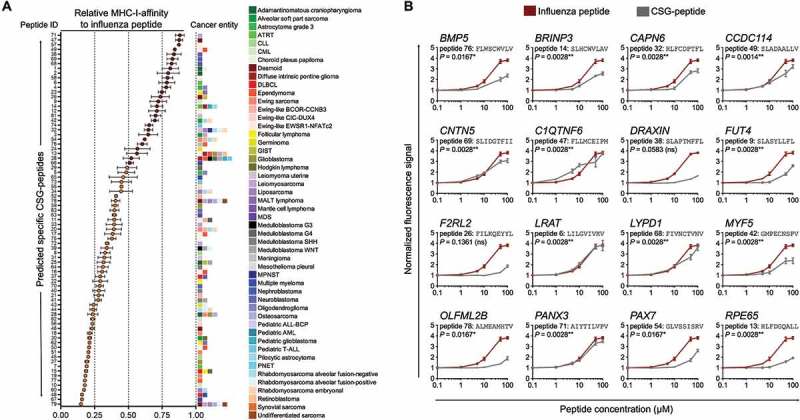
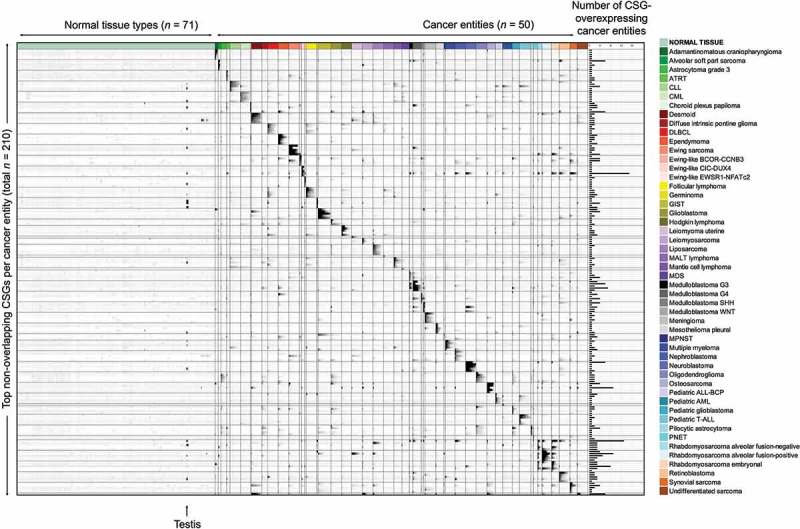
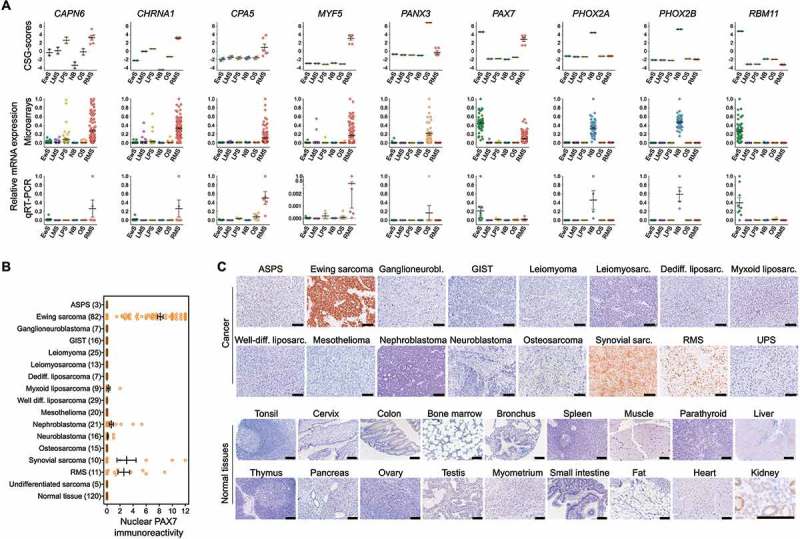
Immunotherapy can revolutionize anti-cancer therapy if specific targets are available. Immunogenic peptides encoded by cancer-specific genes (CSGs) may enable targeted immunotherapy, even of oligo-mutated cancers, which lack neo-antigens generated by protein-coding missense mutations. Here, we describe an algorithm and user-friendly software named RAVEN (Rich Analysis of Variable gene Expressions in Numerous tissues) that automatizes the systematic and fast identification of CSG-encoded peptides highly affine to Major Histocompatibility Complexes (MHC) starting from transcriptome data. We applied RAVEN to a dataset assembled from 2,678 simultaneously normalized gene expression microarrays comprising 50 tumor entities, with a focus on oligo-mutated pediatric cancers, and 71 normal tissue types. RAVEN performed a transcriptome-wide scan in each cancer entity for gender-specific CSGs, and identified several established CSGs, but also many novel candidates potentially suitable for targeting multiple cancer types. The specific expression of the most promising CSGs was validated in cancer cell lines and in a comprehensive tissue-microarray. Subsequently, RAVEN identified likely immunogenic CSG-encoded peptides by predicting their affinity to MHCs and excluded sequence identity to abundantly expressed proteins by interrogating the UniProt protein-database. The predicted affinity of selected peptides was validated in T2-cell peptide-binding assays in which many showed binding-kinetics like a very immunogenic influenza control peptide. Collectively, we provide an exquisitely curated catalogue of cancer-specific and highly MHC-affine peptides across 50 cancer types, and a freely available software (https://github.com/JSGerke/RAVENsoftware) to easily apply our algorithm to any gene expression dataset. We anticipate that our peptide libraries and software constitute a rich resource to advance anti-cancer immunotherapy.
如果有特定靶点,免疫疗法可能会彻底改变抗癌治疗。癌症特异性基因(CSG)编码的免疫原性肽可能实现靶向免疫治疗,即使是对缺乏由蛋白质编码错义突变产生的新抗原的寡突变癌症也是如此。在这里,我们描述了一种算法和用户友好的软件RAVEN(众多组织中可变基因表达的丰富分析),它能从转录组数据开始,自动系统且快速地识别与主要组织相容性复合体(MHC)具有高亲和力的CSG编码肽。我们将RAVEN应用于一个由2678个同时标准化的基因表达微阵列组装而成的数据集,该数据集包含50种肿瘤实体,重点是寡突变儿科癌症,以及71种正常组织类型。RAVEN在每个癌症实体中对性别特异性CSG进行全转录组扫描,识别出了几个已确定的CSG,同时也发现了许多可能适用于靶向多种癌症类型的新候选物。最有前景的CSG的特异性表达在癌细胞系和一个综合组织微阵列中得到了验证。随后,RAVEN通过预测它们与MHC的亲和力来识别可能具有免疫原性的CSG编码肽,并通过查询UniProt蛋白质数据库排除与大量表达蛋白质的序列同一性。所选肽的预测亲和力在T2细胞肽结合试验中得到验证,其中许多肽显示出与一种非常具有免疫原性的流感对照肽相似的结合动力学。总体而言,我们提供了一个精心策划的跨越50种癌症类型的癌症特异性和高度MHC亲和力肽的目录,以及一个免费软件(https://github.com/JSGerke/RAVENsoftware),以便轻松地将我们的算法应用于任何基因表达数据集。我们预计,我们的肽库和软件将成为推进抗癌免疫治疗的丰富资源。