Children's Cancer Research Center, Department of Pediatrics.
Institute of Clinical Chemistry and Pathobiochemistry, Technische Universität München, Munich, Germany.
Blood. 2022 Feb 24;139(8):1184-1197. doi: 10.1182/blood.2020007932.
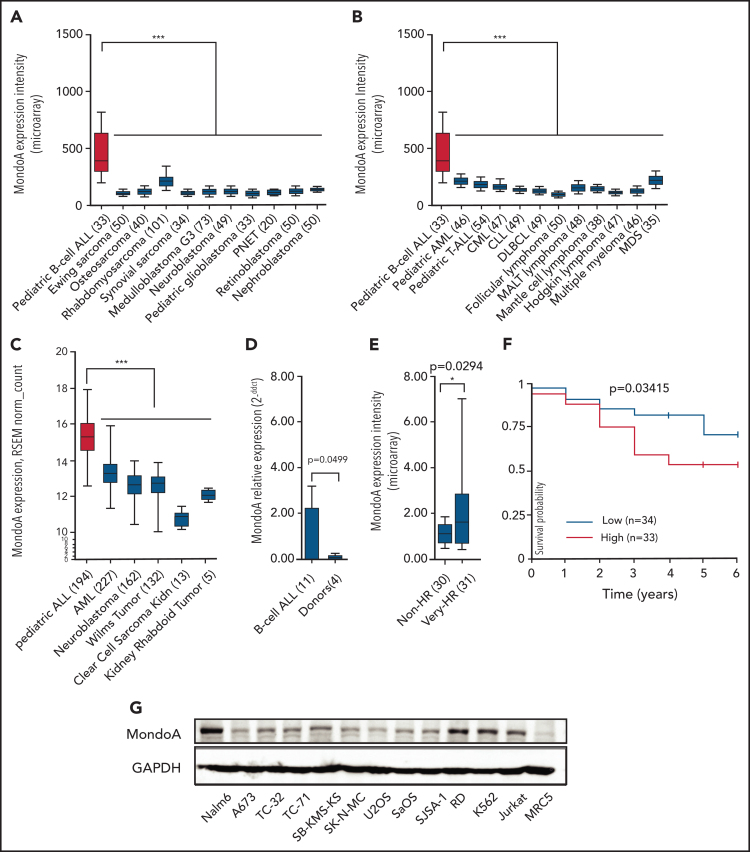
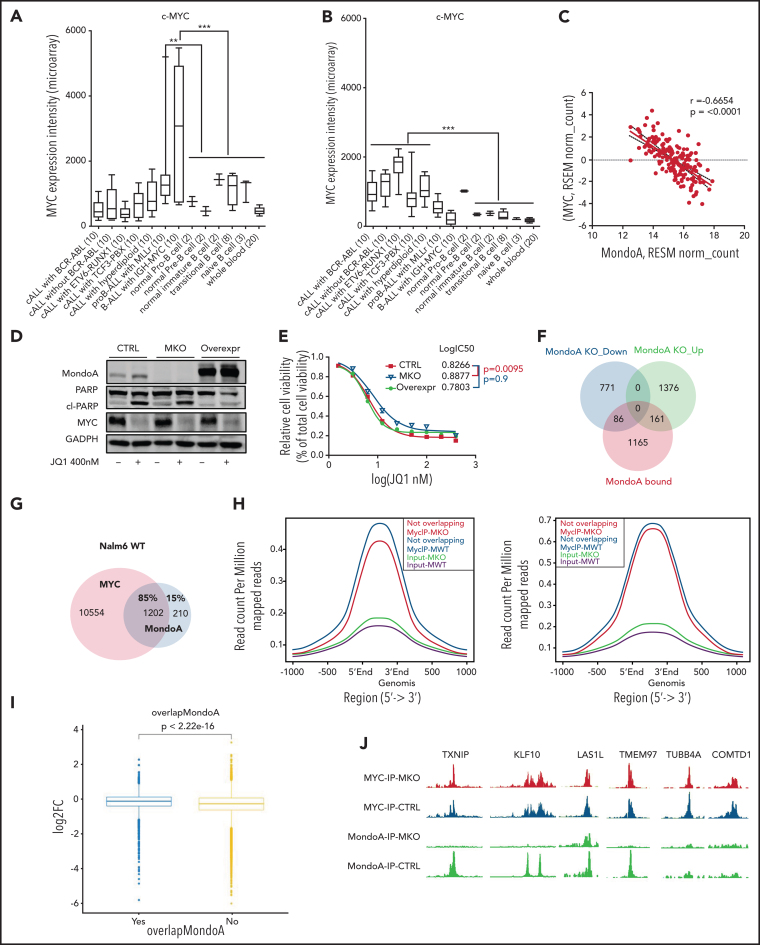
Cancer cells are in most instances characterized by rapid proliferation and uncontrolled cell division. Hence, they must adapt to proliferation-induced metabolic stress through intrinsic or acquired antimetabolic stress responses to maintain homeostasis and survival. One mechanism to achieve this is reprogramming gene expression in a metabolism-dependent manner. MondoA (also known as Myc-associated factor X-like protein X-interacting protein [MLXIP]), a member of the MYC interactome, has been described as an example of such a metabolic sensor. However, the role of MondoA in malignancy is not fully understood and the underlying mechanism in metabolic responses remains elusive. By assessing patient data sets, we found that MondoA overexpression is associated with worse survival in pediatric common acute lymphoblastic leukemia (ALL; B-precursor ALL [B-ALL]). Using clustered regularly interspaced short palindromic repeats (CRISPR)/CRISPR-associated protein 9 (Cas9) and RNA-interference approaches, we observed that MondoA depletion reduces the transformational capacity of B-ALL cells in vitro and dramatically inhibits malignant potential in an in vivo mouse model. Interestingly, reduced expression of MondoA in patient data sets correlated with enrichment in metabolic pathways. The loss of MondoA correlated with increased tricarboxylic acid cycle activity. Mechanistically, MondoA senses metabolic stress in B-ALL cells by restricting oxidative phosphorylation through reduced pyruvate dehydrogenase activity. Glutamine starvation conditions greatly enhance this effect and highlight the inability to mitigate metabolic stress upon loss of MondoA in B-ALL. Our findings give novel insight into the function of MondoA in pediatric B-ALL and support the notion that MondoA inhibition in this entity offers a therapeutic opportunity and should be further explored.
癌细胞在大多数情况下以快速增殖和不受控制的细胞分裂为特征。因此,它们必须通过内在或获得的抗代谢应激反应来适应增殖诱导的代谢应激,以维持体内平衡和生存。实现这一目标的一种机制是依赖代谢的方式重新编程基因表达。MondoA(也称为 Myc 相关因子 X 样蛋白 X 相互作用蛋白 [MLXIP])是 MYC 相互作用组的成员,它被描述为这种代谢传感器的一个例子。然而,MondoA 在恶性肿瘤中的作用尚不完全清楚,代谢反应的潜在机制仍不清楚。通过评估患者数据集,我们发现 MondoA 过表达与儿科常见急性淋巴细胞白血病(ALL;B 前体 ALL [B-ALL])患者的生存预后较差相关。通过使用成簇规律间隔短回文重复(CRISPR)/CRISPR 相关蛋白 9(Cas9)和 RNA 干扰方法,我们观察到 MondoA 耗竭降低了体外 B-ALL 细胞的转化能力,并在体内小鼠模型中显著抑制了恶性潜能。有趣的是,患者数据集中 MondoA 表达降低与代谢途径富集相关。MondoA 的表达减少与三羧酸循环活性增加相关。从机制上讲,MondoA 通过降低丙酮酸脱氢酶活性来限制 B-ALL 细胞中的氧化磷酸化,从而感知代谢应激。谷氨酰胺饥饿条件大大增强了这种作用,并突出了在 B-ALL 中失去 MondoA 时无法缓解代谢应激的情况。我们的研究结果为 MondoA 在儿科 B-ALL 中的功能提供了新的见解,并支持了在该实体中抑制 MondoA 提供治疗机会的观点,应进一步探索。