Crandall Kristen M, Sten May-Britt, Almuhanna Ahmed, Fahey Lisbeth, Shah Rahul K
Children's National Medical Center, Washington, DC.
Pediatr Qual Saf. 2017 May 25;2(3):e025. doi: 10.1097/pq9.0000000000000025. eCollection 2017 May-Jun.
Apparent cause analysis (ACA) is a process in quality improvement used to examine events. A baseline assessment of completed ACAs at a tertiary care free-standing pediatric academic hospital revealed they were ineffective due to low-quality analysis, unreliable action plans, and poor spread, leading to error recurrence. The goal of this project was to increase ACA action plan reliability scores while maintaining or decreasing turnaround time.
The Model for Improvement served as the framework for this quality improvement initiative. We developed a key driver diagram, established measures, tested interventions using plan- do-study-act cycles, and implemented the effective interventions. To measure reliability, we created a high reliability toolkit that links each action item/intervention to a level of reliability and scored each ACA action plan to determine overall reliability score. Action plans scored as low level of reliability required revision before implementation.
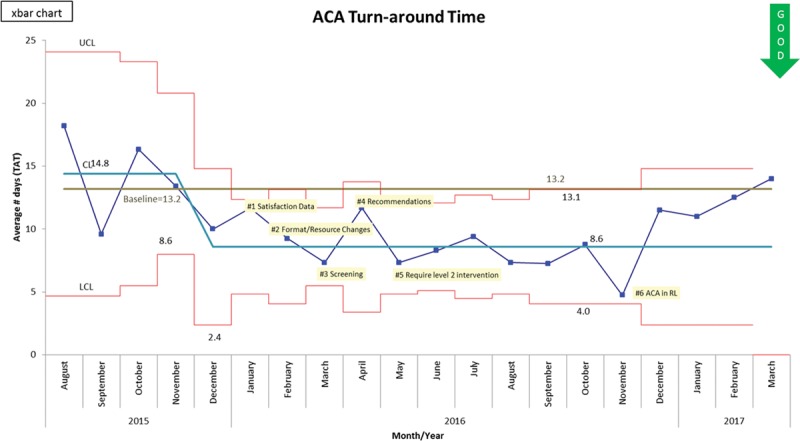
Average ACA action plan reliability scores increased from 86.4% to 96.1%. ACA turnaround time decreased from a baseline of 13 days to 8.6 days. Stakeholders reported a subjective increase in satisfaction with the revamped ACA process.
Incorporating high reliability principles into ACA action plan development increased the effectiveness of ACA while decreasing turnaround time. The high reliability toolkit was instrumental in providing an organizational resource for approaching this subset of cause analyses. The toolkit provides a way for safety/quality leaders to connect with stakeholders to design highly reliable solutions that improve safety for patients, families, and staff.
表面原因分析(ACA)是质量改进中用于审查事件的一个过程。对一家独立的三级儿科教学医院已完成的ACA进行的基线评估显示,由于分析质量低、行动计划不可靠以及推广效果差,这些分析并无效果,导致错误再次发生。本项目的目标是在保持或缩短周转时间的同时,提高ACA行动计划的可靠性得分。
改进模型作为此次质量改进计划的框架。我们绘制了关键驱动因素图,确定了衡量指标,使用计划-执行-研究-改进循环测试干预措施,并实施了有效的干预措施。为衡量可靠性,我们创建了一个高可靠性工具包,将每个行动项目/干预措施与一个可靠性水平相联系,并对每个ACA行动计划进行评分,以确定总体可靠性得分。可靠性得分低的行动计划在实施前需要修订。
ACA行动计划的平均可靠性得分从86.4%提高到了96.1%。ACA周转时间从基线的13天降至8.6天。利益相关者报告称,对改进后的ACA流程的满意度有了主观上的提高。
将高可靠性原则纳入ACA行动计划制定过程中,提高了ACA的有效性,同时缩短了周转时间。高可靠性工具包有助于为进行这一子集的原因分析提供组织资源。该工具包为安全/质量负责人提供了一种与利益相关者联系的方式,以设计出高度可靠的解决方案,从而提高患者、家属和工作人员的安全性。