Nathwani Dinesh, McNicholas Michael, Hart Alister, Miles Jonathan, Bobić Vladimir
Imperial College Healthcare NHS Trust and The London Clinic, London, United Kingdom.
Aintree University Hospital NHS Trust, Liverpool, United Kingdom.
JB JS Open Access. 2017 Apr 6;2(2):e0011. doi: 10.2106/JBJS.OA.16.00011. eCollection 2017 Jun 26.
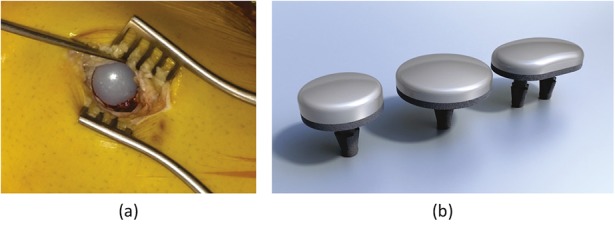
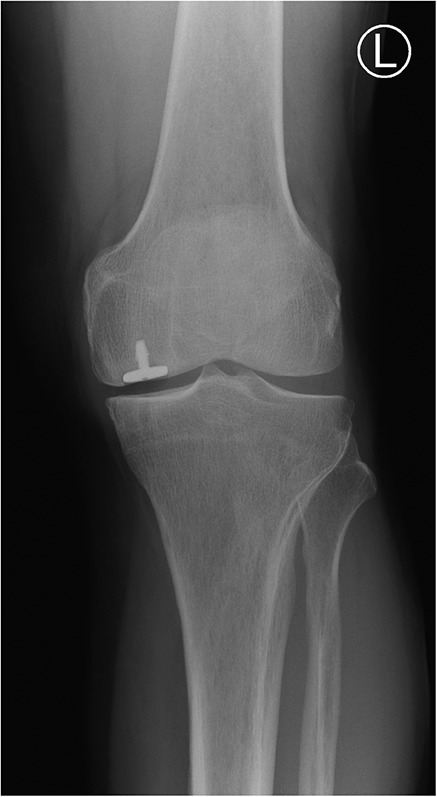
Current treatments for focal chondral and osteochondral lesions of the femoral condyle have been associated with variable outcomes. We conducted a clinical trial of the BioPoly RS Partial Resurfacing Knee Implant to address this unmet need.
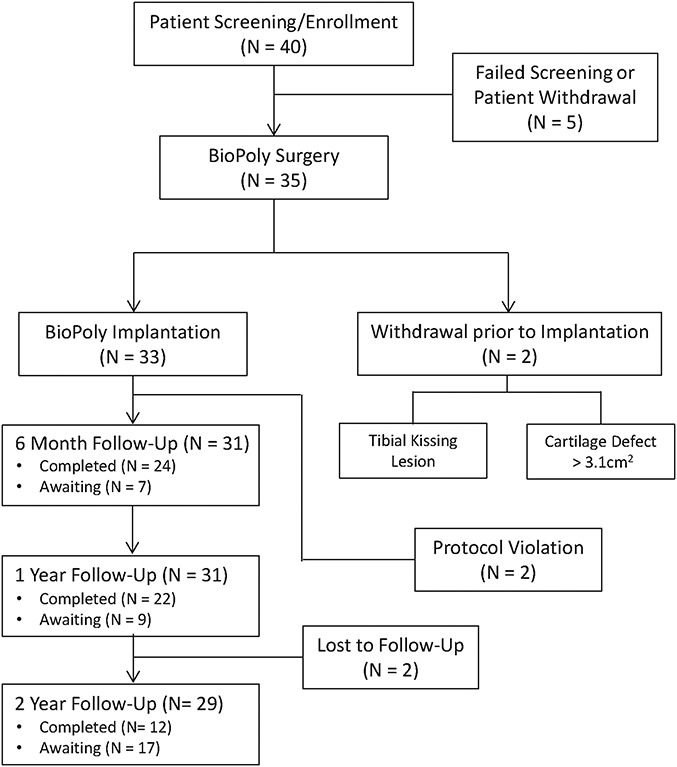
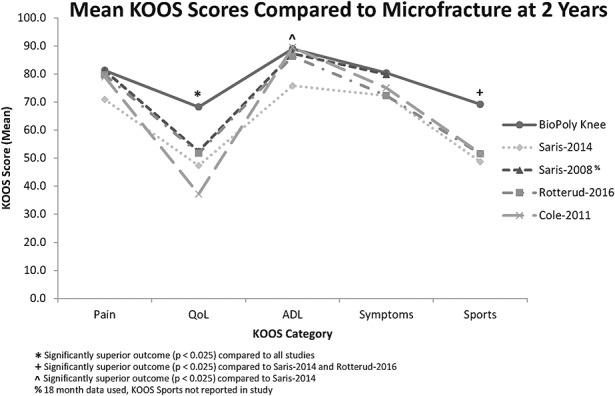
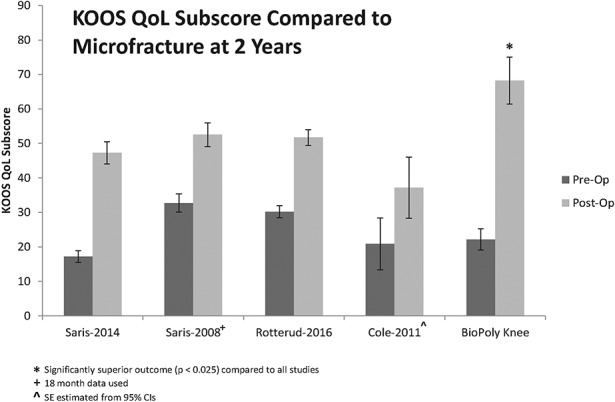
We performed a single-arm, prospective study in which 33 patients with focal cartilage lesions affecting the femoral condyle were managed with the BioPoly RS Partial Resurfacing Knee Implant. Knee injury and Osteoarthritis Outcome Score (KOOS) scores, a visual analog scale (VAS) for pain, the Short Form-36 (SF-36) physical component score , and the Tegner activity score were used to assess outcomes preoperatively and at 6 months, 1 year, and 2 years postoperatively. The KOOS outcomes at 2 years were compared with historical outcomes following microfracture treatment.
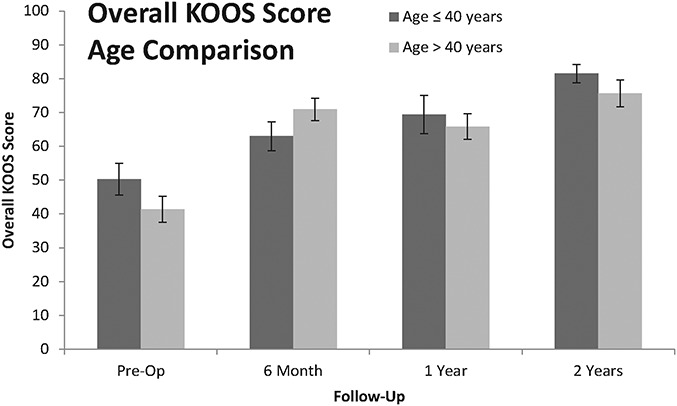
We found significant and clinically meaningful improvements in the KOOS scores, VAS pain score, and SF-36 physical component score (p < 0.025) when the values at all 3 postoperative time points were compared with the preoperative scores, and we also found significant improvements when the Tegner activity score at 2 years was compared with the preoperative score (p < 0.025). More than half of the cohort of patients had had a previous failure of cartilage-repair procedures. No significant differences were detected between younger patients (≤40 years) and older patients (>40 years). When compared with historical microfracture data, the BioPoly RS Implant demonstrated significantly superior KOOS scores for quality of life and sports.
The present study indicated that the BioPoly RS Partial Resurfacing Knee Implant is safe, that it resulted in significantly improved knee function by 6 months, and that this improvement was sustained for 2 years regardless of patient age. The BioPoly RS Knee Implant allows return to a higher level of sporting activity than microfracture. Additional long-term follow-up is needed to determine the long-term effects of the device.
Therapeutic Level IV. See Instructions for Authors for a complete description of levels of evidence.
目前针对股骨髁局灶性软骨和骨软骨损伤的治疗效果存在差异。我们开展了一项关于BioPoly RS部分表面置换膝关节植入物的临床试验,以满足这一未被满足的需求。
我们进行了一项单臂前瞻性研究,对33例影响股骨髁的局灶性软骨损伤患者采用BioPoly RS部分表面置换膝关节植入物进行治疗。采用膝关节损伤和骨关节炎疗效评分(KOOS)、疼痛视觉模拟量表(VAS)、简明健康状况调查量表(SF-36)身体成分评分以及特格纳活动评分,在术前、术后6个月、1年和2年评估疗效。将2年时的KOOS疗效与微骨折治疗后的历史疗效进行比较。
当将所有3个术后时间点的值与术前评分进行比较时,我们发现KOOS评分、VAS疼痛评分和SF-36身体成分评分有显著且具有临床意义的改善(p < 0.025),并且当将2年时的特格纳活动评分与术前评分进行比较时,我们也发现有显著改善(p < 0.025)。超过半数的患者队列曾有过软骨修复手术失败的经历。在年轻患者(≤40岁)和年长患者(>40岁)之间未检测到显著差异。与历史微骨折数据相比,BioPoly RS植入物在生活质量和运动方面的KOOS评分显著更高。
本研究表明,BioPoly RS部分表面置换膝关节植入物是安全的,在6个月时膝关节功能有显著改善,且无论患者年龄大小,这种改善可持续2年。与微骨折相比,BioPoly RS膝关节植入物能使患者恢复到更高水平的体育活动。需要进一步长期随访以确定该装置的长期效果。
治疗性IV级。有关证据水平的完整描述,请参阅作者须知。