Division of Gynecologic Oncology, Department of Obstetrics and Gynecology and Reproductive Biology, Brigham and Women's Hospital, Boston, MA, USA.
Division of Gynecologic Oncology, Dana-Farber Cancer Institute, Boston, MA, USA.
J Pathol. 2018 Dec;246(4):459-469. doi: 10.1002/path.5161. Epub 2018 Oct 19.
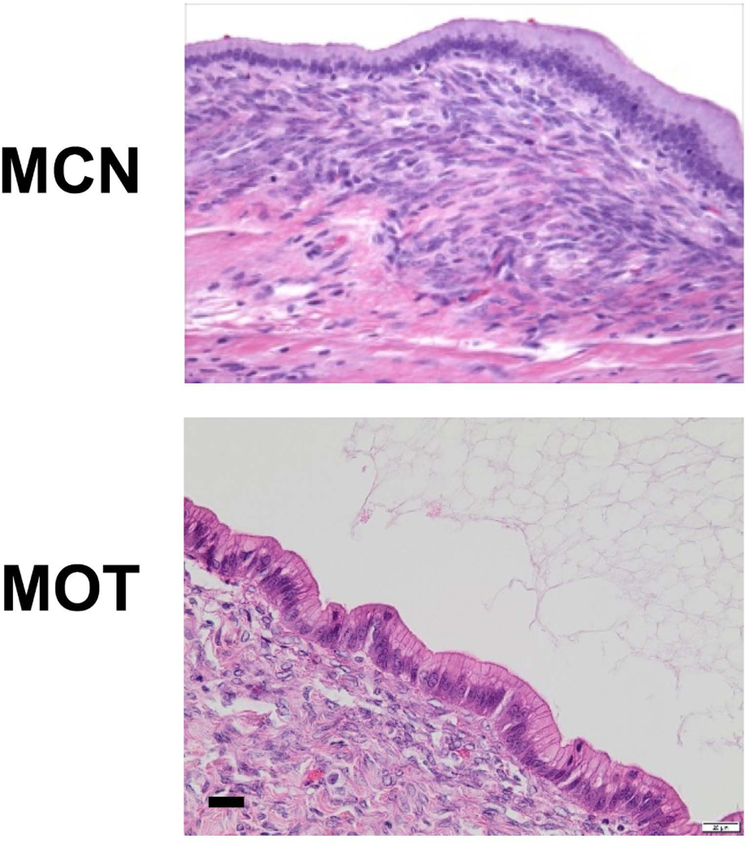
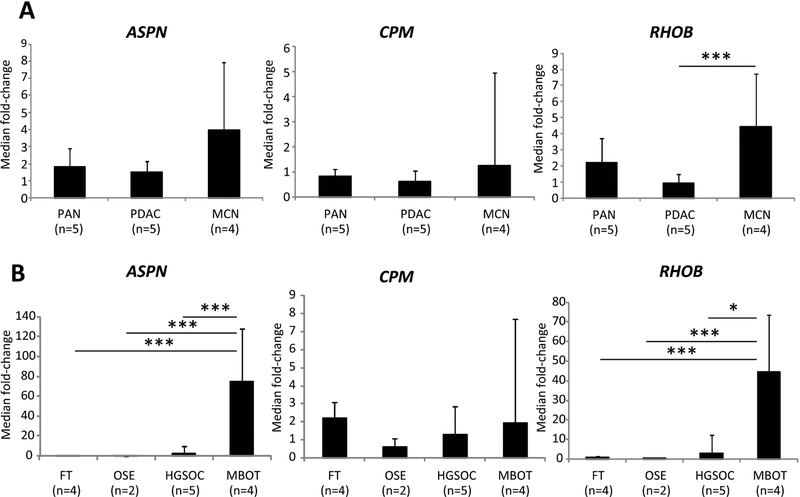
Mucinous ovarian tumors (MOTs) morphologically and epidemiologically resemble mucinous cystic neoplasms (MCNs) of the pancreas, sharing a similar stroma and both occurring disproportionately among young females. Additionally, MOTs and MCNs share similar clinical characteristics and immunohistochemical phenotypes. Exome sequencing has revealed frequent recurrent mutations in KRAS and RNF43 in both MOTs and MCNs. The cell of origin for these tumors remains unclear, but MOTs sometimes arise in the context of mature cystic teratomas and other primordial germ cell (PGC) tumors. We undertook the present study to investigate whether non-teratoma-associated MOTs and MCNs share a common cell of origin. Comparisons of the gene expression profiles of MOTs [including both the mucinous borderline ovarian tumors (MBOTs) and invasive mucinous ovarian carcinomas (MOCs)], high-grade serous ovarian carcinomas, ovarian surface epithelium, Fallopian tube epithelium, normal pancreatic tissue, pancreatic duct adenocarcinomas, MCNs, and single-cell RNA-sequencing of PGCs revealed that both MOTs and MCNs are more closely related to PGCs than to either eutopic epithelial tumors or normal epithelia. We hypothesize that MCNs may arise from PGCs that stopped in the dorsal pancreas during their descent to the gonads during early human embryogenesis, while MOTs arise from PGCs in the ovary. Together, these data suggest a common pathway for the development of MCNs and MOTs, and suggest that these tumors may be more properly classified as germ cell tumor variants. Copyright © 2018 Pathological Society of Great Britain and Ireland. Published by John Wiley & Sons, Ltd.
黏液性卵巢肿瘤 (MOTs) 在形态和流行病学上与胰腺的黏液性囊性腺瘤 (MCNs) 相似,具有相似的基质,并且在年轻女性中发病率不成比例。此外,MOTs 和 MCNs 具有相似的临床特征和免疫组织化学表型。外显子组测序揭示了 MOTs 和 MCNs 中 KRAS 和 RNF43 的频繁反复突变。这些肿瘤的起源细胞仍不清楚,但 MOTs 有时在成熟囊性畸胎瘤和其他原始生殖细胞 (PGC) 肿瘤的背景下发生。我们进行了本研究,以调查非畸胎瘤相关的 MOTs 和 MCN 是否具有共同的起源细胞。MOTs 的基因表达谱 [包括黏液性交界性卵巢肿瘤 (MBOTs) 和浸润性黏液性卵巢癌 (MOCs)]、高级别浆液性卵巢癌、卵巢表面上皮、输卵管上皮、正常胰腺组织、胰腺导管腺癌、MCNs 和 PGC 的单细胞 RNA 测序的比较表明,MOTs 和 MCNs 与 PGCs 的关系比与任何上皮内肿瘤或正常上皮的关系都更密切。我们假设 MCNs 可能起源于 PGCs,这些 PGCs 在人类胚胎发生早期向性腺下降过程中停留在背胰,而 MOTs 则起源于卵巢中的 PGCs。这些数据共同表明了 MCNs 和 MOTs 发展的共同途径,并表明这些肿瘤可能更恰当地归类为生殖细胞肿瘤变体。版权所有 © 2018 英国和爱尔兰病理学学会。由 John Wiley & Sons, Ltd 出版。