van der Zee Anneke, Kraak W Bart, Burggraaf Arjan, Goessens Wil H F, Pirovano Walter, Ossewaarde Jacobus M, Tommassen Jan
Laboratory of Medical Microbiology, Molecular Diagnostics Unit, Maasstad Hospital, Rotterdam, Netherlands.
Erasmus University Medical Center, Rotterdam, Netherlands.
Front Microbiol. 2018 Sep 5;9:2057. doi: 10.3389/fmicb.2018.02057. eCollection 2018.
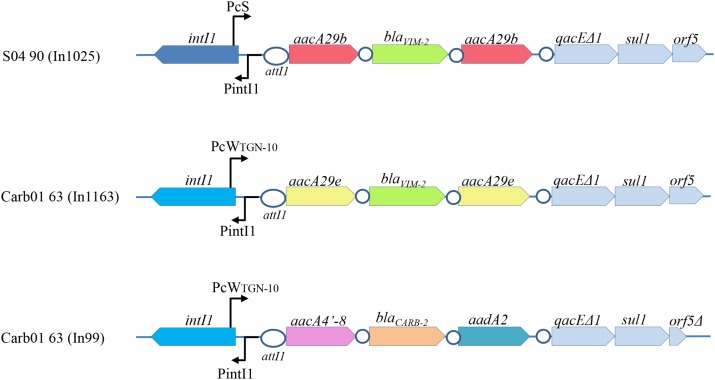
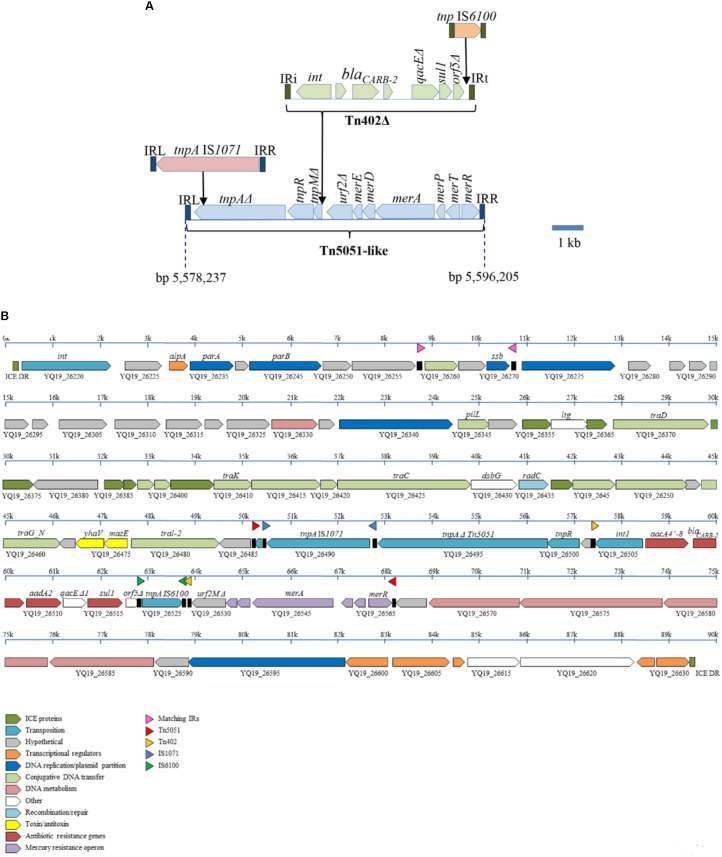
The emergence of carbapenem-resistant represents a worldwide problem. To understand the carbapenem-resistance mechanisms and their spreading among strains, whole genome sequences were determined of two extensively drug-resistant strains that are endemic in Dutch hospitals. Strain Carb01 63 is of O-antigen serotype O12 and of sequence type ST111, whilst S04 90 is a serotype O11 strain of ST446. Both strains carry a gene for metallo-β-lactamase VIM-2 flanked by two genes encoding aminoglycoside acetyltransferases on a class 1 integron. The integron is located on the chromosome in strain Carb01 63 and on a plasmid in strain S04 90. The backbone of the 159-kb plasmid, designated pS04 90, is similar to a previously described plasmid, pND6-2, from . Analysis of the context of the integron showed that it is present in both strains on a ∼30-kb mosaic DNA segment composed of four different transposons that can presumably act together as a novel, active, composite transposon. Apart from the presence of a 1237-bp insertion sequence element in the composite transposon on pS04 90, these transposons show > 99% sequence identity indicating that transposition between plasmid and chromosome could have occurred only very recently. The pS04 90 plasmid could be transferred by conjugation to a susceptible strain. A second class 1 integron containing a gene for a CARB-2 β-lactamase flanked by an and an gene, encoding an aminoglycoside acetyltransferase and adenylyltransferase, respectively, was present only in strain Carb01 63. This integron is located also on a composite transposon that is inserted in an integrative and conjugative element on the chromosome. Additionally, this strain contains a frameshift mutation in the gene encoding a porin involved in the transport of carbapenems across the outer membrane. Together, the results demonstrate that integron-encoded carbapenem and carbapenicillin resistance can easily be disseminated by transposition and conjugation among strains.
耐碳青霉烯类细菌的出现是一个全球性问题。为了解耐碳青霉烯类机制及其在菌株间的传播情况,我们测定了荷兰医院中流行的两株广泛耐药菌株的全基因组序列。菌株Carb01 63为O抗原血清型O12,序列型为ST111,而S04 90是ST446的血清型O11菌株。两株菌株均携带一个金属β-内酰胺酶VIM-2基因,其两侧是两个在1类整合子上编码氨基糖苷乙酰转移酶的基因。该整合子在菌株Carb01 63中位于染色体上,在菌株S04 90中位于质粒上。命名为pS04 90的159 kb质粒的主干与之前描述的来自[具体来源未提及]的质粒pND6-2相似。对整合子周围环境的分析表明,它在两株菌株中均存在于一个约30 kb的镶嵌DNA片段上,该片段由四个不同的转座子组成,推测它们可能共同作为一个新的、活跃的复合转座子发挥作用。除了pS04 90上复合转座子中存在一个1237 bp的插入序列元件外,这些转座子的序列同一性> 99%,表明质粒与染色体之间的转座可能仅在最近发生。pS04 90质粒可通过接合转移至敏感菌株。仅在菌株Carb01 63中存在第二个1类整合子,其包含一个CARB-2β-内酰胺酶基因,两侧分别是一个编码氨基糖苷乙酰转移酶的基因和一个编码腺苷酸转移酶的基因。该整合子也位于一个复合转座子上,该转座子插入到染色体上的一个整合性接合元件中。此外,该菌株在编码参与碳青霉烯类药物跨外膜转运的孔蛋白的基因中存在一个移码突变。总之,结果表明整合子编码的耐碳青霉烯类和耐羧苄青霉素特性可通过转座和接合在菌株间轻易传播。