National Leading Research Laboratory of Drug Resistance Proteomics, Department of Biological Sciences, Myongji University, Yongin 17058, Republic of Korea.
Division of Life Sciences, Jeonbuk National University, Jeonju 54896, Republic of Korea.
Int J Mol Sci. 2023 Oct 15;24(20):15209. doi: 10.3390/ijms242015209.
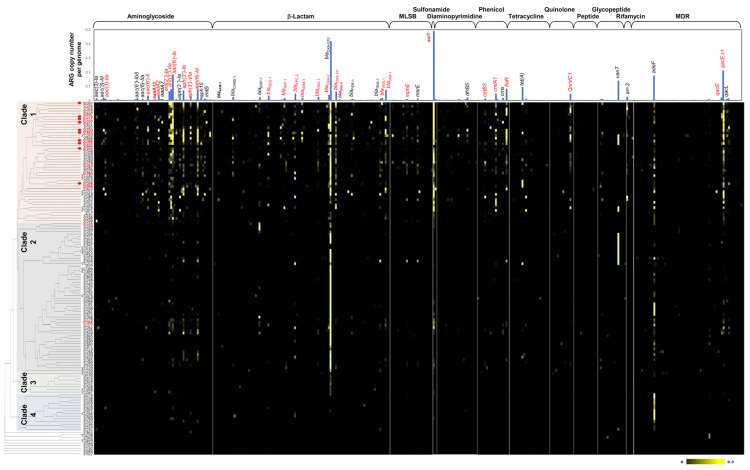
is the primary opportunistic human pathogen responsible for a range of acute and chronic infections; it poses a significant threat to immunocompromised patients and is the leading cause of morbidity and mortality for nosocomial infections. Its high resistance to a diverse array of antimicrobial agents presents an urgent health concern. Among the mechanisms contributing to resistance in , the horizontal acquisition of antibiotic resistance genes (ARGs) via mobile genetic elements (MGEs) has gained recognition as a substantial concern in clinical settings, thus indicating that a comprehensive understanding of ARG dissemination within the species is strongly required for surveillance. Here, two approaches, including a systematic literature analysis and a genome database survey, were employed to gain insights into ARG dissemination. The genome database enabled scrutinizing of all the available sequence information and various attributes of isolates, thus providing an extensive understanding of ARG dissemination within the species. By integrating both approaches, with a primary focus on the genome database survey, mobile ARGs that were linked or correlated with MGEs, important sequence types (STs) carrying diverse ARGs, and MGEs responsible for ARG dissemination were identified as critical factors requiring strict surveillance. Although human isolates play a primary role in dissemination, the importance of animal and environmental isolates has also been suggested. In this study, 25 critical mobile ARGs, 45 critical STs, and associated MGEs involved in ARG dissemination within the species, are suggested as critical factors. Surveillance and management of these prioritized factors across the One Health sectors are essential to mitigate the emergence of multidrug-resistant (MDR) and extensively resistant (XDR) in clinical settings.
是主要的机会性人类病原体,可导致一系列急性和慢性感染;它对免疫功能低下的患者构成重大威胁,是医院感染发病率和死亡率的主要原因。其对各种抗菌药物的高度耐药性是一个紧迫的健康问题。在导致耐药性的机制中,通过移动遗传元件(MGE)横向获得抗生素耐药基因(ARG)已成为临床关注的主要问题,因此表明,为了进行监测,强烈需要全面了解该物种内的 ARG 传播情况。在这里,采用了两种方法,包括系统文献分析和基因组数据库调查,以深入了解 ARG 的传播情况。基因组数据库能够仔细检查所有可用的序列信息和 的各种属性,从而对该物种内的 ARG 传播有了广泛的了解。通过整合这两种方法,主要侧重于基因组数据库调查,确定了与 MGE 相关或关联的可移动 ARG、携带各种 ARG 的重要序列类型(ST)以及负责 ARG 传播的 MGE,这些都是需要严格监测的关键因素。虽然人类分离株在传播中起主要作用,但动物和环境分离株的重要性也已被提出。在这项研究中,25 个关键的可移动 ARG、45 个关键的 ST 以及与该物种内 ARG 传播相关的 MGE 被认为是关键因素。在整个“同一健康”领域对这些优先因素进行监测和管理对于减轻临床中多药耐药(MDR)和广泛耐药(XDR) 的出现至关重要。