• 文献检索
  • 文档翻译
  • 深度研究
  • 学术资讯
  • Suppr Zotero 插件Zotero 插件
  • 邀请有礼
  • 套餐&价格
  • 历史记录
应用&插件
Suppr Zotero 插件Zotero 插件浏览器插件Mac 客户端Windows 客户端微信小程序
定价
高级版会员购买积分包购买API积分包
服务
文献检索文档翻译深度研究API 文档MCP 服务
关于我们
关于 Suppr公司介绍联系我们用户协议隐私条款
关注我们

Suppr 超能文献

核心技术专利:CN118964589B侵权必究
粤ICP备2023148730 号-1Suppr @ 2026

文献检索

告别复杂PubMed语法,用中文像聊天一样搜索,搜遍4000万医学文献。AI智能推荐,让科研检索更轻松。

立即免费搜索

文件翻译

保留排版,准确专业,支持PDF/Word/PPT等文件格式,支持 12+语言互译。

免费翻译文档

深度研究

AI帮你快速写综述,25分钟生成高质量综述,智能提取关键信息,辅助科研写作。

立即免费体验

艾滋病病毒预防:梳理莫桑比克民众对名为“皮塔-库法”的寡妇性净化仪式可接受性的看法。

HIV prevention: mapping Mozambican people's views on the acceptability of the widow's sexual cleansing ritual called pita-kufa.

作者信息

Vera Cruz Germano, Mateus Aniceto, Dlamini Priscilla S

机构信息

Department of Psychology, Faculty of Education, Eduardo Mondlane University, Campus Universitário Principal, Av. Julius Nyerere, N°3453, CP257, Maputo, Mozambique.

Department of Public Health, Higher Institute of Health Sciences, Av. Tomas Ndula, N°977, Maputo, Mozambique.

出版信息

BMC Int Health Hum Rights. 2018 Sep 20;18(1):37. doi: 10.1186/s12914-018-0177-z.

DOI:10.1186/s12914-018-0177-z
PMID:30236108
原文链接:https://pmc.ncbi.nlm.nih.gov/articles/PMC6149074/
Abstract

BACKGROUND

In Mozambique, the widow is traditionally required to undergo a cleansing ritual called pita-kufa, which generally involves several sessions of unprotected sexual intercourse with the brother of her deceased husband. This ritual may play a role in the spread of HIV and reveals, to some degree, the subordinate position to which women are subjected in Mozambican society. Thus, this study's aim was to map Mozambicans' views on the acceptability of this ritual, given the gender and public health concerns linked to it.

METHODS

A total of 359 Mozambicans participated in the study. The data collection instrument consisted of 18 vignettes describing realistic pita-kufa situations, varying as a function of three factors: a widow's willingness or not to perform the ritual, the perceived effectiveness of the ritual, and the risk level of HIV infection linked to the practice. For each pita-kufa situation presented in the vignettes, the participants were asked to rate its acceptability on an 11-point scale. In addition, the participants wrote comments giving their general views on the ritual. A cluster analysis using the K-means procedure was applied to the quantitative raw data to capture different perspectives, and the participants' written comments were subjected to thematic and frequency content analysis.

RESULTS

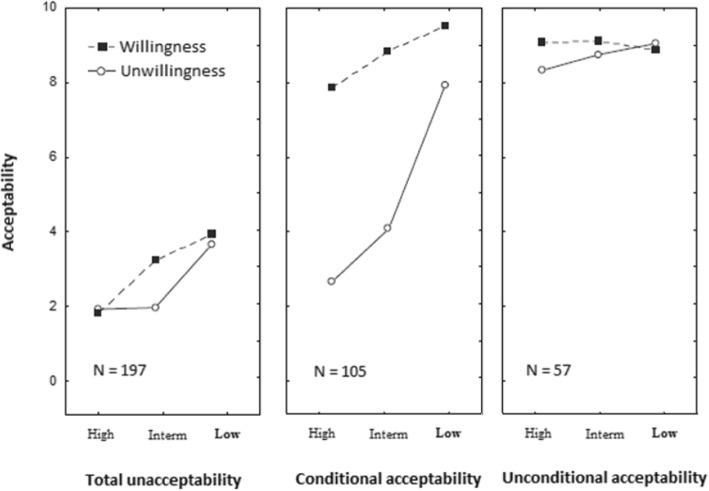
From the data gathered though the vignettes, three different perspectives were found: total unacceptability (55% of the participants), conditional acceptability (29% of the participants) and unconditional acceptability (16% of the participants). From the data gathered though the participants' written comments, it emerged that they thought that the practice of this ritual should evolve (61%), stop (27%) and be kept as it is (12%).

CONCLUSION

According to the main results, it seems that a large majority of study participants think that this ritual is outdated and needs to evolve in order to minimize the risk of HIV transmission and respect women's rights.

摘要

背景

在莫桑比克,传统上要求寡妇进行一种名为“皮塔 - 库法”的净化仪式,该仪式通常包括与亡夫的兄弟进行几次无保护的性行为。这种仪式可能在艾滋病毒传播中起作用,并且在一定程度上揭示了莫桑比克社会中女性所处的从属地位。因此,鉴于与之相关的性别和公共卫生问题,本研究的目的是梳理莫桑比克人对这种仪式可接受性的看法。

方法

共有359名莫桑比克人参与了该研究。数据收集工具包括18个描述现实中“皮塔 - 库法”情况的 vignette,这些情况因三个因素而有所不同:寡妇是否愿意进行该仪式、仪式的感知有效性以及与该行为相关的艾滋病毒感染风险水平。对于 vignette 中呈现的每种“皮塔 - 库法”情况,要求参与者在11分制量表上对其可接受性进行评分。此外,参与者写下评论,给出他们对该仪式的总体看法。使用K均值程序的聚类分析应用于定量原始数据以获取不同观点,参与者的书面评论则进行主题和频率内容分析。

结果

从通过 vignette 收集的数据中,发现了三种不同的观点:完全不可接受(55%的参与者)、有条件接受(29%的参与者)和无条件接受(16%的参与者)。从通过参与者书面评论收集的数据中可以看出,他们认为这种仪式的做法应该演变(61%)、停止(27%)并保持不变(12%)。

结论

根据主要结果,似乎绝大多数研究参与者认为这种仪式已经过时,需要演变以尽量减少艾滋病毒传播风险并尊重妇女权利。
https://cdn.ncbi.nlm.nih.gov/pmc/blobs/5a1e/6149074/21dbf2c69104/12914_2018_177_Fig1_HTML.jpg

相似文献

1
HIV prevention: mapping Mozambican people's views on the acceptability of the widow's sexual cleansing ritual called pita-kufa.艾滋病病毒预防:梳理莫桑比克民众对名为“皮塔-库法”的寡妇性净化仪式可接受性的看法。
BMC Int Health Hum Rights. 2018 Sep 20;18(1):37. doi: 10.1186/s12914-018-0177-z.
2
Widow cleansing and inheritance among the Luo in Kenya: the need for additional women-centred HIV prevention options.肯尼亚卢奥族中的寡妇净身与继承问题:对更多以女性为中心的艾滋病预防方案的需求。
J Int AIDS Soc. 2014 Jun 26;17(1):19010. doi: 10.7448/IAS.17.1.19010. eCollection 2014.
3
[Current status of the female condom in Africa].[非洲女用避孕套的现状]
Sante. 1997 Nov-Dec;7(6):405-15.
4
HIV/AIDS and cultural practices in western Kenya: the impact of sexual cleansing rituals on sexual behaviours.肯尼亚西部的艾滋病毒/艾滋病与文化习俗:性净化仪式对性行为的影响
Cult Health Sex. 2008 Aug;10(6):587-99. doi: 10.1080/13691050802012601.
5
People's willingness and determinants to use selected tele-consultation public health services in Mozambique.莫桑比克民众对特定远程咨询公共卫生服务的使用意愿和决定因素。
BMC Public Health. 2021 May 19;21(1):947. doi: 10.1186/s12889-021-10709-9.
6
Property-grabbing: why Zambia needs stronger laws to protect widows' rights.掠夺财产:赞比亚为何需要更有力的法律来保护寡妇权利。
AIDS Anal Afr. 1994 Jul-Aug;4(4):1, 7.
7
Widowhood in the era of HIV/AIDS: a case study of Slaya District, Kenya.艾滋病时代的寡妇问题:肯尼亚斯拉亚区的案例研究。
SAHARA J. 2007 Aug;4(2):606-15. doi: 10.1080/17290376.2007.9724882.
8
Country watch. Uganda.国家观察。乌干达。
AIDS Health Promot Exch. 1992(3):6-7.
9
The bottom line: Mozambique.关键在于:莫桑比克。
Plan Parent Chall. 1997(1-2):45-7.
10
Pressure to ban "sexual cleansing" in Zambia.赞比亚面临禁止“性清洗”的压力。
AIDS Anal Afr. 1995 Mar-Apr;5(2):4.

引用本文的文献

1
Mitigating HIV risk associated with widow cleansing and wife inheritance using combined biomedical and structural interventions in western Kenya: a mathematical modeling study.在肯尼亚西部采用生物医学与结构干预相结合的措施降低与寡妇净身和妻子继承相关的艾滋病毒风险:一项数学建模研究
BMC Med. 2025 Feb 12;23(1):88. doi: 10.1186/s12916-025-03906-5.
2
"I was forced into it": The continued violation of widows from the Luo community of Kenya through sexual cleansing rituals.“我是被迫这样做的”:肯尼亚卢奥族寡妇因性净化仪式而持续遭受侵害。
Front Glob Womens Health. 2022 Aug 16;3:942635. doi: 10.3389/fgwh.2022.942635. eCollection 2022.
3

本文引用的文献

1
The practice of puxa-puxa among Mozambican women: a systematic inventory of motives.莫桑比克女性中的“普克-普克”习俗:动机的系统梳理
J Sex Res. 2014;51(8):852-62. doi: 10.1080/00224499.2013.795925. Epub 2013 Aug 7.
2
Sociocultural and epidemiological aspects of HIV/AIDS in Mozambique.莫桑比克艾滋病毒/艾滋病的社会文化和流行病学方面。
BMC Int Health Hum Rights. 2010 Jun 8;10:15. doi: 10.1186/1472-698X-10-15.
A Review of Infectious Diseases Associated with Religious and Nonreligious Rituals.
与宗教和非宗教仪式相关的传染病综述
Interdiscip Perspect Infect Dis. 2021 Dec 6;2021:1823957. doi: 10.1155/2021/1823957. eCollection 2021.
4
Predictors of high HIV+ prevalence in Mozambique: A complex samples logistic regression modeling and spatial mapping approaches.莫桑比克高 HIV 阳性率的预测因素:复杂样本逻辑回归建模和空间映射方法。
PLoS One. 2020 Jun 4;15(6):e0234034. doi: 10.1371/journal.pone.0234034. eCollection 2020.
5
Infant vaccination against malaria in Mozambique and in Togo: mapping parents' willingness to get their children vaccinated.莫桑比克和多哥的婴儿疟疾疫苗接种:绘制父母让子女接种疫苗的意愿图。
Hum Vaccin Immunother. 2020 Mar 3;16(3):539-547. doi: 10.1080/21645515.2019.1667728. Epub 2019 Oct 18.