Institut National de Recherche Biomédicale (INRB), P.O Box 1197, Kinshasa 1, Kinshasa, Democratic Republic of the Congo.
Université Pédagogique National (UPN), Kinshasa, Democratic Republic of the Congo.
Malar J. 2018 Sep 20;17(1):334. doi: 10.1186/s12936-018-2480-5.
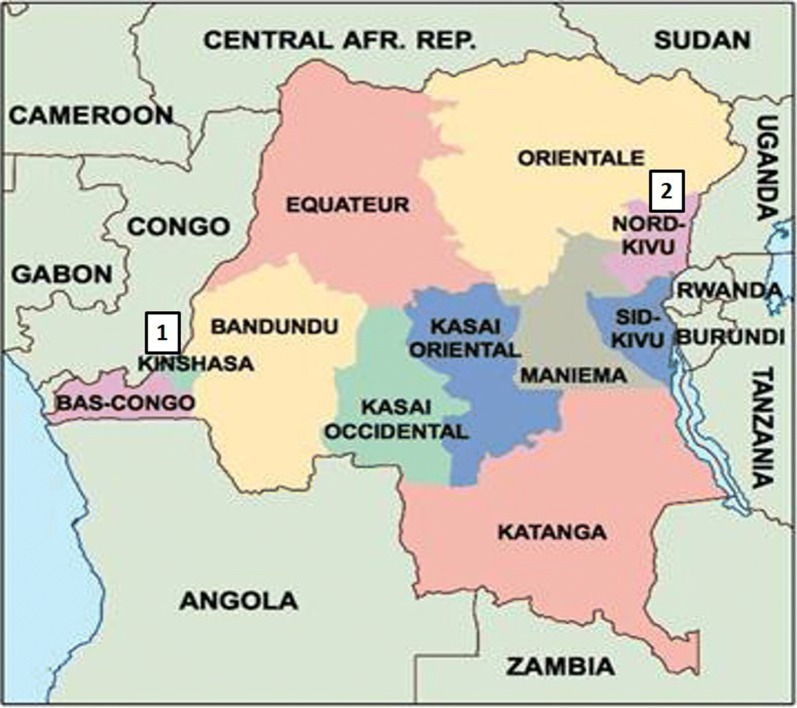
Worldwide, the highest malaria mortality is due to Plasmodium falciparum infection. However, other species of Plasmodium (Plasmodium vivax, Plasmodium ovale, Plasmodium malariae, and Plasmodium knowlesi) can also cause malaria. Therefore, accurate identification of malaria species is crucial for patient management and epidemiological surveillance. This study aimed to determine the different Plasmodium species causing malaria in children under 5 years old in two provinces (Kinshasa and North Kivu) of the Democratic Republic of Congo (DRC).
From October to December 2015, a health-facility based cross-sectional study was conducted in General Reference Hospitals in Kinshasa and North Kivu. Four hundred and seven blood samples were collected from febrile children aged ≤ 5 years. Nested polymerase chain reaction assays were performed for Plasmodium species identification.
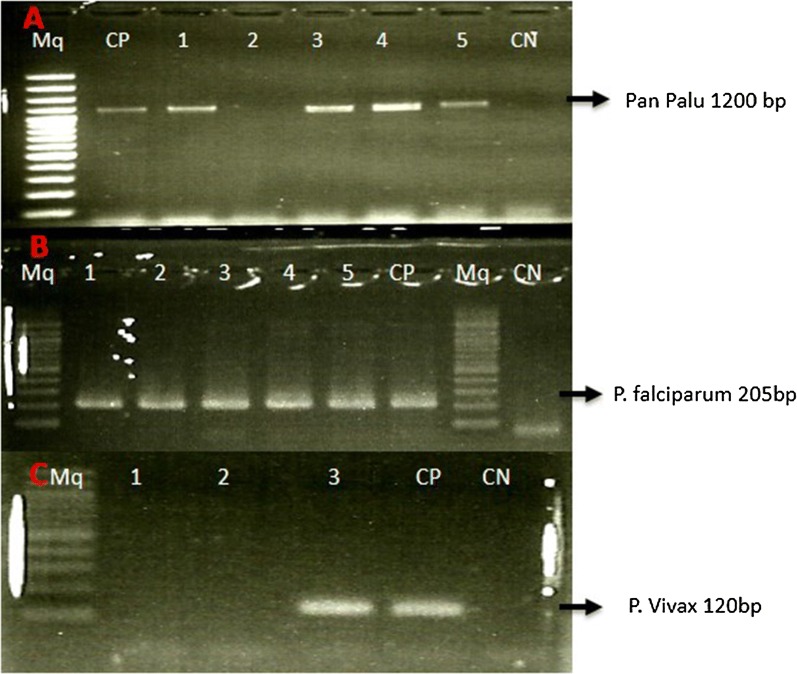
Out of 407 children, 142 (34.9%) were infected with Plasmodium spp. and P. falciparum was the most prevalent species (99.2%). Among those infected children, 124 had a mono infection with P. falciparum and one with P. malariae. Mixed infections with P. falciparum/P. malariae and P. falciparum/P. vivax were observed in 6 (1.5%) and 8 (2.0%) children, respectively. The prevalence of infection was higher in females (64.8%) than in males (35.2%), p < 0.001. The age-specific distribution of infection showed that children of less than 2 years old were less infected (18.4%) compared to those aged above 2 years (81.6%), p < 0.001.
Although this study showed clearly that the most prevalent species identified was P. falciparum, the findings demonstrate the existence of non-falciparum malaria, especially P. malariae and P. vivax among children aged ≤ 5 years living both Kinshasa and North Kivu Provinces in DRC.
在全球范围内,疟疾死亡率最高的是由恶性疟原虫感染引起的。然而,其他疟原虫(间日疟原虫、卵形疟原虫、三日疟原虫和诺氏疟原虫)也可能引起疟疾。因此,准确识别疟原虫种类对于患者管理和流行病学监测至关重要。本研究旨在确定刚果民主共和国(DRC)两个省(金沙萨和北基伍)5 岁以下儿童患疟疾的不同疟原虫种类。
2015 年 10 月至 12 月,在金沙萨和北基伍的综合参考医院进行了一项基于卫生机构的横断面研究。共采集了 407 名 5 岁以下发热儿童的血液样本。采用巢式聚合酶链反应(PCR)检测疟原虫种类。
在 407 名儿童中,142 名(34.9%)感染了疟原虫。最常见的疟原虫是恶性疟原虫(99.2%)。在感染儿童中,124 例为恶性疟原虫单一感染,1 例为间日疟原虫感染。6 例(1.5%)和 8 例(2.0%)儿童分别混合感染了恶性疟原虫/间日疟原虫和恶性疟原虫/间日疟原虫。女性(64.8%)的感染率高于男性(35.2%),p<0.001。感染的年龄分布显示,2 岁以下儿童的感染率(18.4%)明显低于 2 岁以上儿童(81.6%),p<0.001。
尽管本研究明确表明最常见的疟原虫种类是恶性疟原虫,但结果表明在刚果民主共和国金沙萨和北基伍省,5 岁以下儿童中非恶性疟原虫疟疾,特别是间日疟原虫和卵形疟原虫的存在。