Gurley W B, Czarnecka E, Nagao R T, Key J L
Mol Cell Biol. 1986 Feb;6(2):559-65. doi: 10.1128/mcb.6.2.559-565.1986.
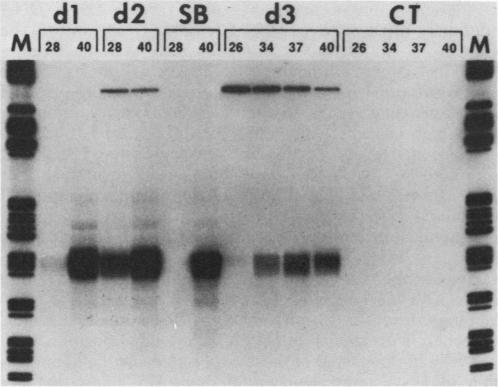
A soybean gene (Gmhsp17.5-E) encoding a small heat shock protein was introduced into primary sunflower tumors via T-DNA-mediated transformation. RNA blot hybridizations and S1-nuclease hybrid protection studies indicated that the heat shock gene containing 3.25 kilobases of 5'-flanking sequences was strongly transcribed in a thermoinducible (40 degrees C) manner. Transcriptional induction also occurred to a lesser extent upon treatment of whole tumors with sodium arsenite and CdCl2. Basal (26 degrees C) transcription was not detected in soybean seedlings, but it was quite evident in transformed tumor tissue. A 5' deletion to -1,175 base pairs with respect to the CAP site had no effect on the levels of thermoinducible transcription, but it resulted in a large increase in basal transcription. Further removal of DNA sequences (including the TATA-distal heat shock consensus element) to -95 base pairs reduced thermoinducible transcription by 95% and also greatly decreased basal transcription. The termini of the Gmhsp17.5-E RNA in the tumor were generally the same as those present in soybean RNA, with the exception of several additional 3' termini.
通过T-DNA介导的转化将一个编码小热激蛋白的大豆基因(Gmhsp17.5-E)导入向日葵原发性肿瘤中。RNA印迹杂交和S1核酸酶杂交保护研究表明,含有3.25千碱基5'侧翼序列的热激基因以热诱导(40℃)方式强烈转录。用亚砷酸钠和氯化镉处理整个肿瘤时,转录诱导也在较小程度上发生。在大豆幼苗中未检测到基础(26℃)转录,但在转化的肿瘤组织中很明显。相对于CAP位点缺失至-1175碱基对的5'端对热诱导转录水平没有影响,但导致基础转录大幅增加。进一步去除DNA序列(包括TATA远端热激共有元件)至-95碱基对使热诱导转录降低了95%,同时也大大降低了基础转录。肿瘤中Gmhsp17.5-E RNA的末端通常与大豆RNA中的末端相同,只是有几个额外的3'末端除外。