IDOCAL/Department of Psychobiology, Psychology Center, University of Valencia, Valencia, Spain.
IDIBAPS (Institut d'Investigacions Biomèdiques August Pi i Sunyer), Barcelona, Spain.
Neuroimage Clin. 2018;20:742-752. doi: 10.1016/j.nicl.2018.09.010. Epub 2018 Sep 15.
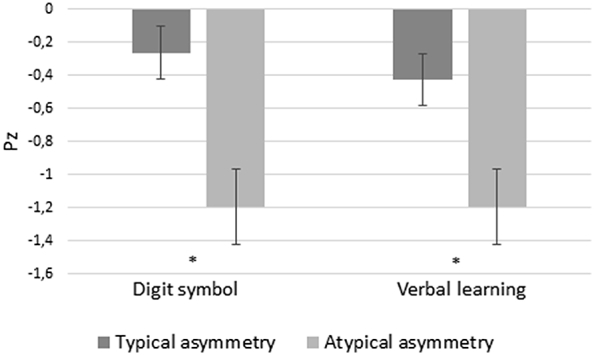
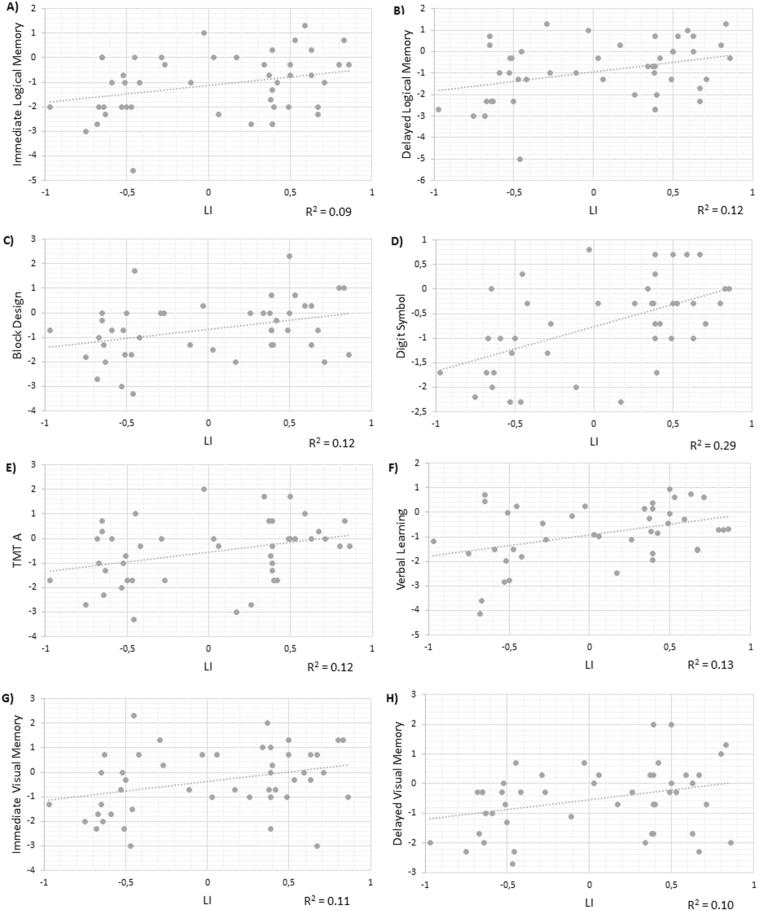
Chronic exposure to seizures in patients with left hemisphere (LH) epileptic focus could favor higher activation in the contralateral hemisphere during language processing, but the cognitive effects of this remain unclear. This study assesses the relationship between asymmetry in hemispheric activation during language fMRI and performance in verbal and non-verbal tasks. Whereas prior studies primarily used fMRI paradigms that favor frontal lobe activation and less prominent activation of the medial or superior temporal lobes, we used a verbal comprehension paradigm previously demonstrated to activate reliably receptive language areas. Forty-seven patients with drug-resistant epilepsy candidates for surgery underwent a multidisciplinary assessment, including a comprehensive neuropsychological evaluation and an fMRI verbal comprehension paradigm. Patients were distributed in two groups depending on laterality indexes (LI): typical hemispheric asymmetry (unilateral left activation preponderance; n = 23) and atypical hemispheric asymmetry (bilateral or unilateral right preponderance; n = 24). Right-handedness and right hemisphere (RH) focus were significant predictors of typical asymmetry. Patients with typical activation pattern presented better performance intelligence quotient and verbal learning than patients with atypical hemispheric asymmetry (for all, p < 0.014). Patients with LH focus had more frequently atypical hemispheric asymmetry than patients with RH focus (p = 0.05). Specifically, they showed lower LI and this was related to worse performance in verbal and non-verbal tasks. In conclusion, an increased activation of homologous RH areas for verbal comprehension processing could imply a competition of cognitive resources in the performance of the same task, disrupting cognitive performance.
慢性癫痫发作暴露于左半球(LH)癫痫灶的患者在语言处理过程中可能会导致对侧半球的更高激活,但这种认知效应尚不清楚。本研究评估了语言 fMRI 中半球激活的不对称性与言语和非言语任务表现之间的关系。先前的研究主要使用了有利于额叶激活且较少激活内侧或上颞叶的 fMRI 范式,而我们使用了先前证明能可靠激活接受性语言区域的言语理解范式。47 名药物难治性癫痫患者接受了多学科评估,包括全面的神经心理学评估和 fMRI 言语理解范式。根据侧化指数(LI)将患者分为两组:典型半球不对称(单侧左激活优势;n = 23)和非典型半球不对称(双侧或单侧右优势;n = 24)。右利手和右半球(RH)焦点是典型不对称的显著预测因子。具有典型激活模式的患者比具有非典型半球不对称的患者具有更好的智商和言语学习表现(所有 p < 0.014)。与 RH 焦点患者相比,LH 焦点患者更频繁地出现非典型半球不对称(p = 0.05)。具体来说,他们的 LI 较低,这与言语和非言语任务的表现较差有关。总之,言语理解处理中同源 RH 区域的增加激活可能意味着在执行相同任务时认知资源的竞争,从而破坏认知表现。