Campbell B A, Villarreal L P
Mol Cell Biol. 1986 Jun;6(6):2068-79. doi: 10.1128/mcb.6.6.2068-2079.1986.
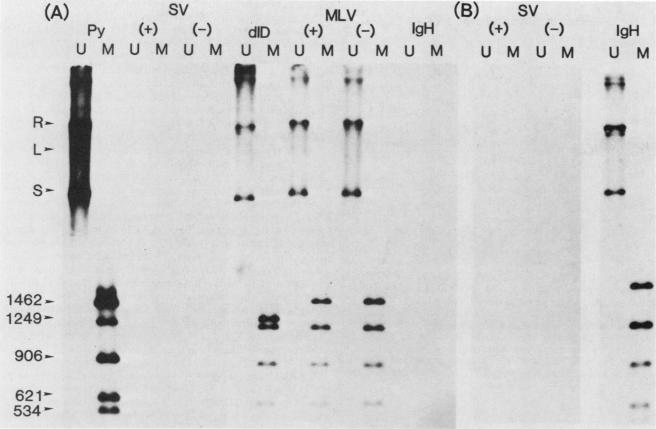
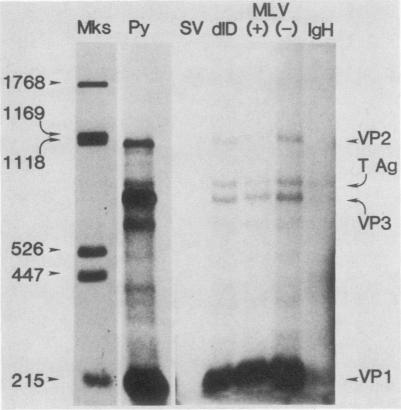
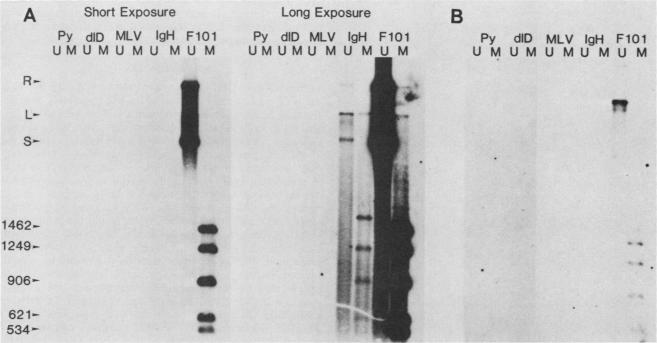
Heterologous enhancer recombinants and deletions of the polyomavirus (Py) noncoding region were constructed and analyzed for tissue specificity of DNA replication and transcription in a number of lymphoid and other cell lines. The simian virus 40 72-base-pair repeat, mouse immunoglobulin heavy-chain enhancer, and Moloney murine leukemia virus enhancer were inserted into the PvuII-D locus (nucleotides 5128 through 5265) of Py. The ability of these recombinants and the parental PvuII-D deletion mutant to replicate in permissive 3T6 cells and MOP-6 cells as well as in nonpermissive mouse B lymphoid, T lymphoid, mastocyte, and embryonal carcinoma cells was determined. Wild-type Py DNA was not permissive for replication in most lymphoid cell lines, except one hybridoma line. Simply deleting the Py PvuII-D region, however, gave Py an expanded host range, allowing high-level replication in some T lymphoid and mastocytoma cell lines, indicating that this element can be a tissue-specific negative as well as positive element. Substitution of the murine leukemia virus enhancer for Py PvuII-D yielded a Py genome which retained the ability to replicate in 3T6 cells but also replicated well in B lymphoid cells. Substitution with the immunoglobulin heavy-chain enhancer allowed replication in B lymphoid cells but interfered with replication in 3T6 cells and mastocytomas. Surprisingly, substitution with the simian virus 40 72-base-pair enhancer repeat gave a recombinant which would not replicate in any cell line tried, including MOP-6 cells, even though other recombinants with this enhancer would replicate. Thus, we observed both cooperation and interference in these combinations between enhancer components and the Py genome and that these combined activities were cell specific. These results are presented as evidence that there may be a positional dependence, or syntax, for the recognition of genetic elements controlling Py tissue specificity.
构建了多瘤病毒(Py)非编码区的异源增强子重组体和缺失体,并在多种淋巴细胞系和其他细胞系中分析了DNA复制和转录的组织特异性。将猿猴病毒40的72碱基对重复序列、小鼠免疫球蛋白重链增强子和莫洛尼鼠白血病病毒增强子插入Py的PvuII-D位点(核苷酸5128至5265)。测定了这些重组体和亲本PvuII-D缺失突变体在允许性3T6细胞和MOP-6细胞以及非允许性小鼠B淋巴细胞、T淋巴细胞、肥大细胞和胚胎癌细胞系中的复制能力。野生型Py DNA在大多数淋巴细胞系中不允许复制,但有一种杂交瘤细胞系除外。然而,简单地删除Py的PvuII-D区域,使Py的宿主范围扩大,允许在一些T淋巴细胞和肥大细胞瘤细胞系中进行高水平复制,这表明该元件既可以是组织特异性的负性元件,也可以是正性元件。用鼠白血病病毒增强子替代Py的PvuII-D产生了一个Py基因组,它保留了在3T6细胞中复制的能力,同时也能在B淋巴细胞中很好地复制。用免疫球蛋白重链增强子替代则允许在B淋巴细胞中复制,但干扰了在3T6细胞和肥大细胞瘤中的复制。令人惊讶的是,用猿猴病毒40的72碱基对增强子重复序列替代后得到的重组体,即使带有该增强子的其他重组体能够复制,它在任何所测试的细胞系中,包括MOP-6细胞,都不能复制。因此,我们在这些增强子成分与Py基因组的组合中观察到了协同作用和干扰,并且这些组合活性具有细胞特异性。这些结果表明,对于控制Py组织特异性的遗传元件的识别,可能存在位置依赖性或语法规则。