Department of Cardiology, Renmin Hospital of Wuhan University, Cardiovascular Research Institute, Hubei Key Laboratory of Cardiology, Wuhan, Hubei 430060, China.
Department of Geriatrics, Tongji Hospital, Tongji Medical College, Huazhong University of Science and Technology, Wuhan, Hubei 430074, China.
Chin Med J (Engl). 2018 Oct 5;131(19):2287-2296. doi: 10.4103/0366-6999.241819.
Shensong Yangxin Capsule (SSYX), traditional Chinese medicine, has been used to treat arrhythmias, angina, cardiac remodeling, cardiac fibrosis, and so on, but its effect on cardiac energy metabolism is still not clear. The objective of this study was to investigate the effects of SSYX on myocardium energy metabolism in angiotensin (Ang) II-induced cardiac hypertrophy.
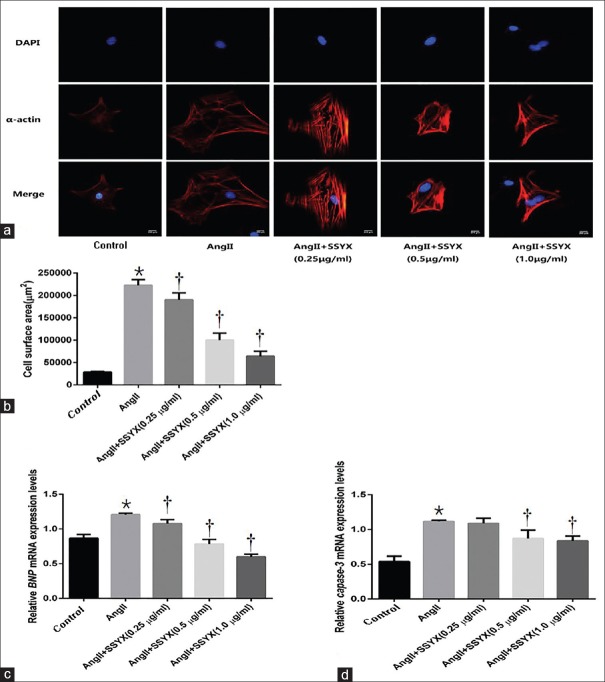
We used 2 μl (10 mol/L) AngII to treat neonatal rat cardiomyocytes (NRCMs) for 48 h. Myocardial α-actinin staining showed that the myocardial cell volume increased. Expression of the cardiac hypertrophic marker-brain natriuretic peptide (BNP) messenger RNA (mRNA) also increased by real-time polymerase chain reaction (PCR). Therefore, it can be assumed that the model of hypertrophic cardiomyocytes was successfully constructed. Then, NRCMs were treated with 1 μl of different concentrations of SSYX (0.25, 0.5, and 1.0 μg/ml) for another 24 h. To explore the time-depend effect of SSYX on energy metabolism, 0.5 μg/ml SSYX was added into cells for 0, 6, 12, 24, and 48 h. Mitochondria was assessed by MitoTracker staining and confocal microscopy. mRNA and protein expression of mitochondrial biogenesis-related genes - Peroxisome proliferator-activated receptor-γ coactivator-1α (PGC-1α), energy balance key factor - adenosine monophosphate-activated protein kinase (AMPK), fatty acids oxidation factor - carnitine palmitoyltransferase-1 (CPT-1), and glucose oxidation factor - glucose transporter- 4 (GLUT-4) were measured by PCR and Western blotting analysis.
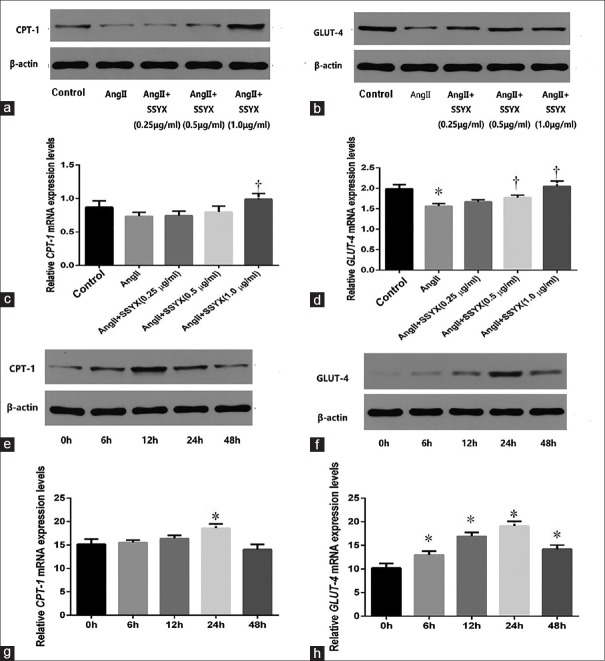
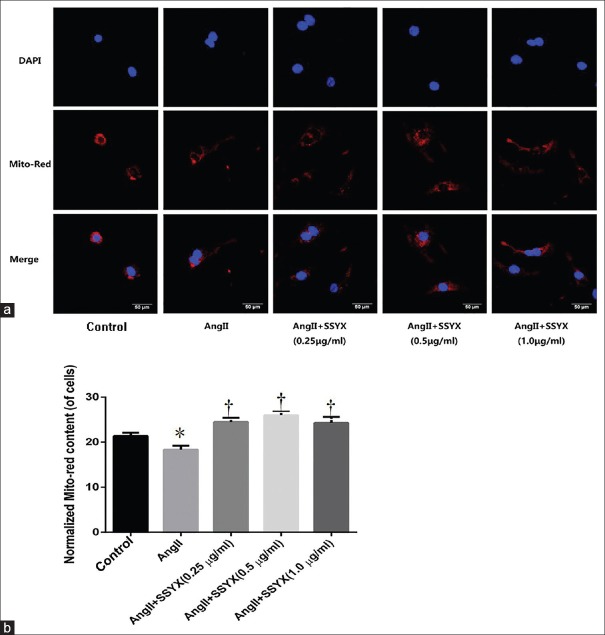
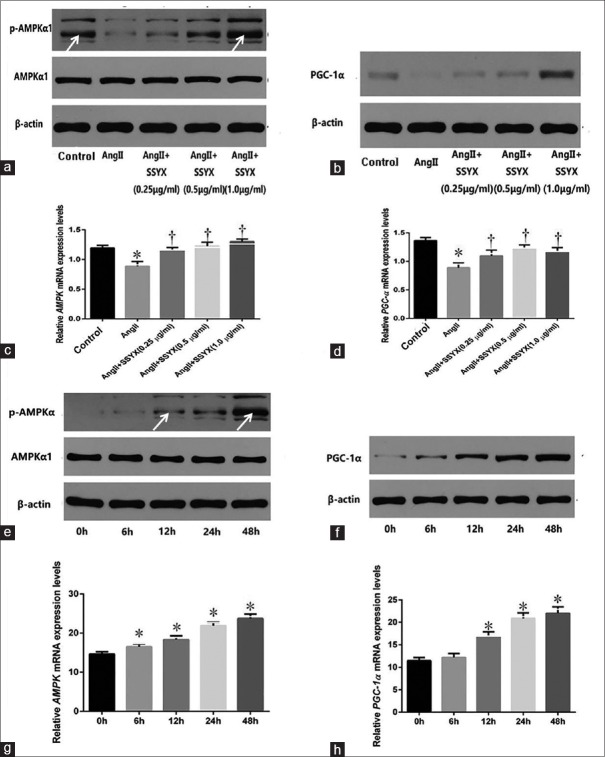
With the increase in the concentration of SSYX (from 0.25 to 1.0 μg/ml), an increased mitochondrial density in AngII-induced cardiomyocytes was found compared to that of those treated with AngII only (0.25 μg/ml, 18.3300 ± 0.8895 vs. 24.4900 ± 0.9041, t = 10.240, P < 0.0001; 0.5 μg/ml, 18.3300 ± 0.8895 vs. 25.9800 ± 0.8187, t = 12.710, P < 0.0001; and 1.0 μg/ml, 18.3300 ± 0.8895 vs. 24.2900 ± 1.3120, t = 9.902, P < 0.0001; n = 5 per dosage group). SSYX also increased the mRNA and protein expression of PGC-1α (0.25 μg/ml, 0.8892 ± 0.0848 vs. 1.0970 ± 0.0994, t = 4.319, P = 0.0013; 0.5 μg/ml, 0.8892 ± 0.0848 vs. 1.2330 ± 0.0564, t = 7.150, P < 0.0001; and 1.0 μg/ml, 0.8892 ± 0.0848 vs. 1.1640 ± 0.0755, t = 5.720, P < 0.0001; n = 5 per dosage group), AMPK (0.25 μg/ml, 0.8872 ± 0.0779 vs. 1.1500 ± 0.0507, t = 7.239, P < 0.0001; 0.5 μg/ml, 0.8872 ± 0.0779 vs. 1.2280 ± 0.0623, t = 9.379, P < 0.0001; and 1.0 μg/ml, 0.8872 ± 0.0779 vs. 1.3020 ± 0.0450, t = 11.400, P < 0.0001; n = 5 per dosage group), CPT-1 (1.0 μg/ml, 0.7348 ± 0.0594 vs. 0.9880 ± 0.0851, t = 4.994, P = 0.0007, n = 5), and GLUT-4 (0.5 μg/ml, 1.5640 ± 0.0599 vs. 1.7720 ± 0.0660, t = 3.783, P = 0.0117; 1.0 μg/ml, 1.5640 ± 0.0599 vs. 2.0490 ± 0.1280, t = 8.808, P < 0.0001; n = 5 per dosage group). The effect became more obvious with the increasing concentration of SSYX. When 0.5 μg/ml SSYX was added into cells for 0, 6, 12, 24, and 48 h, the expression of AMPK (6 h, 14.6100 ± 0.6205 vs. 16.5200 ± 0.7450, t = 3.456, P = 0.0250; 12 h, 14.6100 ± 0.6205 vs. 18.3200 ± 0.9965, t = 6.720, P < 0.0001; 24 h, 14.6100 ± 0.6205 vs. 21.8800 ± 0.8208, t = 13.160, P < 0.0001; and 48 h, 14.6100 ± 0.6205 vs. 23.7400 ± 1.0970, t = 16.530, P < 0.0001; n = 5 per dosage group), PGC-1α (12 h, 11.4700 ± 0.7252 vs. 16.9000 ± 1.0150, t = 7.910, P < 0.0001; 24 h, 11.4700 ± 0.7252 vs. 20.8800 ± 1.2340, t = 13.710, P < 0.0001; and 48 h, 11.4700 ± 0.7252 vs. 22.0300 ± 1.4180, t = 15.390; n = 5 per dosage group), CPT-1 (24 h, 15.1600 ± 1.0960 vs. 18.5800 ± 0.9049, t = 6.048, P < 0.0001, n = 5), and GLUT-4 (6 h, 10.2100 ± 0.9485 vs. 12.9700 ± 0.8221, t = 4.763, P = 0.0012; 12 h, 10.2100 ± 0.9485 vs. 16.9100 ± 0.8481, t = 11.590, P < 0.0001; 24 h, 10.2100 ± 0.9485 vs. 19.0900 ± 0.9797, t = 15.360, P < 0.0001; and 48 h, 10.2100 ± 0.9485 vs. 14.1900 ± 0.9611, t = 6.877, P < 0.0001; n = 5 per dosage group) mRNA and protein increased gradually with the prolongation of drug action time.
SSYX could increase myocardial energy metabolism in AngII-induced cardiac hypertrophy. Therefore, SSYX might be considered to be an alternative therapeutic remedy for myocardial hypertrophy.
参松养心胶囊(SSYX)是一种传统的中药,已被用于治疗心律失常、心绞痛、心脏重构、心脏纤维化等,但它对心肌能量代谢的影响尚不清楚。本研究的目的是探讨 SSYX 对血管紧张素(Ang)II 诱导的心肌肥厚中心肌能量代谢的影响。
我们使用 2μl(10mol/L)AngII 处理新生大鼠心肌细胞(NRCMs)48 小时。心肌肌动蛋白染色显示心肌细胞体积增大。实时聚合酶链反应(PCR)检测心脏肥大标志物-脑钠肽(BNP)信使 RNA(mRNA)的表达也增加。因此,可以假设构建了肥厚型心肌细胞模型。然后,用不同浓度的 SSYX(0.25、0.5 和 1.0μg/ml)处理 NRCMs 另外 24 小时。为了探索 SSYX 对能量代谢的时间依赖性作用,将 0.5μg/ml 的 SSYX 添加到细胞中 0、6、12、24 和 48 小时。使用 MitoTracker 染色和共聚焦显微镜评估线粒体。通过 PCR 和 Western blot 分析测量线粒体生物发生相关基因-过氧化物酶体增殖物激活受体-γ共激活因子-1α(PGC-1α)、能量平衡关键因子-腺苷单磷酸激活蛋白激酶(AMPK)、脂肪酸氧化因子-肉碱棕榈酰转移酶-1(CPT-1)和葡萄糖氧化因子-葡萄糖转运蛋白-4(GLUT-4)的 mRNA 和蛋白表达。
随着 SSYX 浓度的增加(从 0.25μg/ml 增加到 1.0μg/ml),与仅用 AngII 处理的细胞相比,AngII 诱导的心肌细胞中线粒体密度增加(0.25μg/ml,18.3300±0.8895 对 24.4900±0.9041,t=10.240,P<0.0001;0.5μg/ml,18.3300±0.8895 对 25.9800±0.8187,t=12.710,P<0.0001;和 1.0μg/ml,18.3300±0.8895 对 24.2900±1.3120,t=9.902,P<0.0001;n=5 个剂量组)。SSYX 还增加了 PGC-1α 的 mRNA 和蛋白表达(0.25μg/ml,0.8892±0.0848 对 1.0970±0.0994,t=4.319,P=0.0013;0.5μg/ml,0.8892±0.0848 对 1.2330±0.0564,t=7.150,P<0.0001;和 1.0μg/ml,0.8892±0.0848 对 1.1640±0.0755,t=5.720,P<0.0001;n=5 个剂量组)、AMPK(0.25μg/ml,0.8872±0.0779 对 1.1500±0.0507,t=7.239,P<0.0001;0.5μg/ml,0.8872±0.0779 对 1.2280±0.0623,t=9.379,P<0.0001;和 1.0μg/ml,0.8872±0.0779 对 1.3020±0.0450,t=11.400,P<0.0001;n=5 个剂量组)、CPT-1(1.0μg/ml,0.7348±0.0594 对 0.9880±0.0851,t=4.994,P=0.0007,n=5)和 GLUT-4(0.5μg/ml,1.5640±0.0599 对 1.7720±0.0660,t=3.783,P=0.0117;1.0μg/ml,1.5640±0.0599 对 2.0490±0.1280,t=8.808,P<0.0001;n=5 个剂量组)。随着 SSYX 浓度的增加,效果变得更加明显。当 0.5μg/ml SSYX 添加到细胞中 0、6、12、24 和 48 小时时,AMPK 的表达(6 小时,14.6100±0.6205 对 16.5200±0.7450,t=3.456,P=0.0250;12 小时,14.6100±0.6205 对 18.3200±0.9965,t=6.720,P<0.0001;24 小时,14.6100±0.6205 对 21.8800±0.8208,t=13.160,P<0.0001;和 48 小时,14.6100±0.6205 对 23.7400±1.0970,t=16.530,P<0.0001;n=5 个剂量组)、PGC-1α(12 小时,11.4700±0.7252 对 16.9000±1.0150,t=7.910,P<0.0001;24 小时,11.4700±0.7252 对 20.8800±1.2340,t=13.710,P<0.0001;和 48 小时,11.4700±0.7252 对 22.0300±1.4180,t=15.390;n=5 个剂量组)、CPT-1(24 小时,15.1600±1.0960 对 18.5800±0.9049,t=6.048,P<0.0001,n=5)和 GLUT-4(6 小时,10.2100±0.9485 对 12.9700±0.8221,t=4.763,P=0.0012;12 小时,10.2100±0.9485 对 16.9100±0.8481,t=11.590,P<0.0001;24 小时,10.2100±0.9485 对 19.0900±0.9797,t=15.360,P<0.0001;和 48 小时,10.2100±0.9485 对 14.1900±0.9611,t=6.877,P<0.0001;n=5 个剂量组)mRNA 和蛋白表达逐渐增加随着药物作用时间的延长。
SSYX 可以增加 AngII 诱导的心肌肥厚中心肌能量代谢。因此,SSYX 可能被认为是治疗心肌肥厚的一种替代治疗方法。