Pires Flavio O, Dos Anjos Carlos A S, Covolan Roberto J M, Fontes Eduardo B, Noakes Timothy D, St Clair Gibson Alan, Magalhães Fernando H, Ugrinowitsch Carlos
Exercise Psychophysiology Research Group, School of Arts, Sciences and Humanities, University of São Paulo, São Paulo, Brazil.
Neurophysics Group, Gleb Wataghin Physics Institute, University of Campinas, Campinas, Brazil.
Front Physiol. 2018 Aug 17;9:1144. doi: 10.3389/fphys.2018.01144. eCollection 2018.
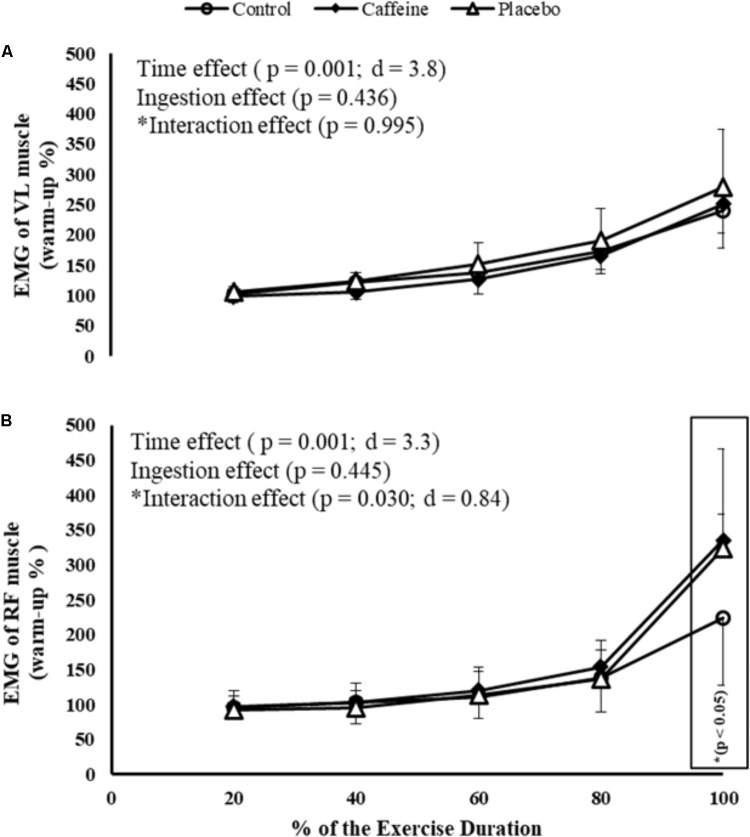
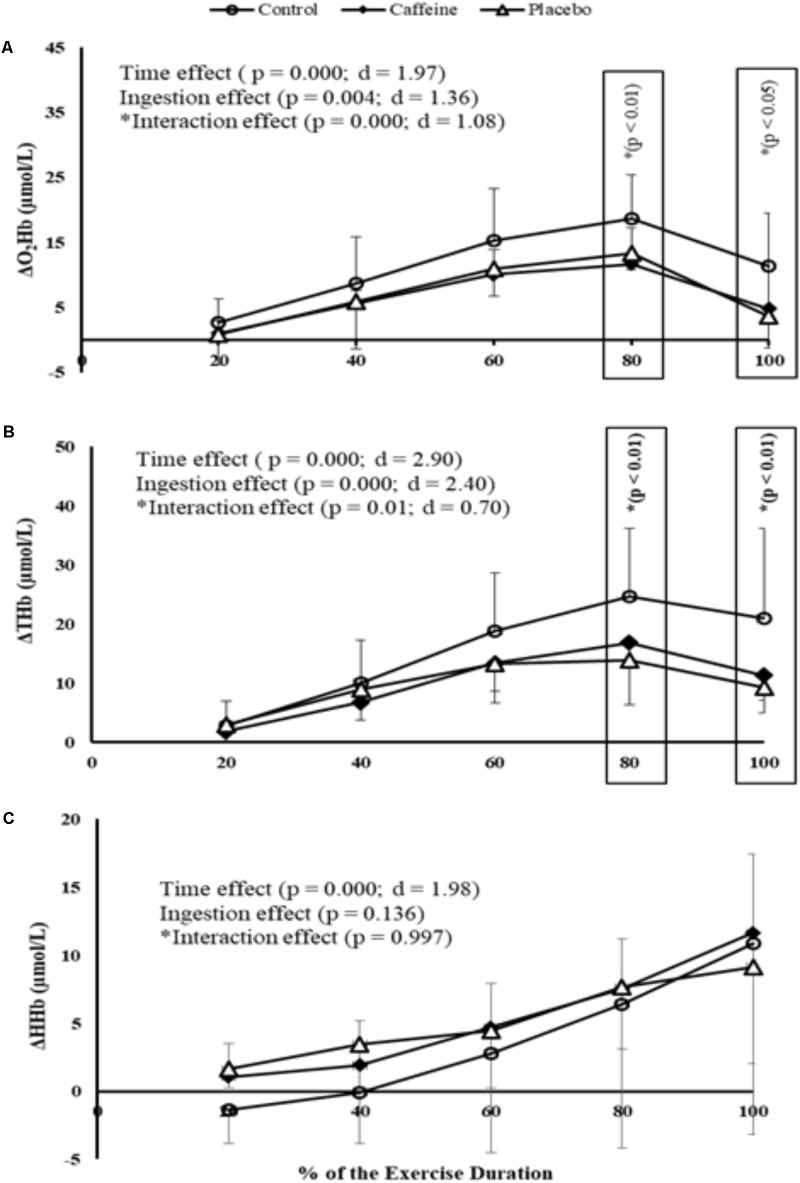
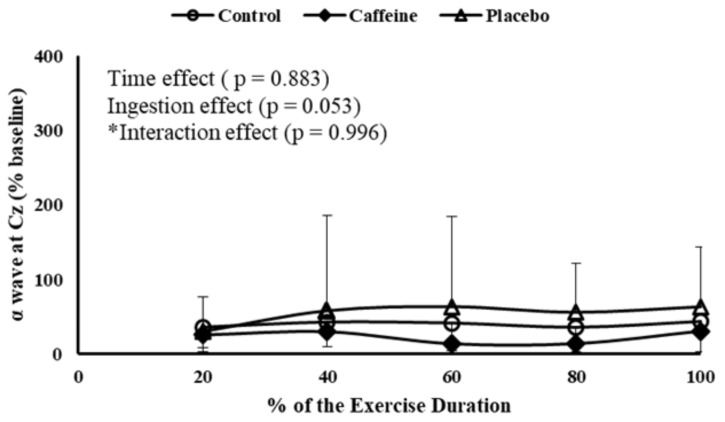
Caffeine (CAF) is an ergogenic aid used to improve exercise performance. Independent studies have suggested that caffeine may have the ability to increase corticospinal excitability, thereby decreasing the motor cortex activation required to generate a similar motor output. However, CAF has also been suggested to induce a prefrontal cortex (PFC) deoxygenation. Others have suggested that placebo (PLA) may trigger comparable effects to CAF, as independent studies found PLA effects on motor performance, corticospinal excitability, and PFC oxygenation. Thus, we investigated if CAF and CAF-perceived PLA may improve motor performance, despite the likely unchanged MC activation and greater PFC deoxygenation. Nine participants (26.4 ± 4.8 years old, VO of 42.2 ± 4.6 mL kg min) performed three maximal incremental tests (MITs) in control (no supplementation) and ∼60 min after CAF and PLA ingestion. PFC oxygenation (near-infrared spectroscopy at Fp1 position), MC activation (EEG at Cz position) and vastus lateralis and rectus femoris muscle activity (EMG) were measured throughout the tests. Compared to control, CAF and PLA increased rectus femoris muscle EMG ( = 0.030; = 2.88; = 0.84) at 100% of the MIT, and enhanced the peak power output ( = 0.006; = 12.97; = 1.8) and time to exhaustion ( = 0.007; = 12.97; = 1.8). In contrast, CAF and PLA did not change MC activation, but increased the PFC deoxygenation as indicated by the lower OHb ( = 0.001; = 4.68; = 1.08) and THb concentrations ( = 0.01; = 1.96; = 0.7) at 80 and 100% the MIT duration. These results showed that CAF and CAF-perceived PLA had the ability to improve motor performance, despite unchanged MC activation and greater PFC deoxygenation. The effectiveness of CAF as ergogenic aid to improve MIT performance was challenged.
咖啡因(CAF)是一种用于提高运动表现的促力剂。独立研究表明,咖啡因可能有能力增加皮质脊髓兴奋性,从而减少产生类似运动输出所需的运动皮层激活。然而,也有人认为咖啡因会导致前额叶皮层(PFC)脱氧。其他人则认为安慰剂(PLA)可能引发与咖啡因相当的效果,因为独立研究发现安慰剂对运动表现、皮质脊髓兴奋性和PFC氧合有影响。因此,我们研究了咖啡因和被认为是咖啡因的安慰剂是否能改善运动表现,尽管运动皮层激活可能未改变且前额叶皮层脱氧程度更高。九名参与者(年龄26.4±4.8岁,VO为42.2±4.6 mL·kg·min)在对照(不补充)以及摄入咖啡因和安慰剂约60分钟后进行了三次最大递增测试(MITs)。在整个测试过程中测量了前额叶皮层氧合(Fp1位置的近红外光谱)、运动皮层激活(Cz位置的脑电图)以及股外侧肌和股直肌的肌肉活动(肌电图)。与对照相比,在MIT的100%时,咖啡因和安慰剂增加了股直肌的肌电图( = 0.030; = 2.88; = 0.84),并提高了峰值功率输出( = 0.006; = 12.97; = 1.8)和疲劳时间( = 0.007; = 12.97; = 1.8)。相比之下,咖啡因和安慰剂并未改变运动皮层激活,但在MIT持续时间的80%和100%时,较低的氧合血红蛋白( = 0.001; = 4.68; = 1.08)和总血红蛋白浓度( = 0.01; = 1.96; = 0.7)表明它们增加了前额叶皮层脱氧。这些结果表明,尽管运动皮层激活未改变且前额叶皮层脱氧程度更高,咖啡因和被认为是咖啡因的安慰剂仍有能力改善运动表现。咖啡因作为提高MIT表现的促力剂的有效性受到了挑战。