Painelli Vitor de Salles, Brietzke Cayque, Franco-Alvarenga Paulo Estevão, Canestri Raul, Vinícius Ítalo, Pires Flávio Oliveira
Exercise Psychophysiology Research Group, School of Arts, Sciences and Humanities, University of São Paulo, São Paulo, Brazil.
Strength Training Study and Research Group, Institute of Health Sciences, Paulista University, São Paulo, Brazil.
SAGE Open Med. 2022 May 13;10:20503121221098120. doi: 10.1177/20503121221098120. eCollection 2022.
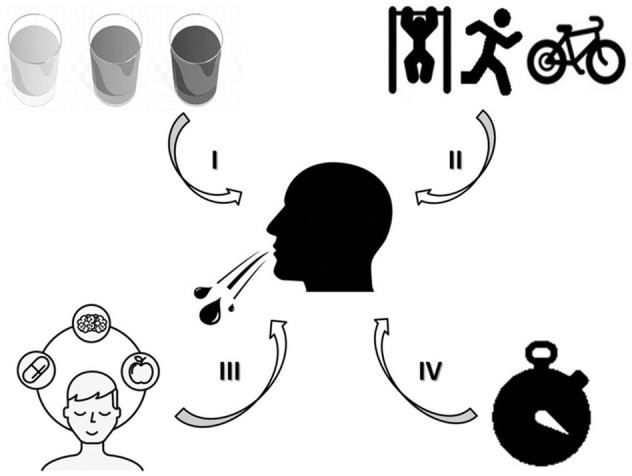
Previous systematic reviews have confirmed that carbohydrate (CHO) mouth rinse may boost physical exercise performance, despite some methodological aspects likely affecting its ergogenic effect. In this review, we discussed if the exercise mode, pre-exercise fasting status, CHO solutions concentration, CHO solutions temperature, mouth rinse duration, and CHO placebo effects may potentially reduce the CHO mouth rinse ergogenic effect, suggesting possible solutions to manage these potential confounders. The effectiveness of CHO mouth rinse as a performance booster is apparently related to the origin of the exercise-induced neuromuscular fatigue, as CHO mouth rinse unequivocally potentiates endurance rather than sprint and strength exercises performance. Furthermore, ergogenic effects have been greater in fasting than fed state, somehow explaining the varied magnitude of the CHO mouth rinse effects in exercise performance. In this regard, the CHO solution concentration and temperature, as well as the mouth rinse duration, may have increased the variability observed in CHO mouth rinse effects in fasting and fed state. Finally, placebo effects have challenged the potential of the CHO mouth rinse as an ergogenic aid. Therefore, we suggest that future studies should consider methodological controls such as sample size and sample homogeneity, proper familiarization with experimental procedures, and the use of alternative placebo designs to provide unbiased evidence regarding the potential of the CHO mouth rinse as an ergogenic aid.
以往的系统评价证实,碳水化合物(CHO)漱口可能会提高体育锻炼表现,尽管某些方法学方面可能会影响其促力效果。在本综述中,我们探讨了运动模式、运动前禁食状态、CHO溶液浓度、CHO溶液温度、漱口持续时间和CHO安慰剂效应是否可能会降低CHO漱口的促力效果,并提出了应对这些潜在混杂因素的可能解决方案。CHO漱口作为一种提高表现的方法,其有效性显然与运动诱导的神经肌肉疲劳的起源有关,因为CHO漱口明确增强了耐力,而非短跑和力量运动的表现。此外,禁食状态下的促力效果大于进食状态,这在一定程度上解释了CHO漱口对运动表现影响程度的差异。在这方面,CHO溶液浓度和温度以及漱口持续时间可能增加了在禁食和进食状态下观察到的CHO漱口效果的变异性。最后,安慰剂效应质疑了CHO漱口作为一种促力辅助手段的潜力。因此,我们建议未来的研究应考虑方法学控制,如样本量和样本同质性、对实验程序的适当熟悉,以及使用替代安慰剂设计,以提供关于CHO漱口作为促力辅助手段潜力的无偏证据。