Laaksonen Marko S, Kyröläinen Heikki, Kemppainen Jukka, Knuuti Juhani, Kalliokoski Kari K
Swedish Winter Sports Research Centre, Department of Health Sciences, Mid Sweden University, Östersund, Sweden.
Neuromuscular Research Centre, Biology of Physical Activity, Faculty of Sport and Health Sciences, University of Jyväskylä, Jyväskylä, Finland.
Front Physiol. 2018 Aug 21;9:1171. doi: 10.3389/fphys.2018.01171. eCollection 2018.
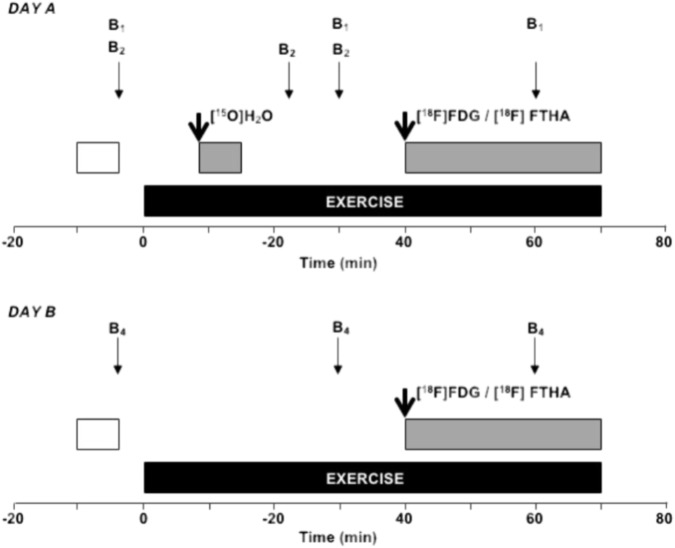
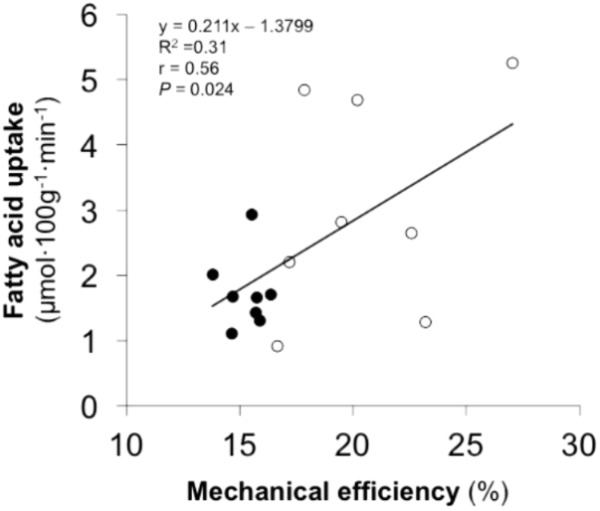
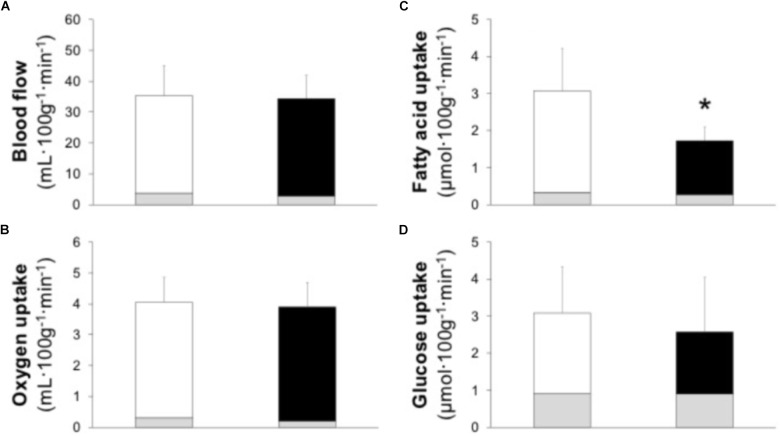
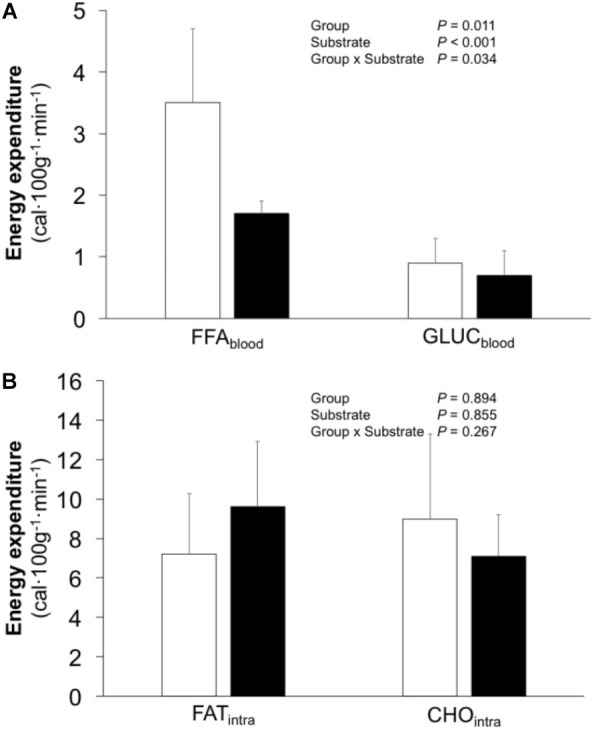
Intrinsic factors related to muscle metabolism may explain the differences in mechanical efficiency (ME) during exercise. Therefore, this study aimed to investigate the relationship between muscle metabolism and ME. Totally 17 healthy recreationally active male participants were recruited and divided into efficient (EF; = 8) and inefficient (IE; = 9) groups, which were matched for age (mean ± SD 24 ± 2 vs. 23 ± 2 years), BMI (23 ± 1 vs. 23 ± 2 kg m), physical activity levels (3.4 ± 1.0 vs. 4.1 ± 1.0 sessions/week), and Opeak (53 ± 3 vs. 52 ± 3 mL kg min), respectively, but differed for ME at 45% of Opeak intensity during submaximal bicycle ergometer test (EF 20.5 ± 3.5 vs. IE 15.4 ± 0.8%, < 0.001). Using positron emission tomography, muscle blood flow (BF) and uptakes of oxygen (m O), fatty acids (FAU) and glucose (GU) were measured during dynamic submaximal knee-extension exercise. Workload-normalized BF (EF 35 ± 14 vs. IE 34 ± 11 mL 100 g min, = 0.896), m O (EF 4.1 ± 1.2 vs. IE 3.9 ± 1.2 mL 100 g min, = 0.808), and GU (EF 3.1 ± 1.8 vs. IE 2.6 ± 2.3 μmol 100 g min, = 0.641) as well as the delivery of oxygen, glucose, and FAU, as well as respiratory quotient were not different between the groups. However, FAU was significantly higher in EF than IE (3.1 ± 1.7 vs. 1.7 ± 0.6 μmol 100 g min, = 0.047) and it also correlated with ME ( = 0.56, = 0.024) in the entire study group. EF group also demonstrated higher use of plasma FAU than IE, but no differences in use of plasma glucose and intramuscular energy sources were observed between the groups. These findings suggest that the effective use of plasma FAU is an important determinant of ME during exercise.
与肌肉代谢相关的内在因素可能解释运动期间机械效率(ME)的差异。因此,本研究旨在调查肌肉代谢与ME之间的关系。共招募了17名健康的、有休闲运动习惯的男性参与者,并将其分为高效组(EF;n = 8)和低效组(IE;n = 9),两组在年龄(平均±标准差24±2岁 vs. 23±2岁)、体重指数(23±1 vs. 23±2 kg/m²)、身体活动水平(3.4±1.0 vs. 4.1±1.0次/周)和峰值摄氧量(VO₂peak;53±3 vs. 52±3 mL/kg/min)方面相匹配,但在次极量自行车测力计测试中,在VO₂peak强度的45%时ME不同(EF 20.5±3.5 vs. IE 15.4±0.8%,P<0.001)。使用正电子发射断层扫描,在动态次极量膝关节伸展运动期间测量肌肉血流量(BF)以及氧气(mVO₂)、脂肪酸(FAU)和葡萄糖(GU)的摄取量。两组之间工作负荷标准化的BF(EF 35±14 vs. IE 34±11 mL/100g/min,P = 0.896)、mVO₂(EF 4.1±1.2 vs. IE 3.9±1.2 mL/100g/min,P = 0.808)和GU(EF 3.1±1.8 vs. IE 2.6±2.3 μmol/100g/min,P = 0.641)以及氧气、葡萄糖和FAU的输送以及呼吸商均无差异。然而,EF组的FAU显著高于IE组(3.1±1.7 vs. 1.7±0.6 μmol/100g/min,P = 0.047),并且在整个研究组中FAU也与ME相关(r = 0.56,P = 0.024)。EF组血浆FAU的利用率也高于IE组,但两组之间血浆葡萄糖和肌肉内能量来源的利用率没有差异。这些发现表明,运动期间血浆FAU的有效利用是ME的一个重要决定因素。