College of Medicine and Public Health, Flinders University, Adelaide 5000, Australia.
Faculty of Health Sciences, School of Public Health, Curtin University, Perth 6102, Australia.
Int J Environ Res Public Health. 2018 Sep 21;15(10):2086. doi: 10.3390/ijerph15102086.
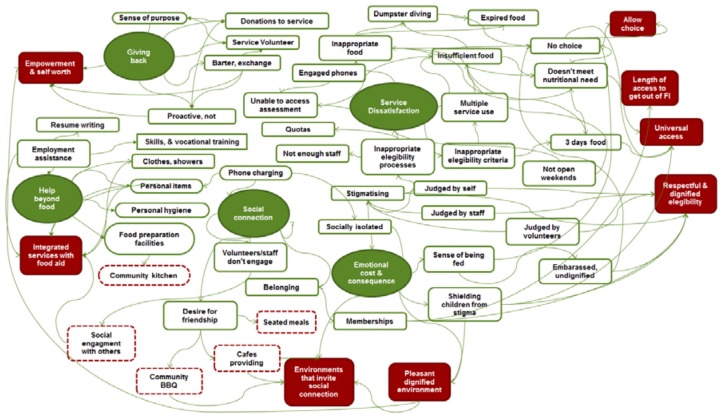
South Australian (SA) food charity recipients' perspectives were sought on existing services and ideas for improvement of food assistance models to address food insecurity. Seven focus groups were conducted between October and November 2017 with 54 adults. Thematically analysed data revealed five themes: (1) Emotional cost and consequences of seeking food relief; (2) Dissatisfaction with inaccessible services and inappropriate food; (3) Returning the favour-a desire for reciprocity; (4) Desiring help beyond food; and, (5) "It's a social thing", the desire for social interaction and connection. Findings revealed that some aspects of the SA food assistance services were disempowering for recipients. Recipients desired more empowering forms of food assistance that humanise their experience and shift the locus of control and place power back into their hands. Some traditional models, such as provision of supermarket vouchers, empower individuals by fostering autonomy and enabling food choice in socially acceptable ways. Improvement in the quality of existing food assistance models, should focus on recipient informed models which re-dress existing power relations. Services which are more strongly aligned with typical features of social enterprise models were generally favoured over traditional models. Services which are recipient-centred, strive to empower recipients and provide opportunities for active involvement, social connection and broader support were preferred.
南澳大利亚(SA)食品慈善机构的受助者对现有的服务提出了意见,并提出了改进食品援助模式以解决粮食不安全问题的想法。2017 年 10 月至 11 月期间,对 54 名成年人进行了 7 次焦点小组讨论。对主题分析的数据显示了五个主题:(1)寻求食品救济的情感成本和后果;(2)对难以获得的服务和不适当的食品不满;(3)回报恩惠——互惠的愿望;(4)渴望得到食物以外的帮助;(5)“这是一件社交的事情”,渴望社交互动和联系。调查结果显示,南澳大利亚食品援助服务的某些方面使受助者失去了权力。受助者希望获得更赋权的食品援助形式,这些形式可以人性化他们的体验,并转移控制中心,将权力重新掌握在他们手中。一些传统模式,如提供超市代金券,可以通过培养自主性和以社会可接受的方式促进食物选择来赋予个人权力。改善现有的食品援助模式的质量,应侧重于受助者知情的模式,以纠正现有的权力关系。与社会企业模式的典型特征更紧密结合的服务通常比传统模式更受欢迎。以受助者为中心的服务,努力赋予受助者权力,并为他们提供积极参与、社会联系和更广泛支持的机会。