Preiner Martina, Xavier Joana C, Sousa Filipa L, Zimorski Verena, Neubeck Anna, Lang Susan Q, Greenwell H Chris, Kleinermanns Karl, Tüysüz Harun, McCollom Tom M, Holm Nils G, Martin William F
Institute of Molecular Evolution, University of Düsseldorf, 40225 Düsseldorf, Germany.
Division of Archaea Biology and Ecogenomics, Department of Ecogenomics and Systems Biology, University of Vienna, Althanstrasse 14 UZA I, 1090 Vienna, Austria.
Life (Basel). 2018 Sep 22;8(4):41. doi: 10.3390/life8040041.
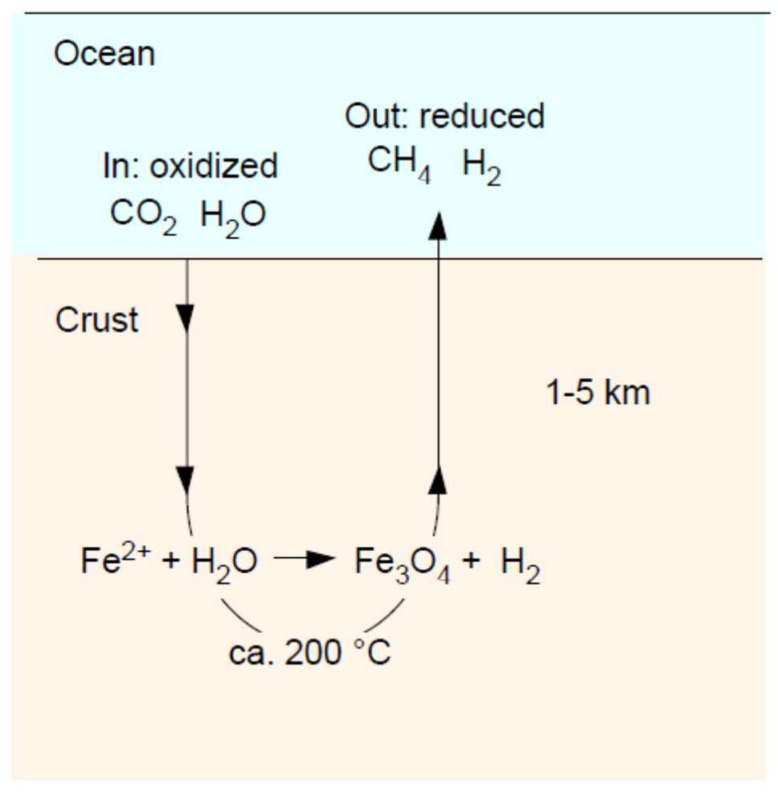
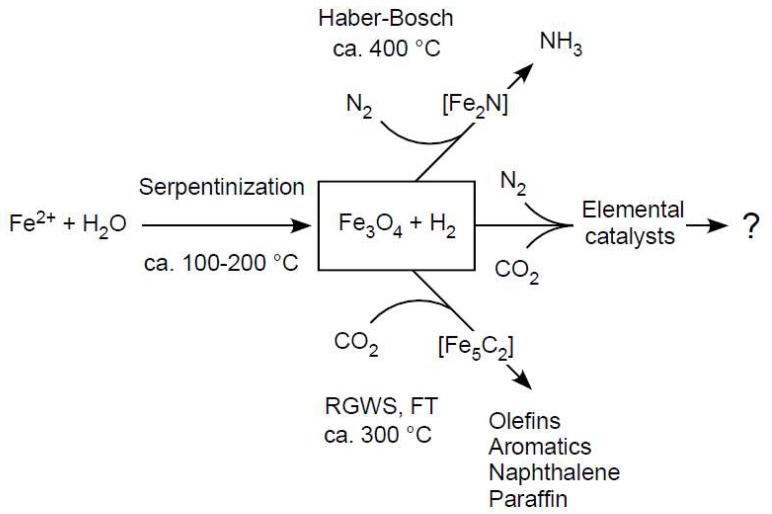
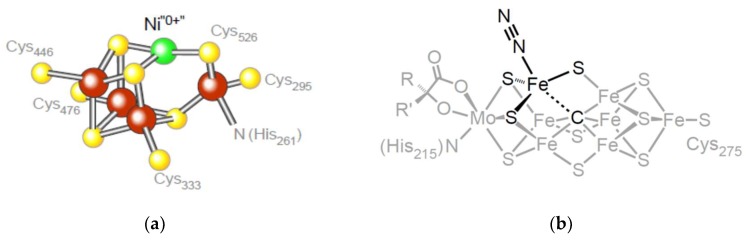
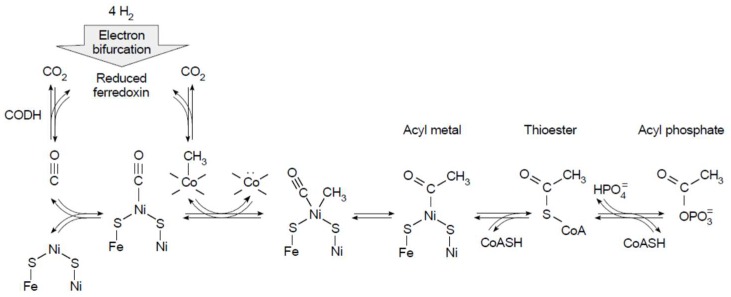
Rock⁻water⁻carbon interactions germane to serpentinization in hydrothermal vents have occurred for over 4 billion years, ever since there was liquid water on Earth. Serpentinization converts iron(II) containing minerals and water to magnetite (Fe₃O₄) plus H₂. The hydrogen can generate native metals such as awaruite (Ni₃Fe), a common serpentinization product. Awaruite catalyzes the synthesis of methane from H₂ and CO₂ under hydrothermal conditions. Native iron and nickel catalyze the synthesis of formate, methanol, acetate, and pyruvate-intermediates of the acetyl-CoA pathway, the most ancient pathway of CO₂ fixation. Carbon monoxide dehydrogenase (CODH) is central to the pathway and employs Ni⁰ in its catalytic mechanism. CODH has been conserved during 4 billion years of evolution as a relic of the natural CO₂-reducing catalyst at the onset of biochemistry. The carbide-containing active site of nitrogenase-the only enzyme on Earth that reduces N₂-is probably also a relic, a biological reconstruction of the naturally occurring inorganic catalyst that generated primordial organic nitrogen. Serpentinization generates Fe₃O₄ and H₂, the catalyst and reductant for industrial CO₂ hydrogenation and for N₂ reduction via the Haber⁻Bosch process. In both industrial processes, an Fe₃O₄ catalyst is matured via H₂-dependent reduction to generate Fe₅C₂ and Fe₂N respectively. Whether serpentinization entails similar catalyst maturation is not known. We suggest that at the onset of life, essential reactions leading to reduced carbon and reduced nitrogen occurred with catalysts that were synthesized during the serpentinization process, connecting the chemistry of life and Earth to industrial chemistry in unexpected ways.
自地球上出现液态水以来,与热液喷口蛇纹石化相关的岩石⁻水⁻碳相互作用已经发生了超过40亿年。蛇纹石化将含铁(II)的矿物和水转化为磁铁矿(Fe₃O₄)和H₂。氢气可以生成天然金属,如镍铁陨石(Ni₃Fe),这是一种常见的蛇纹石化产物。镍铁陨石在热液条件下催化由H₂和CO₂合成甲烷。天然铁和镍催化乙酰辅酶A途径(最古老的CO₂固定途径)的甲酸、甲醇、乙酸和丙酮酸中间体的合成。一氧化碳脱氢酶(CODH)是该途径的核心,其催化机制中使用Ni⁰。在40亿年的进化过程中,CODH作为生物化学起源时天然CO₂还原催化剂的遗迹而被保留下来。固氮酶(地球上唯一能还原N₂的酶)含碳化物的活性位点可能也是一种遗迹,是对产生原始有机氮的天然无机催化剂的生物学重构。蛇纹石化产生Fe₃O₄和H₂,它们分别是工业CO₂加氢和通过哈伯⁻博施法还原N₂的催化剂和还原剂。在这两种工业过程中,Fe₃O₄催化剂通过依赖H₂的还原而成熟,分别生成Fe₅C₂和Fe₂N。蛇纹石化是否需要类似的催化剂成熟过程尚不清楚。我们认为,在生命起源时,导致碳还原和氮还原的关键反应是由蛇纹石化过程中合成的催化剂发生的,这以意想不到的方式将生命化学和地球化学与工业化学联系起来。