Department of Chemical Sciences, University of Napoli "Federico II" Via Cintia, 80126 Napoli, Italy.
Istituto di Biostrutture e Bioimmagini, CNR, Via Mezzocannone 16, 80134 Napoli, Italy.
Int J Mol Sci. 2018 Sep 24;19(10):2896. doi: 10.3390/ijms19102896.
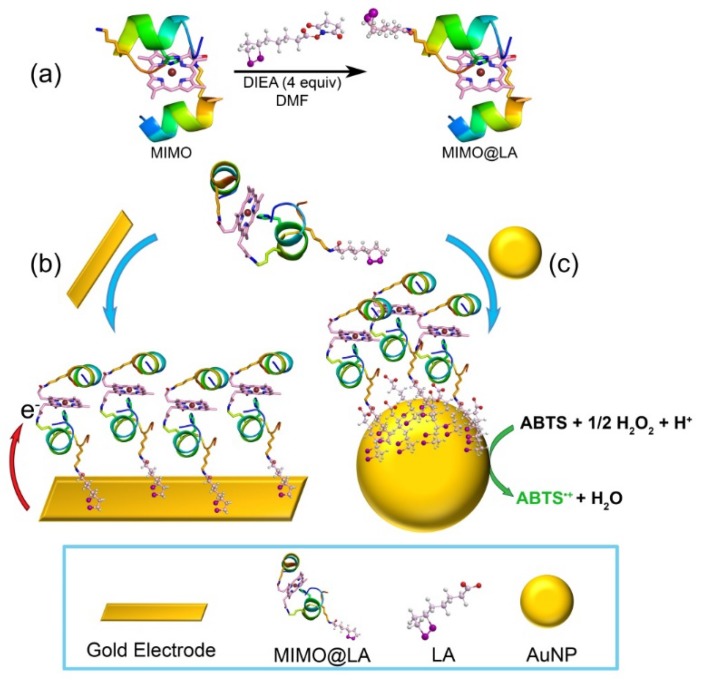
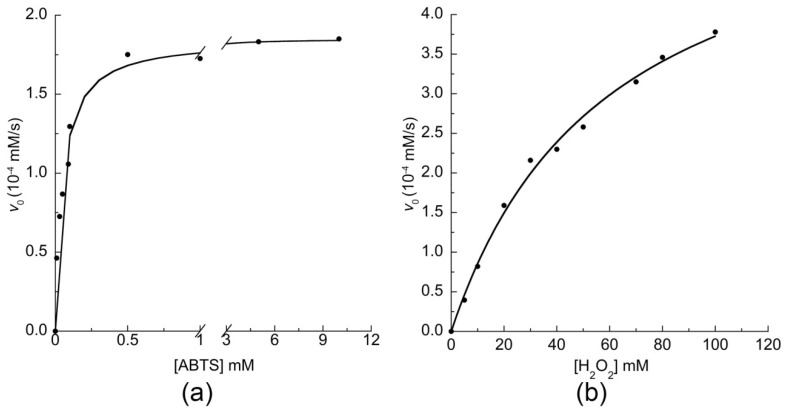
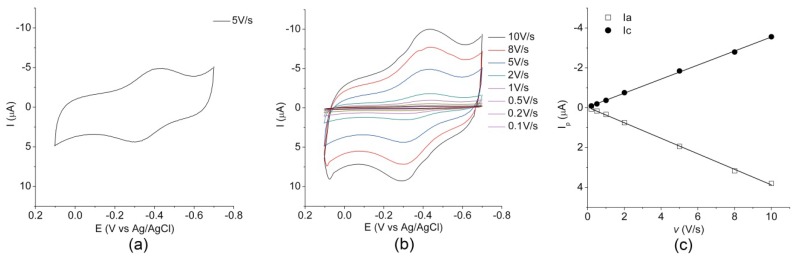
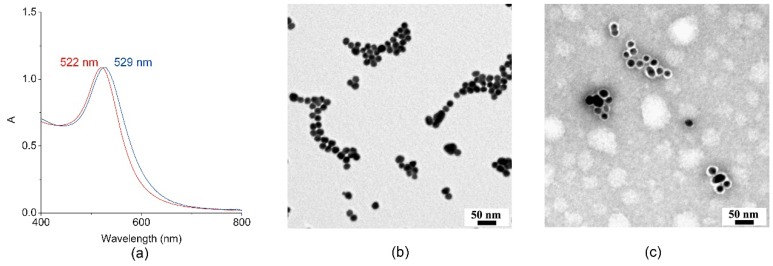
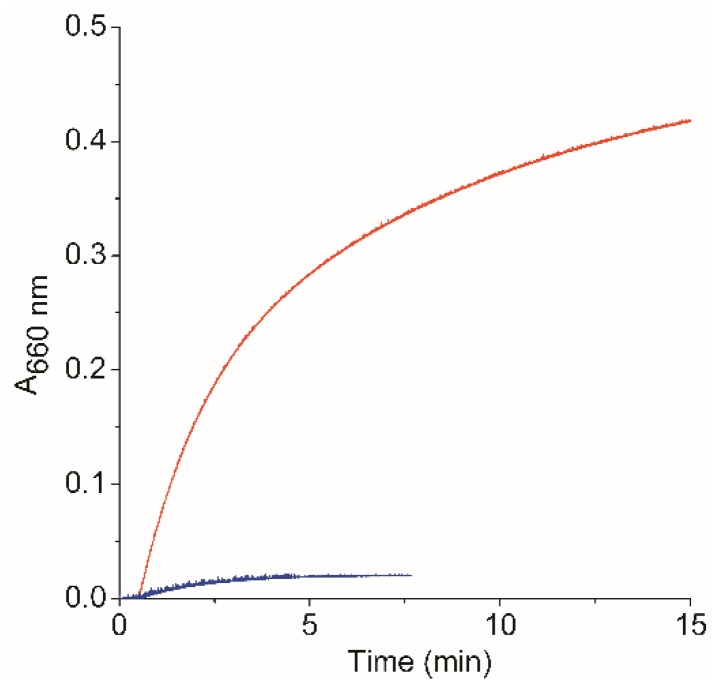
Many efforts are continuously devoted to the construction of hybrid biomaterials for specific applications, by immobilizing enzymes on different types of surfaces and/or nanomaterials. In addition, advances in computational, molecular and structural biology have led to a variety of strategies for designing and engineering artificial enzymes with defined catalytic properties. Here, we report the conjugation of an artificial heme enzyme (MIMO) with lipoic acid (LA) as a building block for the development of gold-based biomaterials. We show that the artificial MIMO@LA can be successfully conjugated to gold nanoparticles or immobilized onto gold electrode surfaces, displaying quasi-reversible redox properties and peroxidase activity. The results of this work open interesting perspectives toward the development of new totally-synthetic catalytic biomaterials for application in biotechnology and biomedicine, expanding the range of the biomolecular component aside from traditional native enzymes.
许多研究致力于通过将酶固定在不同类型的表面和/或纳米材料上来构建用于特定应用的杂化生物材料。此外,计算、分子和结构生物学的进步已经产生了各种设计和工程具有定义催化特性的人工酶的策略。在这里,我们报告了将人工血红素酶(MIMO)与作为开发基于金的生物材料的构建块的硫辛酸(LA)缀合。我们表明,人工 MIMO@LA 可以成功地与金纳米粒子缀合或固定在金电极表面上,显示出准可逆氧化还原性质和过氧化物酶活性。这项工作的结果为开发用于生物技术和生物医学的新型全合成催化生物材料开辟了有趣的前景,除了传统的天然酶之外,还扩展了生物分子成分的范围。