Division of Immunology, Transplantation and Infectious Diseases, San Raffaele Scientific Institute, Milano, Italy.
Institute Curie Laboratoire Immunité et Cancer - INSERM U932, 26 rue d'Ulm, 75248, Paris cedex 05, Paris, France.
Sci Rep. 2018 Sep 24;8(1):14249. doi: 10.1038/s41598-018-32451-w.
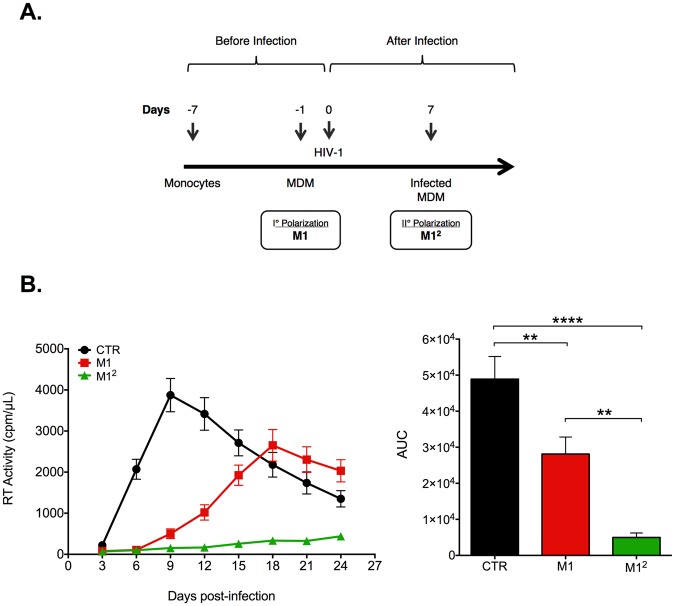
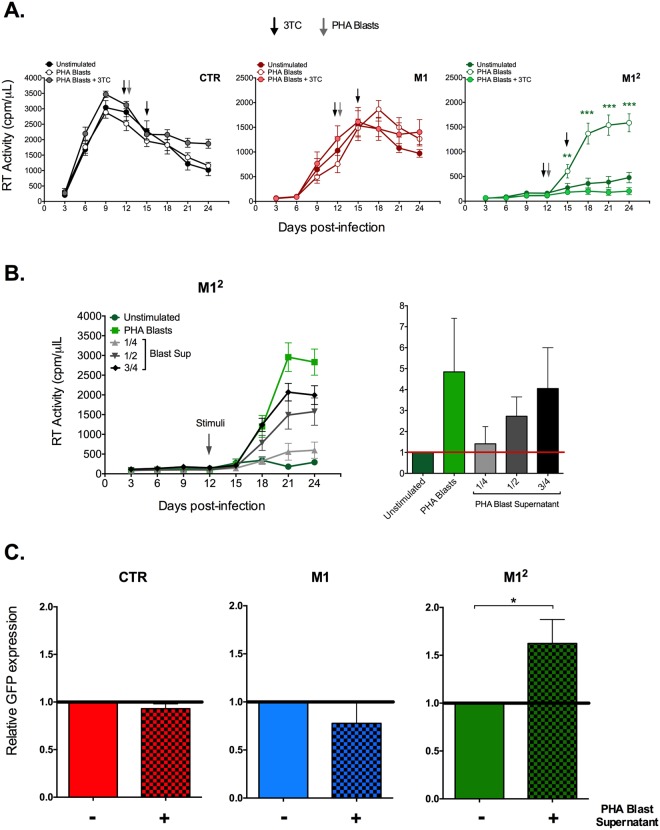
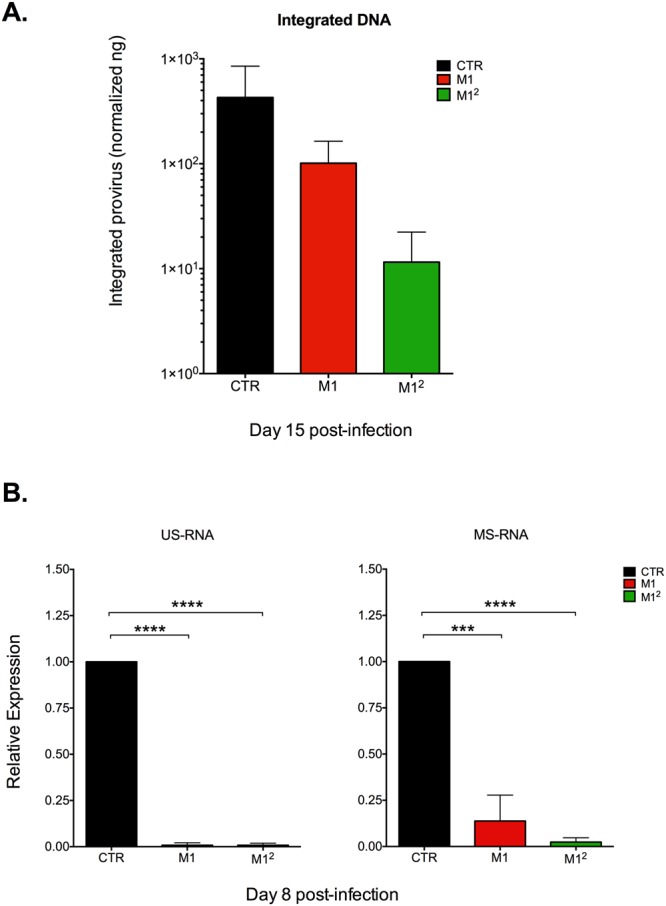
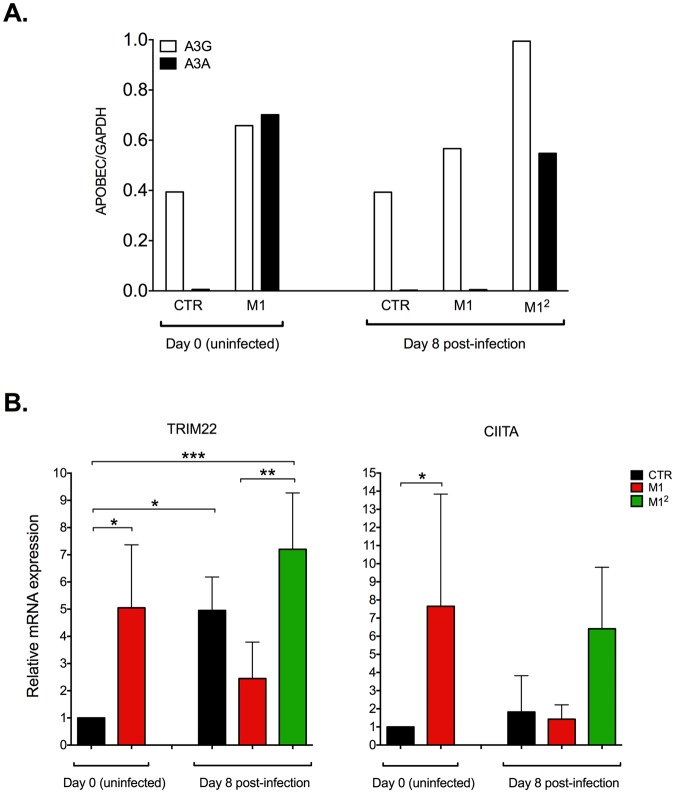
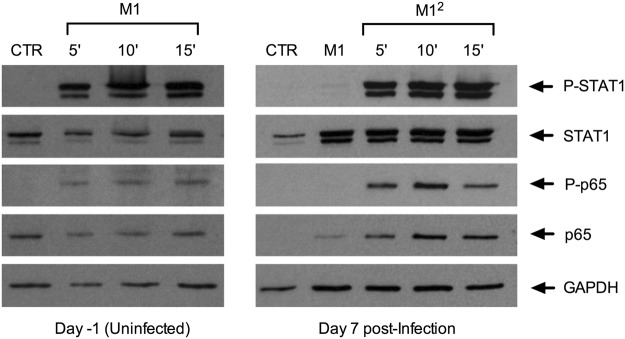
We have reported that short-term stimulation of primary human monocyte-derived macrophages (MDM) with interferon-γ (IFN-γ) and tumor necrosis factor-α (TNF-α), i.e. M1 polarization, leads to a significant containment of virus replication. Here we show that M1-MDM restimulation with these cytokines 7 days after infection (M1 MDM) promoted an increased restriction of HIV-1 replication characterized by very low levels of virus production near to undetectable levels. In comparison to control and M1-MDM that were not restimulated, M1 MDM showed a stronger reduction of both total and integrated HIV DNA as well as of viral mRNA expression. M1 MDM were characterized by an upregulated expression of restriction factors acting at the level of reverse transcription (RT), including apolipoprotein B mRNA editing enzyme, catalytic polypeptide-like 3A (APOBEC3A) and APOBEC3G, but not SAM domain and HD domain-containing protein 1 (SAMHD1). M1 MDM also showed an increased expression of Class II Transactivator (CIITA) and Tripartite Motif22 (TRIM22), two negative regulators of proviral transcription, whereas expression and phosphorylation of transcriptional inducers of HIV-1, such as nuclear factor kB (NF-kB) and signal transducer and activator of transcription 1 (STAT1), were not impaired in these cells. The almost quiescent state of the infection in M1 MDM was promptly reversed by coculture with mitogen-stimulated leukocytes or cell incubation with their filtered culture supernatant. M1 MDM harbored replication-competent HIV-1 as virus spreading following cell stimulation was fully prevented by the RT inhibitor lamivudine/3TC. Selective reactivation of proviral expression in M1 MDM, but not in control or in M1-MDM that were not restimulated, was confirmed in cells infected with single round Vesicular Stomatitis Virus-G-pseudotyped HIV-1. Thus, M1 MDM represent an in vitro model of reversible, almost quiescent HIV-1 infection of primary human macrophages that could be further exploited for "Cure" related investigations.
我们曾报道,用干扰素-γ(IFN-γ)和肿瘤坏死因子-α(TNF-α)短期刺激原代人单核细胞衍生的巨噬细胞(MDM),即 M1 极化,可显著抑制病毒复制。在这里,我们发现感染后第 7 天用这些细胞因子再刺激 M1-MDM(M1 MDM)可增强对 HIV-1 复制的限制,其特征是病毒产量极低,接近无法检测的水平。与未受刺激的对照和 M1-MDM 相比,M1 MDM 表现出总 HIV DNA 和整合 HIV DNA 以及病毒 mRNA 表达的更强减少。M1 MDM 的特征是逆转录(RT)水平上作用的限制因子表达上调,包括载脂蛋白 B mRNA 编辑酶、催化多肽样 3A(APOBEC3A)和 APOBEC3G,但不包括 SAM 结构域和 HD 结构域蛋白 1(SAMHD1)。M1 MDM 还表现出 II 类转录激活物(CIITA)和三肽基重复蛋白 22(TRIM22)的表达增加,这两种是前病毒转录的负调节剂,而 HIV-1 的转录诱导物,如核因子 kB(NF-kB)和信号转导和转录激活物 1(STAT1)的表达和磷酸化在这些细胞中并未受损。在 M1 MDM 中,感染几乎处于静止状态,通过与有丝分裂原刺激的白细胞共培养或用其过滤培养上清孵育细胞,可迅速逆转这种状态。M1 MDM 携带复制能力的 HIV-1,因为在细胞刺激后病毒传播被 RT 抑制剂拉米夫定/3TC 完全阻止。在感染单轮水疱性口炎病毒-G 假型 HIV-1 的细胞中,确认了 M1 MDM 中前病毒表达的选择性再激活,而对照或未受刺激的 M1-MDM 则没有。因此,M1 MDM 代表一种可逆转的、几乎静止的原发性人巨噬细胞中 HIV-1 感染的体外模型,可进一步用于“治愈”相关研究。