Division of Hematology, Department of Internal Medicine, Department of General Medicine, Juntendo University Nerima Hospital, 3-1-10 Nerima, Takanodai, Nerima-ku, Tokyo, Japan.
Laboratory of Cell Biology, Research Support Center, Juntendo University Graduate School of Medicine, 2-1-1 Hongo, Bunkyo-ku, Tokyo, Japan.
Sci Rep. 2018 Sep 24;8(1):14237. doi: 10.1038/s41598-018-32200-z.
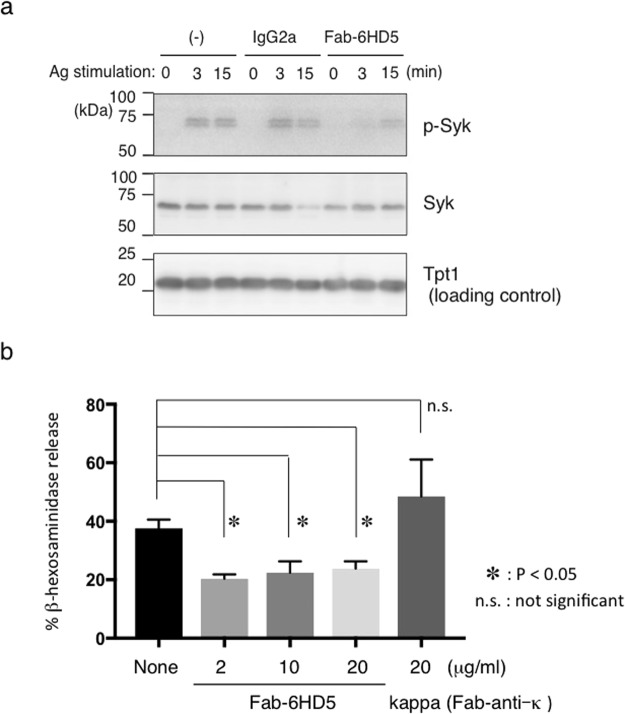
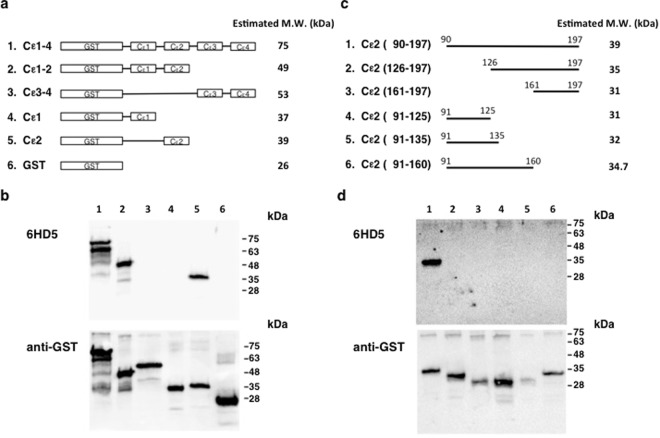
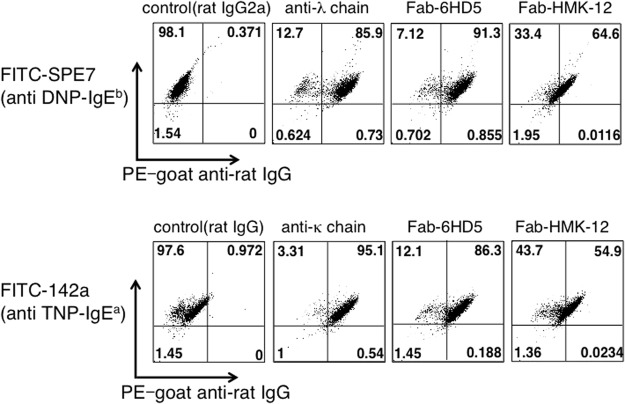
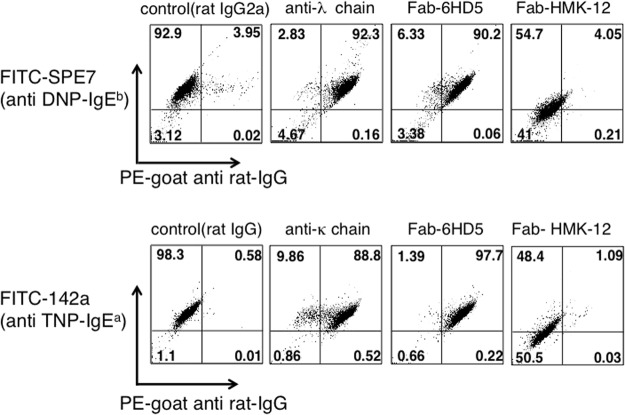
Immunoglobulin E (IgE) plays a central role in the pathogenesis of Type I hypersensitivity through interaction with a high-affinity receptor (FcεRIα). For therapeutic applications, substantial attention has been focused recently on the blockade of the IgE interaction with FcεRIα. While exploring better options for preventing allergic diseases, we found that the Fab fragment of the rat anti-murine IgE antibody (Fab-6HD5) strongly inhibited passive cutaneous anaphylaxis (PCA) in vivo, as well as spleen tyrosine kinase (Syk) activity and β-hexosaminidase release from basophilic leukemia cells in vitro. The in vivo effects of Fab-6HD5 pre-administration were maintained over a long period of time for at least 10 days. Using flow cytometry analysis, we also found that Fab-6HD5 did not recognize the IgE Cε3 domain containing specific binding sites for FcεRIα. Furthermore, deletion-mapping studies revealed that Fab-6HD5 recognized conformational epitopes on the Cε2 domain of IgE. Given that the Cε2 domain plays a key role in stabilizing the interaction of IgE with FcRIα, our results suggest that the specific binding of Fab-6HD5 to the Cε2 domain prevents allergic reactions through destabilizing the preformed IgE-FcεRIα complex on rat mast cells. Although the present study was performed using animal models, these findings support the idea that a certain antibody directed against IgE CH domains may contribute to preventing allergic diseases through interacting with IgE-FcεRIα complex.
免疫球蛋白 E(IgE)通过与高亲和力受体(FcεRIα)相互作用,在 I 型超敏反应的发病机制中发挥核心作用。为了治疗应用,最近人们对阻断 IgE 与 FcεRIα 的相互作用给予了极大的关注。在探索预防过敏性疾病的更好方法时,我们发现抗鼠 IgE 抗体的 Fab 片段(Fab-6HD5)强烈抑制体内被动皮肤过敏反应(PCA),以及体外嗜碱性白血病细胞中的脾酪氨酸激酶(Syk)活性和β-己糖胺酶释放。Fab-6HD5 预先给药的体内作用至少维持 10 天的长时间。通过流式细胞术分析,我们还发现 Fab-6HD5 不识别 IgE Cε3 结构域,该结构域包含与 FcεRIα 特异性结合的位点。此外,缺失作图研究表明,Fab-6HD5 识别 IgE 的 Cε2 结构域上的构象表位。鉴于 Cε2 结构域在稳定 IgE 与 FcRIα 的相互作用中起关键作用,我们的结果表明 Fab-6HD5 与 Cε2 结构域的特异性结合通过使预先形成的 IgE-FcεRIα 复合物失稳来防止过敏反应。尽管本研究使用动物模型进行,但这些发现支持这样一种观点,即针对 IgE CH 结构域的特定抗体可能通过与 IgE-FcεRIα 复合物相互作用有助于预防过敏性疾病。