Section on Analytical and Functional Biophotonics, National Institute of Child Health and Human Development, National Institutes of Health, Bethesda, Maryland.
Department of Computer Science and Electrical Engineering, University of Maryland Baltimore County, Baltimore, Maryland.
Brain Behav. 2018 Nov;8(11):e01116. doi: 10.1002/brb3.1116. Epub 2018 Sep 25.
Understanding the neural basis of moral judgment (MJ) and human decision-making has been the subject of numerous studies because of their impact on daily life activities and social norms. Here, we aimed to investigate the neural process of MJ using functional near-infrared spectroscopy (fNIRS), a noninvasive, portable, and affordable neuroimaging modality.
We examined prefrontal cortex (PFC) activation in 33 healthy participants engaging in MJ exercises. We hypothesized that participants presented with personal (emotionally salient) and impersonal (less emotional) dilemmas would exhibit different brain activation observable through fNIRS. We also investigated the effects of utilitarian and nonutilitarian responses to MJ scenarios on PFC activation. Utilitarian responses are those that favor the greatest good while nonutilitarian responses favor moral actions. Mixed effect models were applied to model the cerebral hemodynamic changes that occurred during MJ dilemmas.
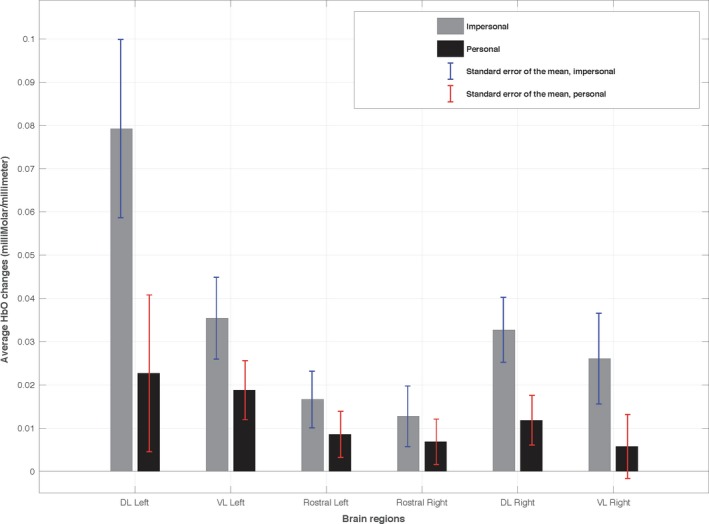
Our analysis found significant differences in PFC activation during personal versus impersonal dilemmas. Specifically, the left dorsolateral PFC was highly activated during impersonal MJ when a nonutilitarian decision was made. This is consistent with the majority of relevant fMRI studies, and demonstrates the feasibility of using fNIRS, with its portable and motion tolerant capacities, to investigate the neural basis of MJ dilemmas.
理解道德判断(MJ)和人类决策的神经基础是众多研究的主题,因为它们会影响日常生活活动和社会规范。在这里,我们旨在使用功能近红外光谱(fNIRS)研究 MJ 的神经过程,fNIRS 是一种非侵入性、便携式且经济实惠的神经影像学模式。
我们检查了 33 名健康参与者在进行 MJ 练习时的前额叶皮层(PFC)激活情况。我们假设参与者在面对个人(情感上显著)和非个人(较少情感)困境时,会表现出通过 fNIRS 观察到的不同大脑激活。我们还研究了功利和非功利对 MJ 场景的反应对 PFC 激活的影响。功利反应是指有利于最大利益的反应,而非功利反应则有利于道德行为。混合效应模型被应用于建模在 MJ 困境中发生的大脑血液动力学变化。
我们的分析发现,在个人与非个人困境中,PFC 的激活存在显著差异。具体来说,在做出非功利决策时,非个人 MJ 期间左背外侧 PFC 高度激活。这与大多数相关的 fMRI 研究一致,并证明了使用 fNIRS 的可行性,fNIRS 具有便携式和耐受运动的能力,可以研究 MJ 困境的神经基础。