National Engineering Research Center of Marine Facilities Aquaculture, Marine Science and Technology College, Zhejiang Ocean University, Zhoushan, 316004, China.
Key Laboratory of Sustainable Utilization of Technology Research, Marine Fisheries Research Institute of Zhejiang, Zhejiang, Zhoushan, 316021, China.
Sci Rep. 2018 Sep 25;8(1):14353. doi: 10.1038/s41598-018-32771-x.
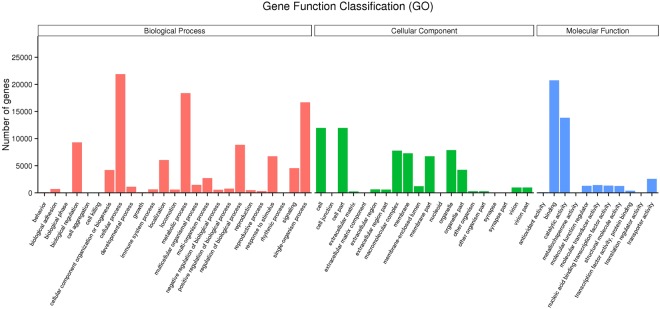
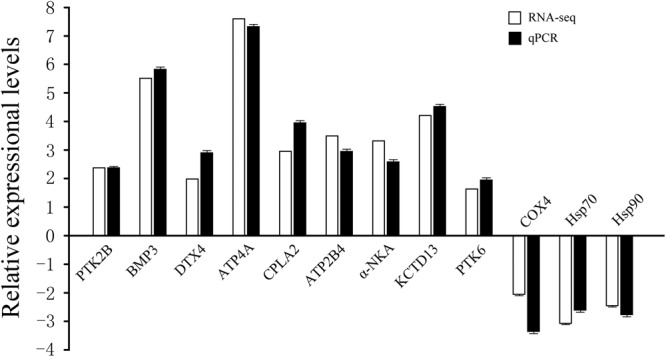
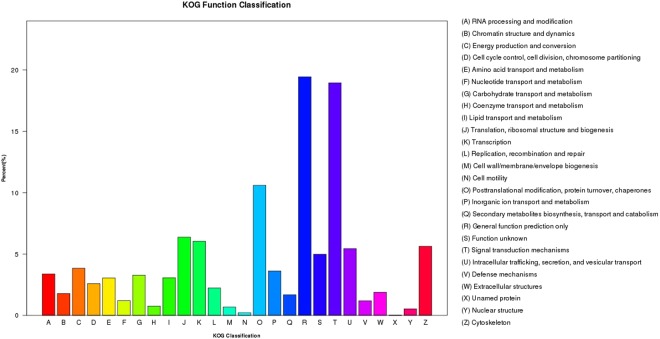
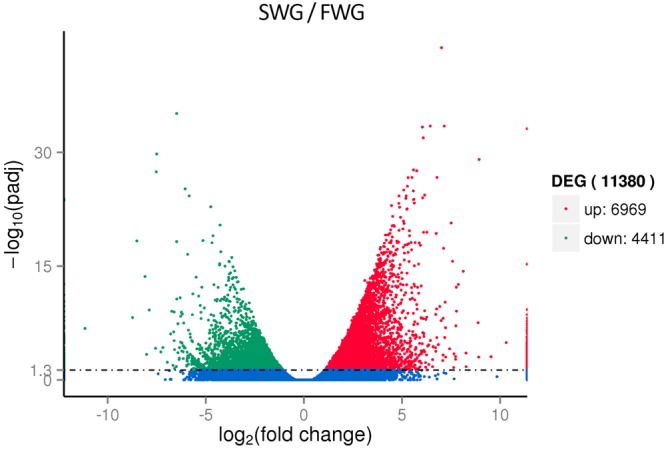
Sturgeons are euryhaline fish species that have developed specific mechanisms of osmotic and ion regulation to adapt to waters of varying salinity. For the aim to elucidate the osmoregulation strategy behind its high salinity tolerance of sturgeons, the transcriptomes of gills in Siberian sturgeon Acipenser baeri under salinity stress (30 ppt) were sequenced using deep-sequencing platform Illumina/HiSeq-2500 and differential expression genes (DEGs) were identified. A total of 167, 501, 278 clean reads were obtained and 280, 238 unigenes were composed of those clean reads with the mean length of 520nt, and the N50 of 630 bp. Unigenes Sequence alignment was implemented via KEGG, KOG, NT, NR, PFAM, Swiss-Prot, and GO databases. 62, 242 unigenes (22.21%) were annoated in at least one database. 11380 significantly differentially expressed unigenes were found, 6969 of which were up-regulated and 4411 were down-regulated by salinity stress. Amongst the top 20 KEGG pathways with the most amount of annotation sequences, some pathways such as glycerophospholipid metabolism, fatty-acid biosynthesis, glycolysis/gluconeogenesis, oxidative phosphorylation have been comprehensively proved to be relevant to osmoregulation. Despite of these, three possible osmoregulation-related signaling pathways as lipid metabolism related pathways, tight junction pathway and thyroid hormone signaling pathway have been widely analyzed in the current study. In all DEGs, some of the typical genes involved in osmoregulation, including calcium-transporting ATPase 4 (ATP2B4), Na/K-ATPase alpha subunit (α-NKA), potassium-transporting ATPase alpha chain 1 (ATP4A) and Ras GTPase-activating protein (RasGAP) etc were also identified. RNA-seq results were validated with quantitative real-time PCR (qPCR), the 12 selected genes showed a consistent direction in both DGE library and qPCR analysis, proving that the RNA-seq results are reliable. The present results would be helpful to elucidate the osmoregulation mechanism of aquatic animals adapting to salinity challenge.
鲟鱼是一种广盐性鱼类,它们已经发展出了特定的渗透和离子调节机制,以适应不同盐度的水域。为了阐明鲟鱼对高盐度耐受性的渗透压调节策略,我们使用高通量测序平台 Illumina/HiSeq-2500 对西伯利亚鲟(Acipenser baeri)鳃组织在盐胁迫(30 ppt)下的转录组进行了测序,并鉴定了差异表达基因(DEGs)。共获得 167501278 条清洁reads,由这些清洁reads 组成的 280238 条 unigenes 的平均长度为 520nt,N50 为 630bp。通过 KEGG、KOG、NT、NR、PFAM、Swiss-Prot 和 GO 数据库对 unigenes 序列进行比对。在至少一个数据库中注释的 unigenes 有 62242 个(22.21%)。发现 11380 个显著差异表达的 unigenes,其中 6969 个受盐胁迫上调,4411 个受盐胁迫下调。在注释序列数量最多的前 20 个 KEGG 途径中,一些途径,如甘油磷脂代谢、脂肪酸生物合成、糖酵解/糖异生、氧化磷酸化,已被广泛证明与渗透压调节有关。尽管如此,本研究还广泛分析了三种可能与渗透压调节相关的信号通路,如脂质代谢相关通路、紧密连接通路和甲状腺激素信号通路。在所有 DEGs 中,一些参与渗透压调节的典型基因,如钙转运 ATP 酶 4(ATP2B4)、Na/K-ATPase α 亚基(α-NKA)、钾转运 ATP 酶 α 链 1(ATP4A)和 Ras GTP 酶激活蛋白(RasGAP)等也被鉴定出来。RNA-seq 结果用定量实时 PCR(qPCR)进行验证,在 DGE 文库和 qPCR 分析中,12 个选定的基因均表现出一致的方向,证明了 RNA-seq 结果是可靠的。本研究结果有助于阐明水生动物适应盐度挑战的渗透压调节机制。