
油酰乙醇胺和棕榈酰乙醇胺可保护培养的皮质神经元免受缺氧损伤。
Oleoylethanolamide and Palmitoylethanolamide Protect Cultured Cortical Neurons Against Hypoxia.
作者信息
Portavella Manuel, Rodriguez-Espinosa Nieves, Galeano Pablo, Blanco Eduardo, Romero Juan I, Holubiec Mariana I, Rodriguez de Fonseca Fernando, Fernández-Espejo Emilio
机构信息
Laboratory of Animal Behavior and Neuroscience, Department of Experimental Psychology, Faculty of Psychology, Universidad de Sevilla, Seville, Spain.
Neurophysiology and Molecular Neurology Lab, Department of Medical Physiology and Biophysics, Faculty of Medicine, Universidad de Sevilla, Seville, Spain.
出版信息
Cannabis Cannabinoid Res. 2018 Sep 19;3(1):171-178. doi: 10.1089/can.2018.0013. eCollection 2018.
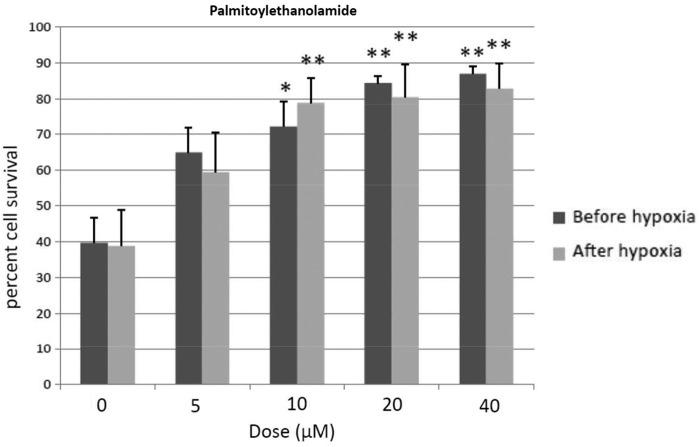
Perinatal hypoxic-ischemic (HI) encephalopathy is defined as a neurological syndrome where the newborn suffers from acute ischemia and hypoxia during the perinatal period. New therapies are needed. The acylethanolamides, oleoylethanolamide (OEA) and palmitoylethanolamide (PEA), possess neuroprotective properties, and they could be effective against perinatal HI. These lipid mediators act through peroxisome proliferator-activated receptors subtype α (PPARα), or transient receptor potential vanilloid (TRPV), such as TRPV subtype 1 and 4. The objectives of this study were to discern: (1) the neuroprotective role of OEA and PEA in parietotemporal cortical neurons of newborn rats and mice subjected to hypoxia, and (2) the role of the receptors, PPARα, TRPV1, and TRPV4, in neuroprotective effects. Cell culture of cortical neurons and the lactate dehydrogenase assay was carried out. The role of receptors was discerned by using selective antagonist and agonist ligands, as well as knockout (KO) PPARα mice. The findings indicate that OEA and PEA exert neuroprotective effects on cultured cortical neurons subjected to a hypoxic episode. These protective effects are not mediated by the receptors, PPARα, TRPV1, or TRPV4, because neither PPARα KO mice nor receptor ligands significantly modify OEA and PEA-induced effects. Blocking TRPV4 with RN1734 is neuroprotective , and cotreatment with OEA and PEA is able to enhance neuroprotective effects of the acylethanolamides. Since stimulating TRPV4 was devoid of effects on OEA and PEA-induced protective effects, effects of RN1734 cotreatment seem to be a consequence of additive actions. The lipid mediators, OEA and PEA, exert neuroprotective effects on cultured cortical neurons subjected to hypoxia. Coadministration of OEA or PEA, and the TRPV4 antagonist RN1734 is able to enhance neuroprotective effects. These results could be of utility for developing new therapeutic tools against perinatal HI.
围产期缺氧缺血性(HI)脑病被定义为一种神经综合征,即新生儿在围产期遭受急性缺血和缺氧。需要新的治疗方法。酰基乙醇酰胺、油酰乙醇酰胺(OEA)和棕榈酰乙醇酰胺(PEA)具有神经保护特性,它们可能对围产期HI有效。这些脂质介质通过过氧化物酶体增殖物激活受体α亚型(PPARα)或瞬时受体电位香草酸亚型(TRPV)发挥作用,如TRPV1和TRPV4亚型。本研究的目的是确定:(1)OEA和PEA在缺氧的新生大鼠和小鼠顶颞叶皮质神经元中的神经保护作用,以及(2)受体PPARα、TRPV1和TRPV4在神经保护作用中的作用。进行了皮质神经元的细胞培养和乳酸脱氢酶测定。通过使用选择性拮抗剂和激动剂配体以及敲除(KO)PPARα小鼠来确定受体的作用。研究结果表明,OEA和PEA对经历缺氧发作的培养皮质神经元具有神经保护作用。这些保护作用不是由PPARα、TRPV1或TRPV4受体介导的,因为PPARα基因敲除小鼠和受体配体均未显著改变OEA和PEA诱导的作用。用RN1734阻断TRPV4具有神经保护作用,OEA和PEA联合治疗能够增强酰基乙醇酰胺的神经保护作用。由于刺激TRPV4对OEA和PEA诱导的保护作用没有影响,RN1734联合治疗的效果似乎是相加作用的结果。脂质介质OEA和PEA对经历缺氧的培养皮质神经元具有神经保护作用。OEA或PEA与TRPV4拮抗剂RN1734联合给药能够增强神经保护作用。这些结果可能有助于开发针对围产期HI的新治疗工具。


 Zotero 插件