State Key Laboratory of Oncology in South China, Collaborative Innovation Center for Cancer Medicine, Sun Yat-sen University Cancer, Guangzhou, China.
Department of Hepatobiliary Oncology, Sun Yat-sen University Cancer Center, Guangzhou, China.
Cancer Med. 2018 Oct;7(10):5027-5035. doi: 10.1002/cam4.1787. Epub 2018 Sep 27.
The existed staging systems were limited in the accuracy of prediction for overall survival (OS) of hepatocellular carcinoma (HCC) patients. The aim of this study is to establish a novel inflammation-based prognostic system with nomogram for HCC patients.
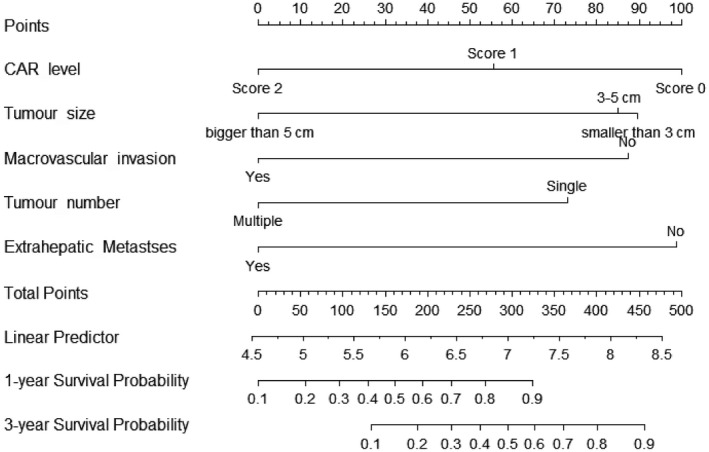
A prospective cohort of patients was recruited and assigned to the training cohort (n = 659) and validation cohort (n = 320) randomly. Different inflammation-based score systems were evaluated to select the best one predicting overall survival (OS). The inflammation-based score system with the highest predicting value and the parameters best reflecting tumor burden identified by multivariate analysis were selected to construct a novel predicting nomogram system. The predictive accuracy and discriminative ability of the nomogram were evaluated by concordance index (C-index) and calibration curve and compared with conventional staging systems.
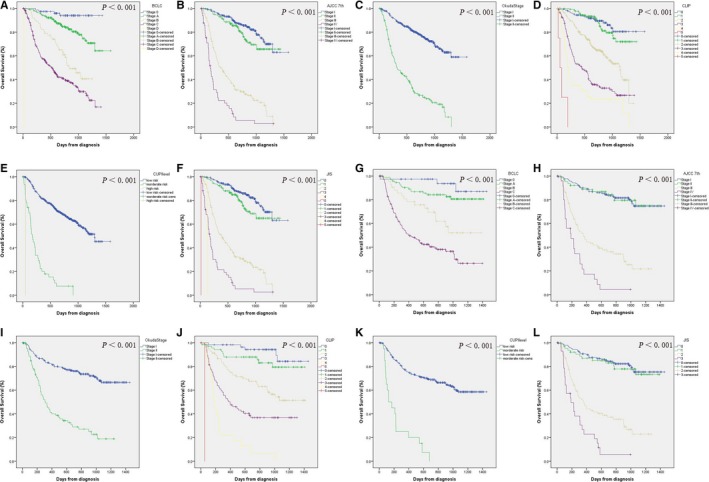
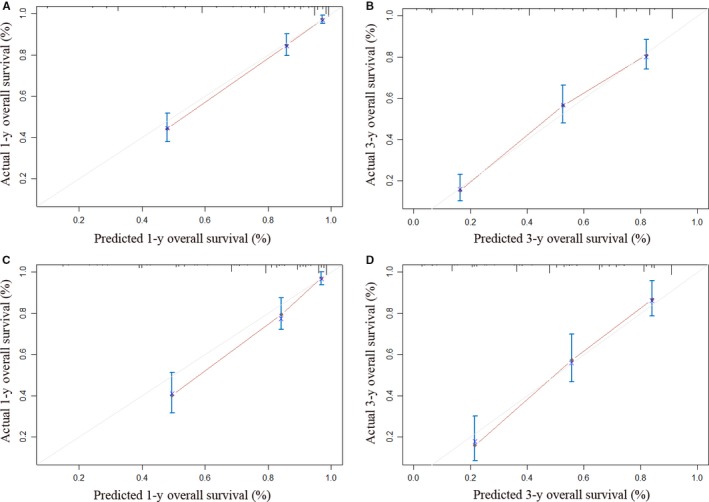
With a highest C-index and areas under the receiver operating characteristic curve (AUC), C-reactive protein/albumin ratio (CAR) was selected to construct the novel system, along with tumor number, tumor size, macrovascular invasion and extra-hepatic metastases. The C-index of the nomogram was 0.813 (95% CI, 0.789-0.837) in the training cohort and 0.794 (95% CI, 0.756-0.832) in the validation cohort. The calibration curve for predicting probability of survival showed that the nomogram had a high consistency with follow-up data. The C-index of the novel system was higher than other conventional staging systems (P < 0.001).
The novel inflammation-based nomogram, developed from prospectively collected data in the present study, predicted the OS of HCC patients.
现有的分期系统在预测肝细胞癌(HCC)患者总生存期(OS)方面的准确性有限。本研究旨在建立一种新的基于炎症的预测模型,并构建列线图。
前瞻性收集患者队列并随机分为训练队列(n=659)和验证队列(n=320)。评估不同的基于炎症的评分系统,以选择预测 OS 的最佳评分系统。选择预测价值最高的炎症评分系统和多因素分析确定的最佳反映肿瘤负荷的参数来构建新的预测列线图系统。通过一致性指数(C-index)和校准曲线评估列线图的预测准确性和判别能力,并与传统分期系统进行比较。
基于最高的 C-index 和受试者工作特征曲线(ROC)下面积(AUC),选择 C 反应蛋白/白蛋白比值(CAR)构建新系统,同时纳入肿瘤数量、肿瘤大小、大血管侵犯和肝外转移。列线图在训练队列中的 C-index 为 0.813(95%CI,0.789-0.837),在验证队列中的 C-index 为 0.794(95%CI,0.756-0.832)。预测生存概率的校准曲线表明,列线图与随访数据具有高度一致性。新系统的 C-index 高于其他传统分期系统(P<0.001)。
本研究建立的新的基于炎症的列线图是基于前瞻性收集的数据,可预测 HCC 患者的 OS。