Division of Allergy, Pulmonary, and Critical Care Medicine, Department of Medicine, Vanderbilt University Medical Center, Nashville, Tennessee, USA.
Department of Internal Medicine-Pulmonary, Critical Care, Allergy and Immunologic Diseases, Wake Forest School of Medicine, Winston-Salem, North Carolina, USA.
JPEN J Parenter Enteral Nutr. 2019 May;43(4):471-480. doi: 10.1002/jpen.1447. Epub 2018 Sep 27.
Enteral nutrition (EN) increases hyperglycemia due to high carbohydrate concentrations while providing insufficient protein. The study tested whether an EN formula with very high-protein- and low-carbohydrate-facilitated glucose control delivered higher protein concentrations within a hypocaloric protocol.
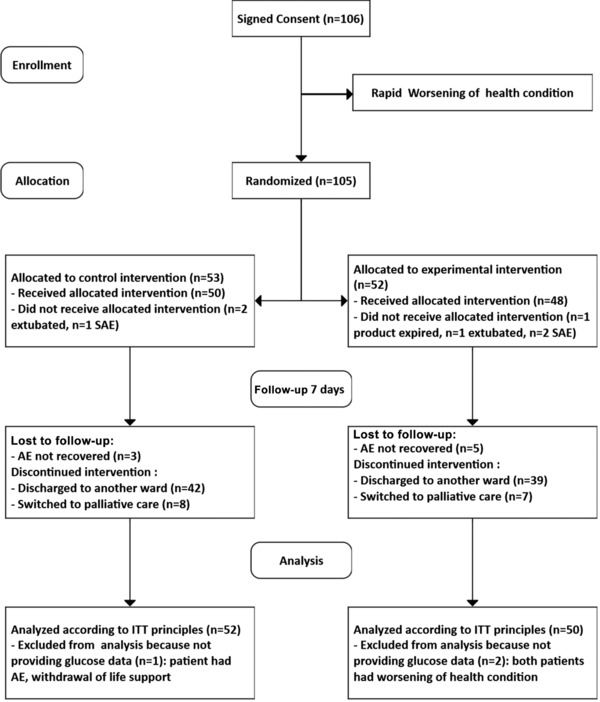
This was a multicenter, randomized, open-label clinical trial with parallel design in overweight/obese mechanically ventilated critically ill patients prescribed 1.5 g protein/kg ideal body weight/day. Patients received either an experimental very high-protein (37%) and low-carbohydrate (29%) or control high-protein (25%) and conventional-carbohydrate (45%) EN formula.
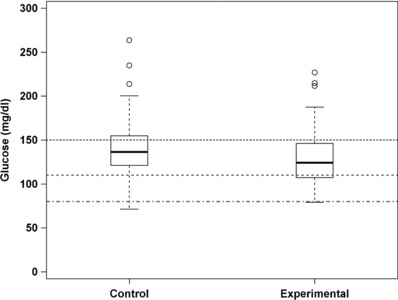
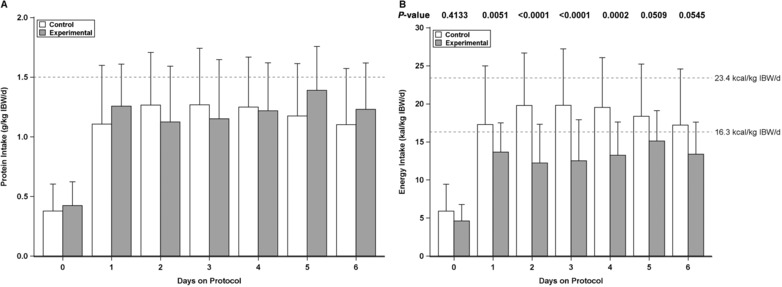
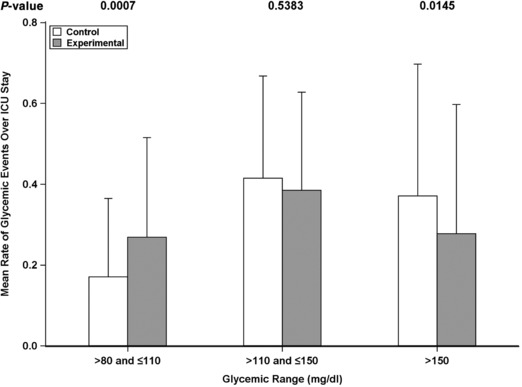
A prespecified interim analysis was performed after enrollment of 105 patients (52 experimental, 53 control). Protein and energy delivery for controls and experimental groups on days 1-5 were 1.2 ± 0.4 and 1.1 ± 0.3 g/kg ideal body weight/day (P = .83), and 18.2 ± 6.0 and 12.5 ± 3.7 kcals/kg ideal body weight/day (P < .0001), respectively. The combined rate of glucose events outside the range of >110 and ≤150 mg/dL were not different (P = .54, primary endpoint); thereby the trial was terminated. The mean blood glucose for the control and the experimental groups were 138 (-SD 108, +SD 177) and 126 (-SD 99, +SD 160) mg/dL (P = .004), respectively. Mean rate of glucose events >150 mg/dL decreased (Δ = -13%, P = .015), whereas that of 80-110 mg/dL increased (Δ = 14%, P = .0007). Insulin administration decreased 10.9% (95% CI, -22% to 0.1%; P = .048) in the experimental group relative to the controls. Glycemic events ≤80 mg/dL and rescue dextrose use were not different (P = .23 and P = .53).
A very high-protein and low-carbohydrate EN formula in a hypocaloric protocol reduces hyperglycemic events and insulin requirements while increasing glycemic events between 80-110 mg/dL.
肠内营养(EN)由于碳水化合物浓度高而导致高血糖,同时提供的蛋白质不足。本研究测试了一种高蛋白、低碳水化合物的 EN 配方是否能在低热量方案中提供更高的蛋白质浓度,从而促进血糖控制。
这是一项多中心、随机、开放标签的临床试验,采用平行设计,纳入超重/肥胖、机械通气的重症患者,给予 1.5 g/kg 理想体重/天的蛋白质。患者接受高蛋白(37%)低碳水化合物(29%)的实验配方或高蛋白(25%)和常规碳水化合物(45%)的对照配方。
在纳入 105 例患者(实验组 52 例,对照组 53 例)后进行了预设的中期分析。对照组和实验组在第 1-5 天的蛋白质和能量供给分别为 1.2±0.4 g/kg 理想体重/天和 1.1±0.3 g/kg 理想体重/天(P=0.83),18.2±6.0 kcals/kg 理想体重/天和 12.5±3.7 kcals/kg 理想体重/天(P<0.0001)。两组患者血糖水平在 110-150 mg/dL 之间的血糖事件发生率无差异(P=0.54,主要终点),因此试验终止。对照组和实验组的平均血糖分别为 138(-SD 108,+SD 177)和 126(-SD 99,+SD 160)mg/dL(P=0.004)。血糖水平>150 mg/dL 的发生率降低(Δ=-13%,P=0.015),而 80-110 mg/dL 的发生率升高(Δ=14%,P=0.0007)。实验组胰岛素的使用量减少了 10.9%(95%CI,-22%至 0.1%;P=0.048)。血糖水平≤80 mg/dL 和使用葡萄糖抢救的发生率无差异(P=0.23 和 P=0.53)。
在低热量方案中,高蛋白、低碳水化合物的 EN 配方可减少高血糖事件和胰岛素需求,同时增加 80-110 mg/dL 之间的血糖事件。