Gallipoli Medical Research Institute, Veteran Mental Health Initiative, Greenslopes Private Hospital, Brisbane, Queensland, Australia.
Faculty of Health and Behavioural Sciences, The University of Queensland, Brisbane, Queensland, Australia.
PLoS One. 2018 Sep 27;13(9):e0203943. doi: 10.1371/journal.pone.0203943. eCollection 2018.
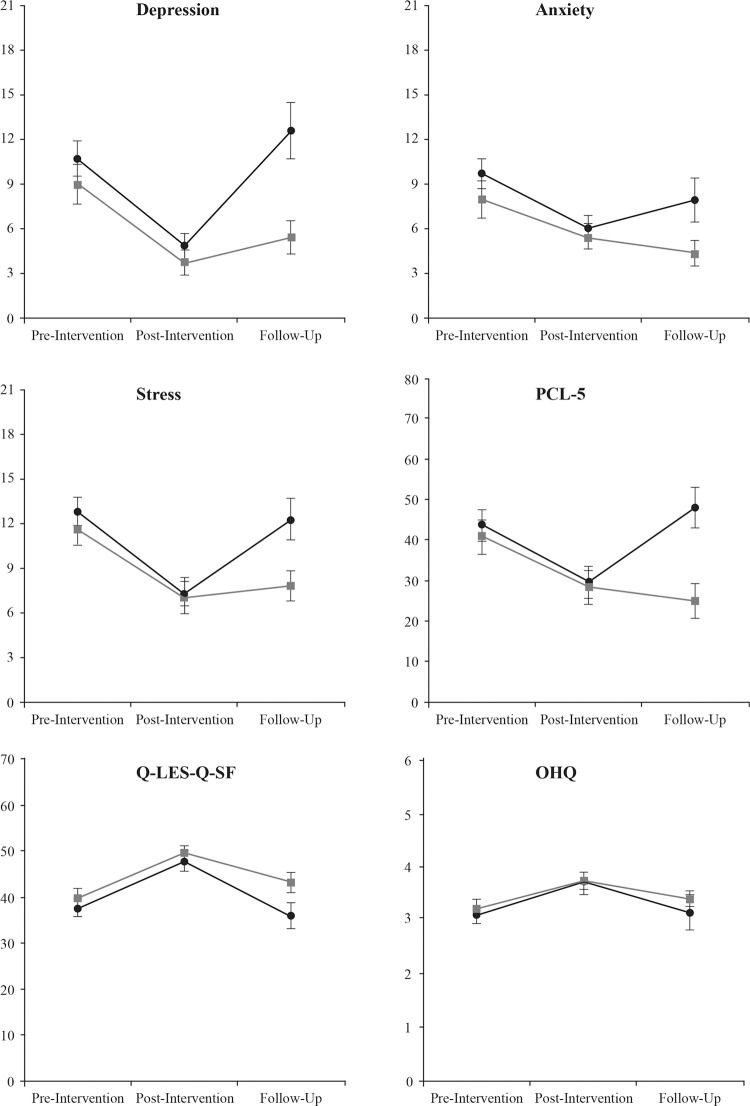
The aim of this study was to evaluate outcomes of an equine-assisted therapy program for Defence Force veterans and their partners across the psychological domains of depression, anxiety, stress, posttraumatic stress, happiness, and quality of life, as well as compare the outcomes of an Individual and Couples program. A non-controlled, within-subjects longitudinal design was utilized with assessment at three time points (pre-intervention, post-intervention, and three months follow-up). Between-subjects analysis with two groups was also conducted to compare the outcomes of the Individual and Couples programs. Participants were recruited from ten programs in 2016 with a total of 47 veterans and partners from both an Individual program (n = 25; veterans only) and a Couples program (n = 22). Outcome measures included the Depression Anxiety Stress Scale-21, Posttraumatic Stress Disorder Checklist for DSM-5, Oxford Happiness Questionnaire, and Quality-of-Life Enjoyment and Satisfaction Questionnaire-Short Form. Paired samples t-tests revealed that within both the Individual and Couples programs, there were significantly fewer psychological symptoms and significantly greater levels of happiness and quality of life at post-intervention compared to pre-intervention. Reduced psychological symptoms were maintained at the three months follow-up for participants of the Couples program only. Independent samples t-tests revealed participants in the Couples program reported significantly less symptoms of depression, stress, and posttraumatic stress disorder (PTSD) at follow-up compared to participants in the Individual program. These results indicate there may only be meaningful benefits for equine-assisted therapy in the reduction of depression, stress, and PTSD symptoms for veterans, if partners are integrated into the intervention.
本研究旨在评估一项针对国防军退伍军人及其伴侣的马术辅助治疗计划在抑郁、焦虑、压力、创伤后应激、幸福感和生活质量等心理领域的结果,并比较个体和夫妻计划的结果。采用非对照、受试者内纵向设计,在三个时间点(干预前、干预后和三个月随访)进行评估。还进行了组间分析,比较个体和夫妻计划的结果。2016 年,从十个项目中招募参与者,共有来自个体项目(n=25;仅限退伍军人)和夫妻项目(n=22)的 47 名退伍军人及其伴侣参与。结果测量包括抑郁焦虑压力量表-21、创伤后应激障碍检查表-5、牛津幸福感问卷和生活质量享受和满意度问卷-短表。配对样本 t 检验显示,在个体和夫妻两个项目中,与干预前相比,干预后心理症状明显减少,幸福感和生活质量明显提高。只有夫妻项目的参与者在三个月随访时仍保持心理症状减轻。独立样本 t 检验显示,夫妻项目的参与者在随访时报告的抑郁、压力和创伤后应激障碍(PTSD)症状明显少于个体项目的参与者。这些结果表明,如果将伴侣纳入干预,马术辅助治疗可能仅对减轻退伍军人的抑郁、压力和 PTSD 症状有意义。