CNRS UMR5286, Centre de Recherche en Cancérologie de Lyon, 69000, Lyon, France.
Inserm U1052, Centre de Recherche en Cancérologie de Lyon, 69008, Lyon, France.
Cell Death Dis. 2018 Sep 27;9(10):1011. doi: 10.1038/s41419-018-1042-7.
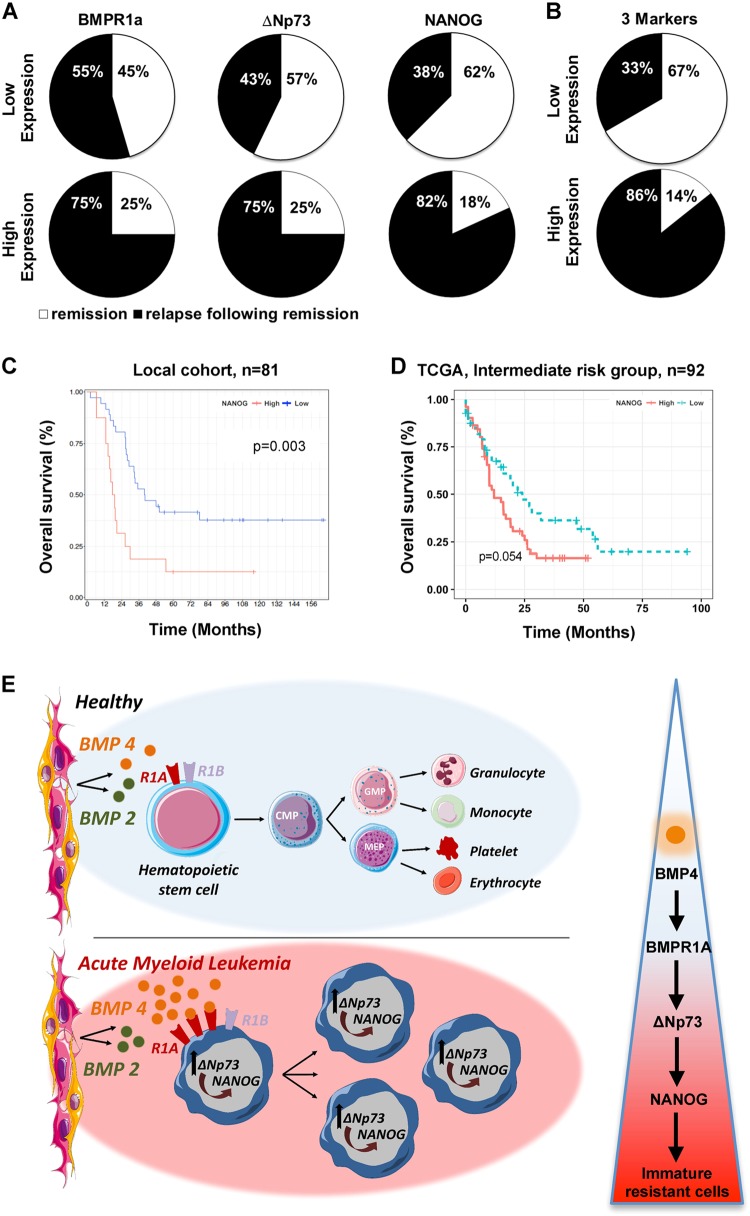
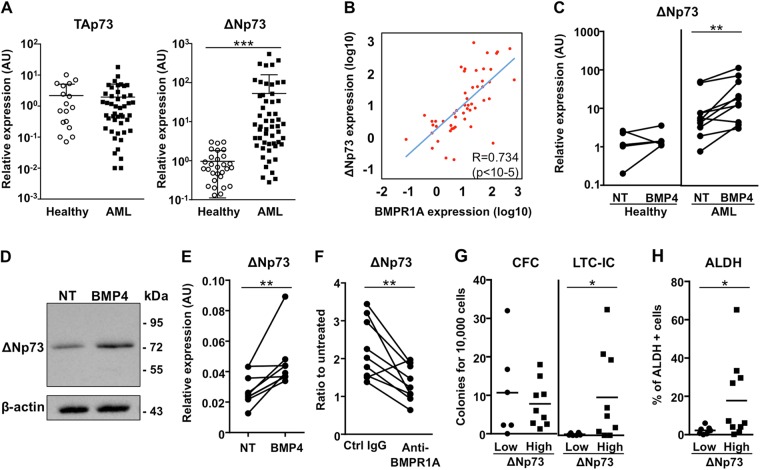
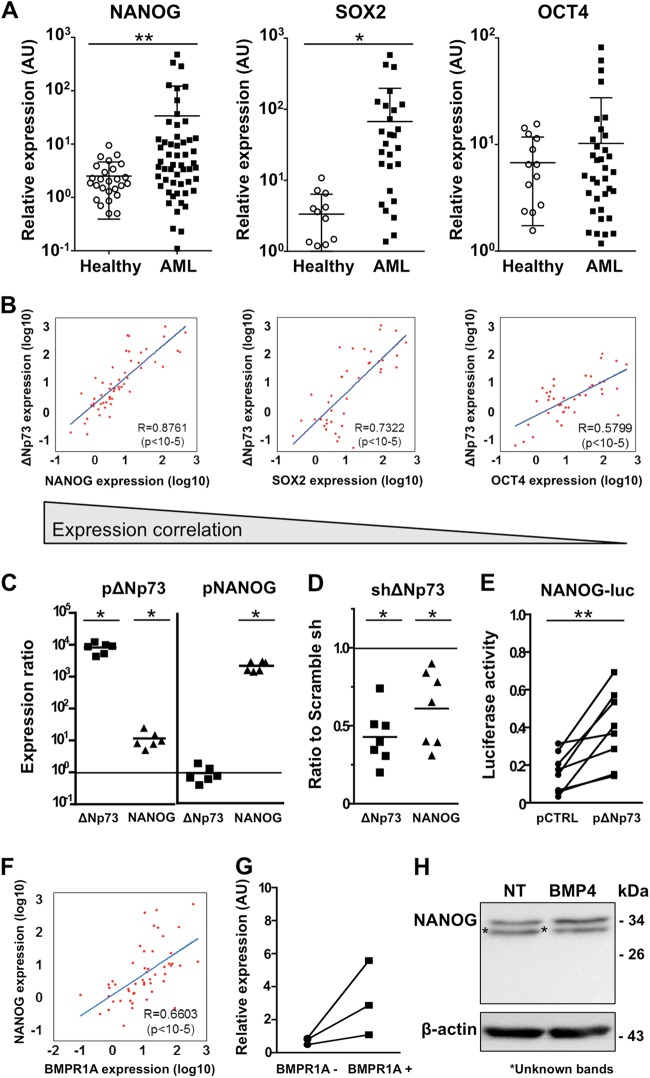
In a significant number of cases cancer therapy is followed by a resurgence of more aggressive tumors derived from immature cells. One example is acute myeloid leukemia (AML), where an accumulation of immature cells is responsible for relapse following treatment. We previously demonstrated in chronic myeloid leukemia that the bone morphogenetic proteins (BMP) pathway is involved in stem cell fate and contributes to transformation, expansion, and persistence of leukemic stem cells. Here, we have identified intrinsic and extrinsic dysregulations of the BMP pathway in AML patients at diagnosis. BMP2 and BMP4 protein concentrations are elevated within patients' bone marrow with a BMP4-dominant availability. This overproduction likely depends on the bone marrow microenvironment, since MNCs do not overexpress BMP4 transcripts. Intrinsically, the receptor BMPR1A transcript is increased in leukemic samples with more cells presenting this receptor at the membrane. This high expression of BMPR1A is further increased upon BMP4 exposure, specifically in AML cells. Downstream analysis demonstrated that BMP4 controls the expression of the survival factor ΔNp73 through its binding to BMPR1A. At the functional level, this results in the direct induction of NANOG expression and an increase of stem-like features in leukemic cells, as shown by ALDH and functional assays. In addition, we identified for the first time a strong correlation between ΔNp73, BMPR1A and NANOG expression with patient outcome. These results highlight a new signaling cascade initiated by tumor environment alterations leading to stem-cell features and poor patients' outcome.
在相当多的情况下,癌症治疗后会出现更具侵袭性的肿瘤,这些肿瘤源自不成熟的细胞。一个例子是急性髓细胞白血病 (AML),其中不成熟细胞的积累是治疗后复发的原因。我们之前在慢性髓细胞白血病中证明,骨形态发生蛋白 (BMP) 途径参与干细胞命运,并有助于白血病干细胞的转化、扩增和持续存在。在这里,我们在 AML 患者诊断时确定了 BMP 途径的内在和外在失调。BMP2 和 BMP4 蛋白浓度在患者骨髓中升高,BMP4 具有优势可用性。这种过度产生可能取决于骨髓微环境,因为 MNC 不过度表达 BMP4 转录本。从内在上讲,受体 BMPR1A 转录本在白血病样本中增加,更多的细胞在膜上呈现这种受体。BMP4 暴露后,BMPR1A 的这种高表达进一步增加,特别是在 AML 细胞中。下游分析表明,BMP4 通过与其受体 BMPR1A 结合来控制生存因子 ΔNp73 的表达。在功能水平上,这导致在白血病细胞中直接诱导 NANOG 的表达和增加干细胞样特征,如 ALDH 和功能测定所示。此外,我们首次发现 ΔNp73、BMPR1A 和 NANOG 表达与患者预后之间存在很强的相关性。这些结果强调了由肿瘤环境改变引发的新信号级联反应,导致干细胞特征和患者预后不良。