1 Department of Interdisciplinary Social Sciences, Utrecht University , Utrecht, The Netherlands.
J Behav Addict. 2018 Sep 1;7(3):697-706. doi: 10.1556/2006.7.2018.65. Epub 2018 Sep 28.
To extend the scholarly debate on (a) whether or not the compulsive use of games and social media should be regarded as behavioral addictions (Kardefelt-Winther et al., 2017) and (b) whether the nine DSM-5 criteria for Internet gaming disorder (IGD; American Psychiatric Association [APA], 2013) are appropriate to distinguish highly engaged, non-disordered users of games and social media from disordered users, this study investigated the impact of engaged and disordered use of games and social media on the psychosocial well-being and school performances of adolescents.
As part of the Digital Youth Project of the University of Utrecht, a three-wave longitudinal sample of 12- to 15-year-old adolescents (N = 538) was utilized. Three annual online measurements were administered in the classroom setting, including IGD, social media disorder, life satisfaction, and perceived social competence. Schools provided information on students' grade point average.
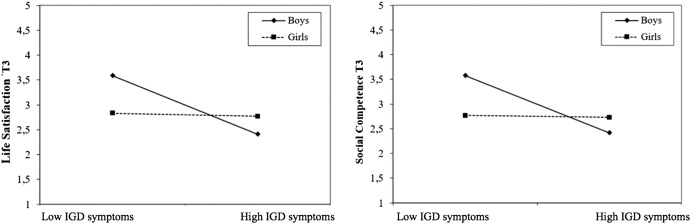
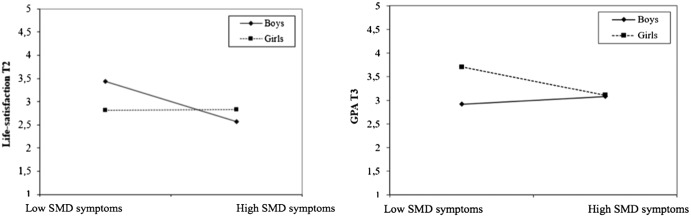
The symptoms of disordered use of games and social media showed to have a negative effect on adolescent's life satisfaction, and the symptoms of disordered gaming showed a negative impact on adolescents' perceived social competence. On the other hand, heavy use of games and social media predicted positive effects on adolescents' perceived social competence. However, the heavy use of social media also predicted a decrease in school performances. Several gender differences in these outcomes are discussed.
The findings propose that symptoms of disordered use of games and social media predict a decrease in the psychosocial well-being and school performances of adolescents, thereby meeting one of the core criteria of behavioral addictions.
扩展关于(a)是否应将游戏和社交媒体的强制性使用视为行为成瘾(Kardefelt-Winther 等人,2017),以及(b)DSM-5 中用于互联网游戏障碍(IGD;美国精神病学协会 [APA],2013)的九个标准是否适合区分高度参与、非障碍性游戏和社交媒体使用者与障碍性使用者的学术争论。本研究调查了游戏和社交媒体的参与性和障碍性使用对青少年心理社会健康和学业成绩的影响。
作为乌得勒支大学数字青年项目的一部分,利用了一个 12 至 15 岁青少年的三波纵向样本(N=538)。在课堂环境中进行了三次年度在线测量,包括 IGD、社交媒体障碍、生活满意度和感知社会能力。学校提供了学生平均绩点的信息。
障碍性使用游戏和社交媒体的症状表现出对青少年生活满意度的负面影响,而障碍性游戏的症状表现出对青少年感知社会能力的负面影响。另一方面,游戏和社交媒体的重度使用预测了对青少年感知社会能力的积极影响。然而,社交媒体的重度使用也预示着学业成绩的下降。讨论了这些结果中的一些性别差异。
研究结果表明,游戏和社交媒体的障碍性使用症状预示着青少年的心理社会健康和学业成绩下降,从而符合行为成瘾的核心标准之一。