Chen Chung-Ming, Juan Shu-Hui, Chou Hsiu-Chu
1 Department of Pediatrics, Taipei Medical University Hospital, Taipei, Taiwan.
2 Department of Pediatrics, School of Medicine, College of Medicine, Taipei Medical University, Taipei, Taiwan.
J Renin Angiotensin Aldosterone Syst. 2018 Jul-Sep;19(3):1470320318803009. doi: 10.1177/1470320318803009.
The renin-angiotensin system and epithelial-mesenchymal transition play crucial roles in the development of kidney fibrosis. The connection between the renin-angiotensin system and transforming growth factor-β in epithelial-mesenchymal transition remains largely unknown.
We assessed oxidative stress, cytokine levels, renal morphology, profibrotic growth factor and renin-angiotensin system component expression, and cell-specific E- and N-cadherin expression in the kidneys of gerbils with streptozotocin-induced diabetes mellitus.
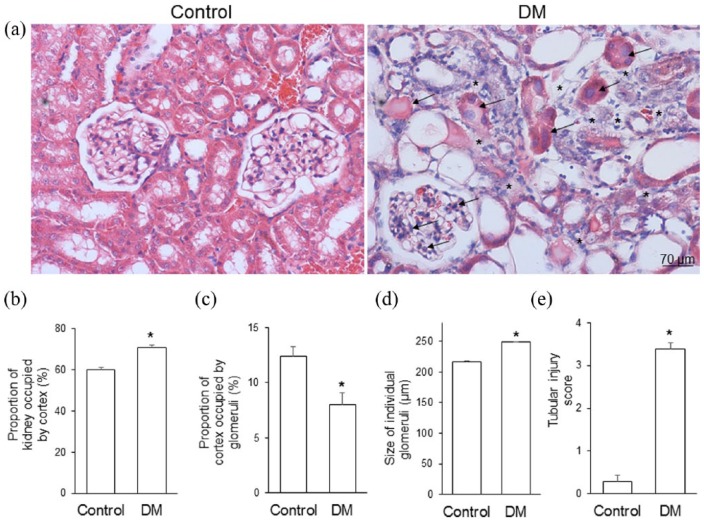
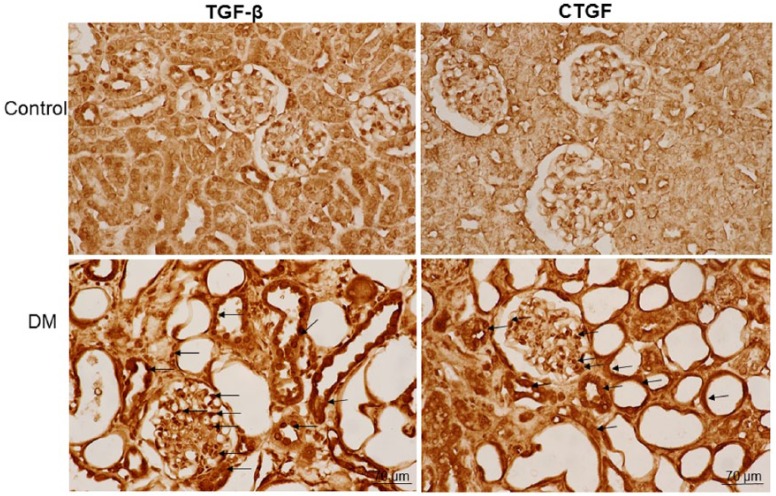
Animals in the experimental group received an intraperitoneal injection of streptozotocin to induce diabetes. The diabetic gerbil kidneys presented kidney injury, which was manifested as distorted glomeruli, necrosis of tubular cells, dilated tubular lumen, and brush border loss. Additionally, the diabetic gerbil kidneys exhibited significantly higher expressions of 8-hydroxy-2'-deoxyguanosine, nuclear factor-kB, toll-like receptor 4, tumor necrosis factor-α, transforming growth factor-β, connective tissue growth factor, α-smooth muscle actin, and N-cadherin and higher collagen deposition than did the control gerbil kidneys. Compared with the control kidneys, the diabetic gerbil kidneys exhibited significantly lower E-cadherin expression. These epithelial-mesenchymal transition characteristics were associated with an increase in renin-angiotensin system expression in the diabetic gerbils.
We demonstrate that hyperglycemia activated the renin-angiotensin system, induced epithelial-mesenchymal transition, and contributed to kidney fibrosis in an experimental diabetes mellitus model.
肾素-血管紧张素系统和上皮-间质转化在肾纤维化的发展中起关键作用。肾素-血管紧张素系统与上皮-间质转化中转化生长因子-β之间的联系仍 largely 未知。
我们评估了链脲佐菌素诱导的糖尿病沙鼠肾脏中的氧化应激、细胞因子水平、肾脏形态、促纤维化生长因子和肾素-血管紧张素系统成分表达,以及细胞特异性 E-钙黏蛋白和 N-钙黏蛋白表达。
实验组动物腹腔注射链脲佐菌素诱导糖尿病。糖尿病沙鼠肾脏出现肾损伤,表现为肾小球扭曲、肾小管细胞坏死、肾小管腔扩张和刷状缘丧失。此外,糖尿病沙鼠肾脏中 8-羟基-2'-脱氧鸟苷、核因子-κB、Toll 样受体 4、肿瘤坏死因子-α、转化生长因子-β、结缔组织生长因子、α-平滑肌肌动蛋白和 N-钙黏蛋白的表达明显高于对照沙鼠肾脏,且胶原沉积更多。与对照肾脏相比,糖尿病沙鼠肾脏中 E-钙黏蛋白表达明显降低。这些上皮-间质转化特征与糖尿病沙鼠肾素-血管紧张素系统表达增加有关。
我们证明高血糖激活了肾素-血管紧张素系统,诱导了上皮-间质转化,并在实验性糖尿病模型中导致了肾纤维化。