Washington University in St. Louis, St. Louis, Missouri.
VA Palo Alto Health Care System, Menlo Park, California.
Prev Chronic Dis. 2018 Sep 27;15:E117. doi: 10.5888/pcd15.180128.
Applying Design Thinking to health care could enhance innovation, efficiency, and effectiveness by increasing focus on patient and provider needs. The objective of this review is to determine how Design Thinking has been used in health care and whether it is effective.
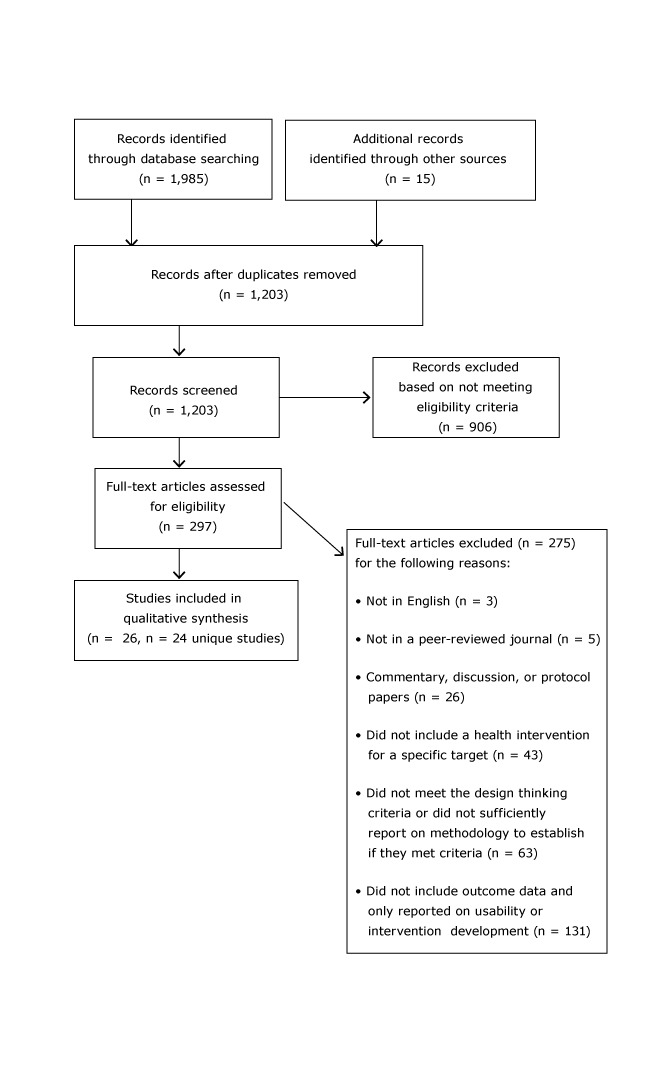
We searched online databases (PubMed, Medline, Web of Science, CINAHL, and PyscINFO) for articles published through March 31, 2017, using the terms "health," "health care," or "healthcare"; and "Design Thinking," "design science," "design approach," "user centered design," or "human centered design." Studies were included if they were written in English, were published in a peer-reviewed journal, provided outcome data on a health-related intervention, and used Design Thinking in intervention development, implementation, or both. Data were collected on target users, health conditions, intervention, Design Thinking approach, study design or sample, and health outcomes. Studies were categorized as being successful (all outcomes improved), having mixed success (at least one outcome improved), or being not successful (no outcomes improved).
Twenty-four studies using Design Thinking were included across 19 physical health conditions, 2 mental health conditions, and 3 systems processes. Twelve were successful, 11 reported mixed success, and one was not successful. All 4 studies comparing Design Thinking interventions to traditional interventions showed greater satisfaction, usability, and effectiveness.
Design Thinking is being used in varied health care settings and conditions, although application varies. Design Thinking may result in usable, acceptable, and effective interventions, although there are methodological and quality limitations. More research is needed, including studies to isolate critical components of Design Thinking and compare Design Thinking-based interventions with traditionally developed interventions.
将设计思维应用于医疗保健可以通过更多地关注患者和医务人员的需求来提高创新、效率和效果。本研究旨在确定设计思维在医疗保健中的应用情况及其效果。
我们使用“健康”、“医疗保健”或“卫生保健”和“设计思维”、“设计科学”、“设计方法”、“以用户为中心的设计”或“以人为中心的设计”等术语,对截至 2017 年 3 月 31 日在在线数据库(PubMed、Medline、Web of Science、CINAHL 和 PyscINFO)中发表的文章进行了检索。研究包括:用英文撰写、发表在同行评议期刊上、提供与健康干预相关的结果数据、并在干预措施的开发和实施中使用设计思维的研究。我们收集了目标用户、健康状况、干预措施、设计思维方法、研究设计或样本以及健康结果等方面的数据。研究根据其结果分为成功(所有结果均得到改善)、部分成功(至少一项结果得到改善)和不成功(无结果改善)。
在 19 种不同的身体状况、2 种心理健康状况和 3 种系统流程中,共有 24 项使用设计思维的研究被纳入。其中 12 项研究取得成功,11 项报告取得部分成功,1 项不成功。所有 4 项将设计思维干预措施与传统干预措施进行比较的研究均显示出更高的满意度、可用性和有效性。
设计思维正在各种医疗保健环境和条件中得到应用,尽管应用方式不同。设计思维可能会产生可用、可接受且有效的干预措施,尽管存在方法学和质量上的限制。需要开展更多研究,包括对设计思维的关键组成部分进行单独研究,并将基于设计思维的干预措施与传统开发的干预措施进行比较。