South African Medical Research Council Bioinformatics Unit, South African National Bioinformatics Institute, University of the Western Cape, Cape Town, South Africa.
School of Pharmacy, University of the Western Cape, Cape Town, South Africa.
PLoS One. 2018 Sep 28;13(9):e0204644. doi: 10.1371/journal.pone.0204644. eCollection 2018.
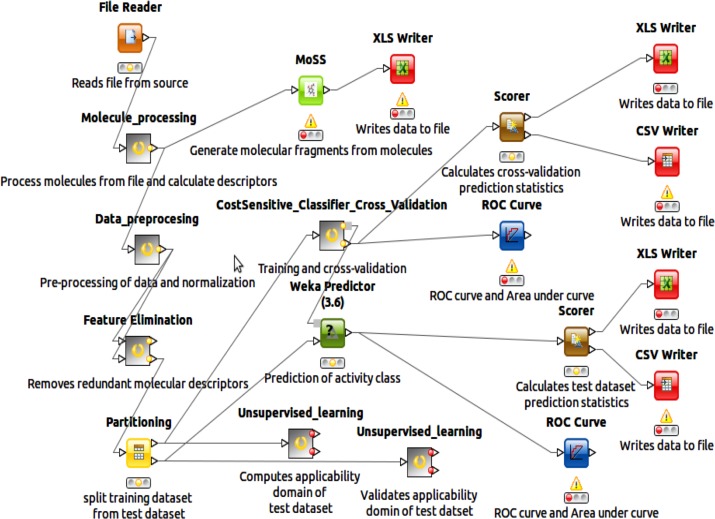
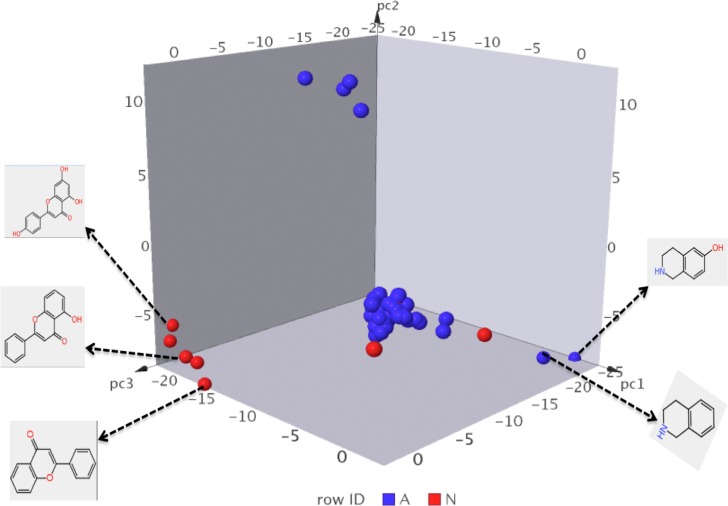
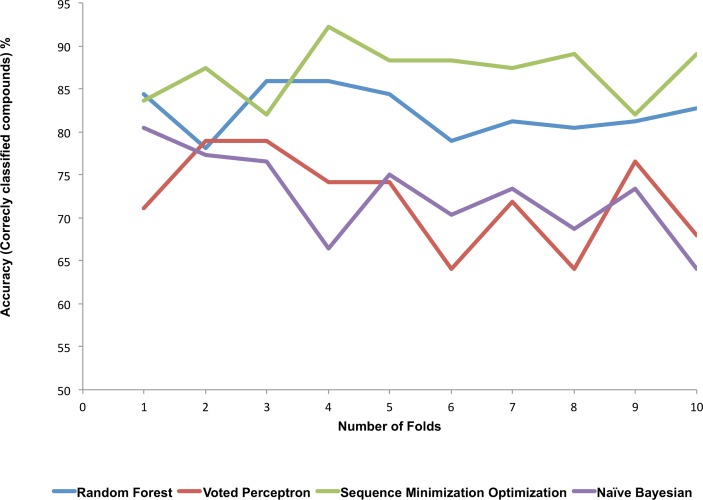
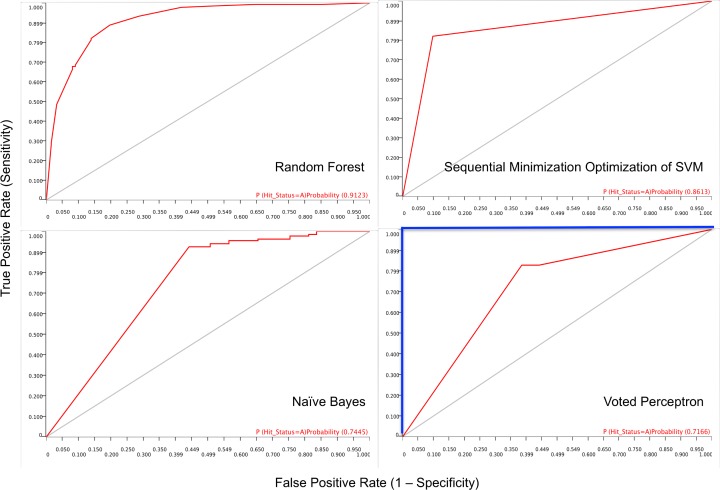
In view of the vast number of natural products with potential antiplasmodial bioactivity and cost of conducting antiplasmodial bioactivity assays, it may be judicious to learn from previous antiplasmodial bioassays and predict bioactivity of these natural products before experimental bioassays. This study set out to harness antimalarial bioactivity data of natural products to build accurate predictive models, utilizing classical machine learning approaches, which can find potential antimalarial hits from new sets of natural products. Classical machine learning approaches were used to build four classifier models (Naïve Bayesian, Voted Perceptron, Random Forest and Sequence Minimization Optimization of Support Vector Machines) from bioactivity data of natural products with in-vitro antiplasmodial activity (NAA) using a combination of the molecular descriptors and two-dimensional molecular fingerprints of the compounds. Models were evaluated with an independent test dataset. Possible chemical features associated with reported antimalarial activities of the compounds were also extracted. From the results, Random Forest (accuracy 82.81%, Kappa statistics 0.65 and Area under Receiver Operating Characteristics curve 0.91) and Sequential Minimization Optimization (accuracy 85.93%, Kappa statistics 0.72 and Area under Receiver Operating Characteristics curve 0.86) showed good predictive performance for the NAA dataset. The amine chemical group (specifically alkyl amines and basic nitrogen) was confirmed to be essential for antimalarial activity in active NAA dataset. This study built and evaluated classifier models that were used to predict the antiplasmodial bioactivity class (active or inactive) of a set of natural products from interBioScreen chemical library.
鉴于具有潜在抗疟生物活性的天然产物数量众多,且抗疟生物活性测定的成本高昂,因此在进行实验性生物测定之前,借鉴以前的抗疟生物测定并预测这些天然产物的生物活性可能是明智之举。本研究旨在利用天然产物的抗疟生物活性数据构建准确的预测模型,利用经典的机器学习方法,从新的天然产物集中发现潜在的抗疟药物。经典的机器学习方法被用于从具有体外抗疟活性(NAA)的天然产物的生物活性数据中构建四个分类器模型(朴素贝叶斯、投票感知机、随机森林和支持向量机序列最小化优化),使用化合物的分子描述符和二维分子指纹的组合。使用独立的测试数据集评估模型。还提取了与报告的化合物抗疟活性相关的可能化学特征。结果表明,随机森林(准确率 82.81%,Kappa 统计量 0.65,接收器工作特征曲线下面积 0.91)和顺序最小化优化(准确率 85.93%,Kappa 统计量 0.72,接收器工作特征曲线下面积 0.86)对 NAA 数据集具有良好的预测性能。胺化学基团(特别是烷基胺和碱性氮)被确认为活性 NAA 数据集中抗疟活性所必需的。本研究构建并评估了分类器模型,用于从 InterBioScreen 化学文库中的一组天然产物中预测抗疟生物活性(活性或非活性)类别。