Dorsey Matthew A, Dsouza Kelvin, Ranganath Dhruv, Harris Joshua S, Lane Thomas R, Urbina Fabio, Ekins Sean
Chemical and Biomolecular Engineering, North Carolina State University, Raleigh, North Carolina 27606, United States.
Electrical and Computer Engineering, North Carolina State University, Raleigh, North Carolina 27606, United States.
J Chem Inf Model. 2024 Aug 12;64(15):5922-5930. doi: 10.1021/acs.jcim.4c00953. Epub 2024 Jul 16.
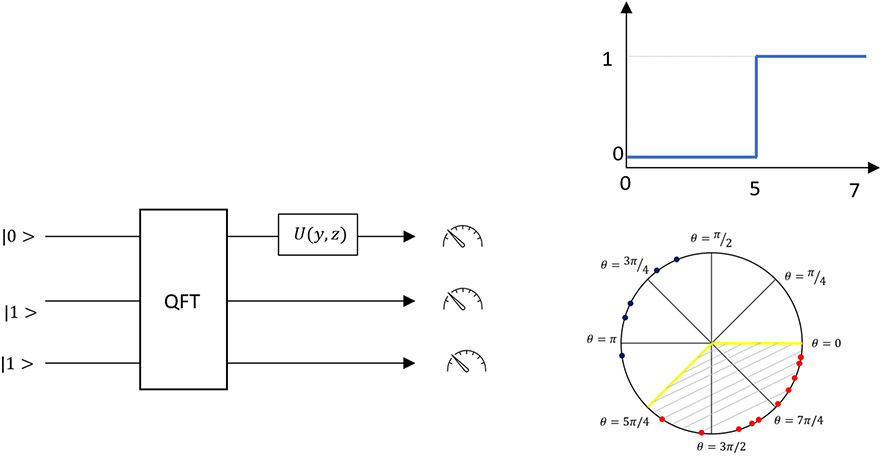
Computational approaches are widely applied in drug discovery to explore properties related to bioactivity, physiochemistry, and toxicology. Over at least the last 20 years, the exploitation of machine learning on molecular data sets has been used to understand the structure-activity relationships that exist between biomolecules and druggable targets. More recently, these methods have also seen application for phenotypic screening data for neglected diseases such as tuberculosis and malaria. Herein, we apply machine learning to build quantum Quantitative Structure Activity Relationship models from antimalarial data sets. There is a continual need for new antimalarials to address drug resistance, and the readily available data sets could be utilized with newer machine learning approaches as these develop. Furthermore, quantum machine learning is a relatively new method that uses a quantum computer to perform the calculations. First, we present a classical-quantum hybrid computational approach by building a Latent Bernoulli Autoencoder machine learning model for compressing bit-vector descriptors to a size that can be adapted to quantum computers for classification tasks with limited loss of embedded information. Second, we apply our method for feature map compression to quantum classification algorithms, including a completely novel machine learning algorithm with no analogy in classical computers: the Quantum Fourier Transform Classifier. We apply both these approaches to build quantum machine learning models for small-molecule antimalarials with quantum simulation software and then benchmark these quantum models against classical machine learning approaches. While there are many challenges currently facing the development of reliable quantum computers, our results demonstrate that there is potential for the use of this technology in the field of drug discovery.
计算方法在药物发现中被广泛应用,以探索与生物活性、物理化学和毒理学相关的性质。至少在过去20年里,利用机器学习处理分子数据集已被用于理解生物分子与可成药靶点之间存在的构效关系。最近,这些方法也被应用于结核病和疟疾等被忽视疾病的表型筛选数据。在此,我们应用机器学习从抗疟数据集构建量子定量构效关系模型。持续需要新的抗疟药物来应对耐药性问题,随着机器学习方法的不断发展,现有的数据集可以与更新的方法结合使用。此外,量子机器学习是一种相对较新的方法,它使用量子计算机来执行计算。首先,我们提出一种经典 - 量子混合计算方法,通过构建潜在伯努利自动编码器机器学习模型,将位向量描述符压缩到可适配量子计算机的大小,以用于分类任务,同时嵌入信息的损失有限。其次,我们将特征映射压缩方法应用于量子分类算法,包括一种在经典计算机中没有类似物的全新机器学习算法:量子傅里叶变换分类器。我们使用量子模拟软件将这两种方法应用于构建小分子抗疟药物的量子机器学习模型,然后将这些量子模型与经典机器学习方法进行基准测试。虽然目前可靠量子计算机的发展面临诸多挑战,但我们的结果表明,这项技术在药物发现领域有应用潜力。