Division of High-Consequence Pathogens and Pathology, National Center for Emerging and Zoonotic Infectious Diseases, US Centers for Disease Control and Prevention, Atlanta, Georgia.
Indiana Department of Health, Indianapolis.
JAMA Netw Open. 2023 Jun 1;6(6):e2317121. doi: 10.1001/jamanetworkopen.2023.17121.
In the US, rabies postexposure prophylaxis (PEP) is often administered without a comprehensive and regionally appropriate rabies risk assessment. For low-risk exposures, this can result in patients incurring out-of-pocket expenses or experiencing adverse effects of PEP unnecessarily.
To use a model to estimate (1) the probability that an animal would test positive for rabies virus (RABV) given that a person was exposed, and (2) the probability that a person would die from rabies given that they were exposed to a suspect rabid animal and did not receive PEP, and to propose a risk threshold for recommending PEP according to model estimates and a survey.
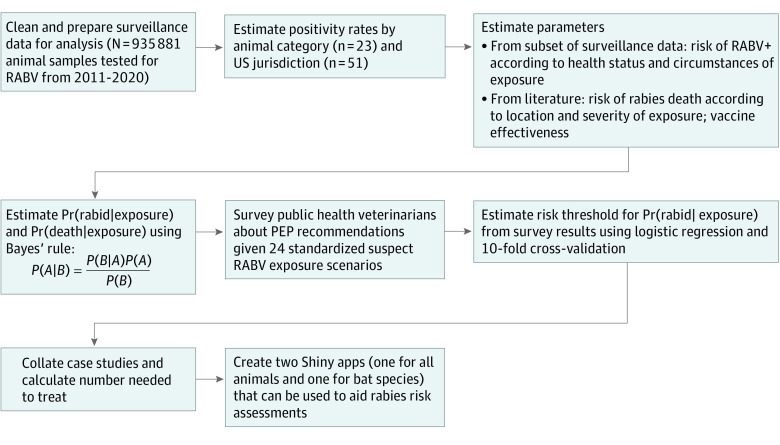
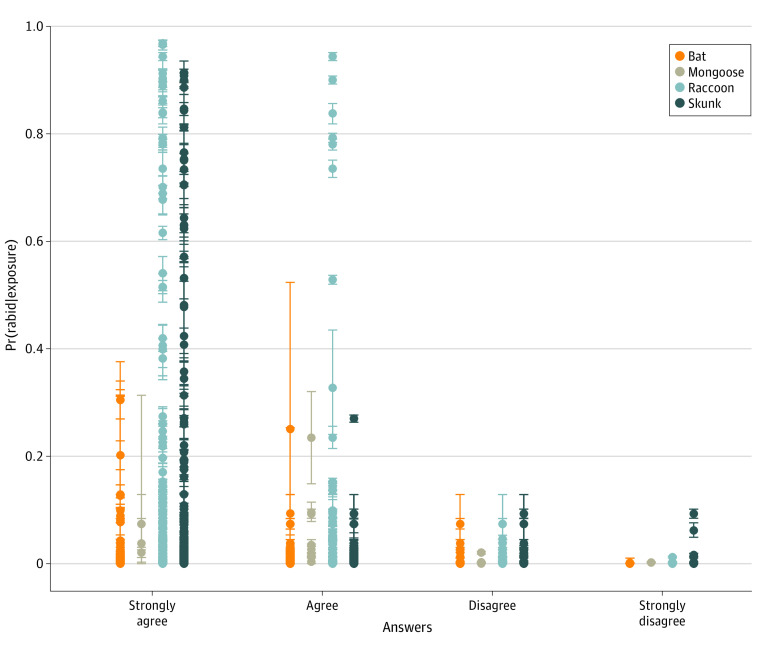
DESIGN, SETTING, AND PARTICIPANTS: In this decision analytical modeling study, positivity rates were calculated using more than 900 000 animal samples tested for RABV between 2011 and 2020. Other parameters were estimated from a subset of the surveillance data and the literature. Probabilities were estimated using Bayes' rule. A survey was administered among a convenience sample of state public health officials in all US states (excluding Hawaii) plus Washington, DC and Puerto Rico to determine a risk threshold for PEP recommendation. Respondents were asked whether they would recommend PEP given 24 standardized exposure scenarios while accounting for local rabies epidemiology.
A quantitative and regionally appropriate approach for helping health care practitioners and public health professionals determine whether to recommend and/or administer rabies PEP.
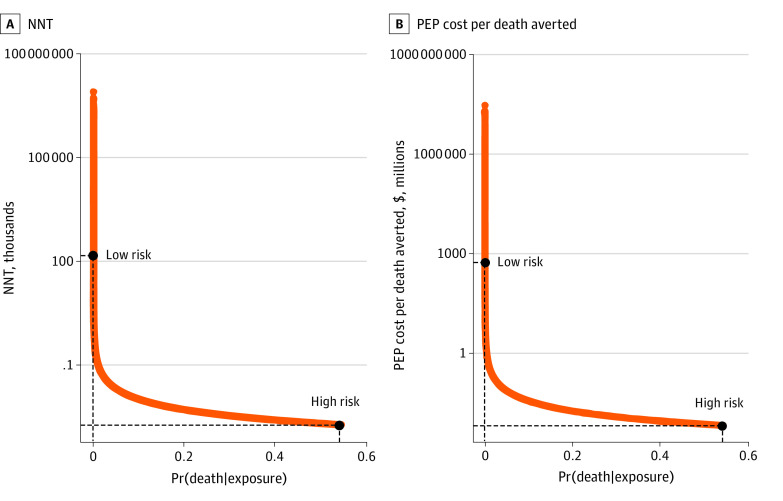
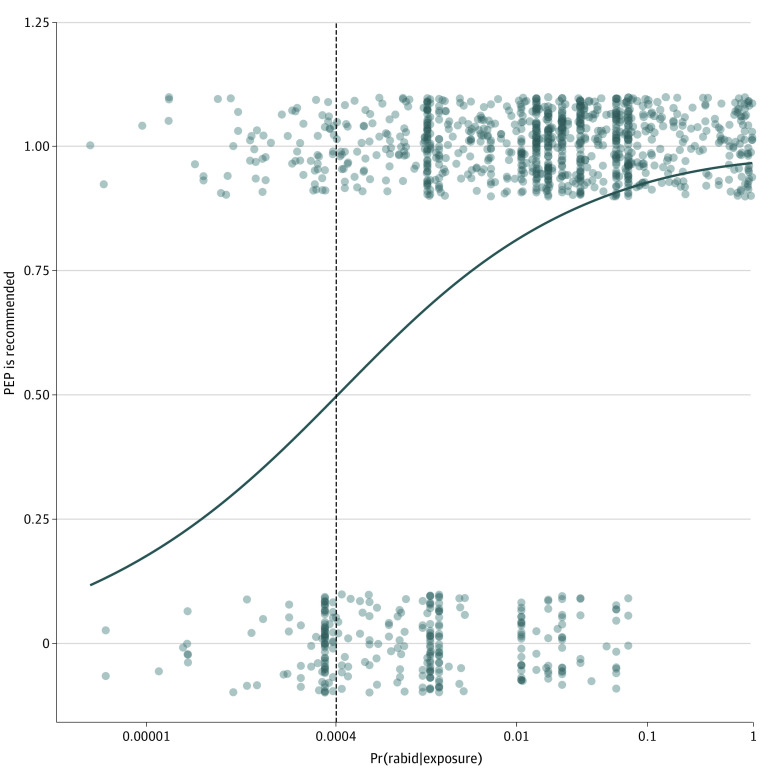
A total of 1728 unique observations were obtained from the model for the probability that an animal would test positive for RABV given that a person was exposed, and 41 472 for ) the probability that a person would die from rabies given that they were exposed to a suspect rabid animal and did not receive PEP. The median probability that an animal would test positive for RABV given that a person was exposed ranged from 3 × 10⁻⁷ to 0.97, while the probability that a person would die from rabies given that they were exposed to a suspect rabid animal and did not receive PEP ranged from 1 × 10⁻¹⁰ to 0.55. Fifty public health officials out of a target sample size of 102 responded to the survey. Using logistic regression, a risk threshold was estimated for PEP recommendation of 0.0004; PEP may not be recommended for exposures with probabilities below this threshold.
In this modeling study of rabies in the US, the risk of death|exposure was quantified and a risk threshold was estimated. These results could be used to inform the decision-making process as to the appropriateness of recommending rabies PEP.
在美国,狂犬病暴露后预防 (PEP) 通常在没有全面和区域适当的狂犬病风险评估的情况下进行。对于低风险暴露,这可能导致患者产生自付费用或不必要地经历 PEP 的不良反应。
使用模型估计 (1) 已知人接触后动物检测出狂犬病病毒 (RABV) 阳性的概率,以及 (2) 已知人接触可疑狂犬病动物且未接受 PEP 后死于狂犬病的概率,并根据模型估计和调查提出推荐 PEP 的风险阈值。
设计、设置和参与者:在这项决策分析建模研究中,使用 2011 年至 2020 年间检测的超过 90 万份动物样本的阳性率计算了阳性率。其他参数是从监测数据的一个子集和文献中估计的。使用贝叶斯规则估计概率。在所有美国州(不包括夏威夷)加上华盛顿特区和波多黎各的州公共卫生官员中进行了一项调查,以确定 PEP 推荐的风险阈值。受访者被要求在考虑当地狂犬病流行病学的情况下,针对 24 种标准化暴露情况,回答他们是否会推荐 PEP。
一种帮助医疗保健从业者和公共卫生专业人员确定是否推荐和/或管理狂犬病 PEP 的定量和区域适当方法。
从模型中获得了 1728 个独特的观察值,用于确定已知人接触后动物检测出 RABV 阳性的概率,以及 41472 个用于确定已知人接触可疑狂犬病动物且未接受 PEP 后死于狂犬病的概率。动物检测出 RABV 阳性的概率中位数从 3×10⁻⁷ 到 0.97 不等,而人接触可疑狂犬病动物且未接受 PEP 后死于狂犬病的概率中位数从 1×10⁻¹⁰ 到 0.55 不等。在目标样本量为 102 的情况下,有 50 名公共卫生官员对调查做出了回应。使用逻辑回归,估计了 PEP 推荐的风险阈值为 0.0004;对于低于此阈值的暴露,可能不建议使用 PEP。
在这项对美国狂犬病的建模研究中,量化了死亡风险|暴露,并估计了风险阈值。这些结果可用于为推荐狂犬病 PEP 的适当性提供决策依据。