Oettle Rebecca C, Wilson Shona
Department of Pathology, University of Cambridge, Tennis Court Road, Cambridge CB2 1QP, UK.
Trop Med Infect Dis. 2017 Aug 23;2(3):42. doi: 10.3390/tropicalmed2030042.
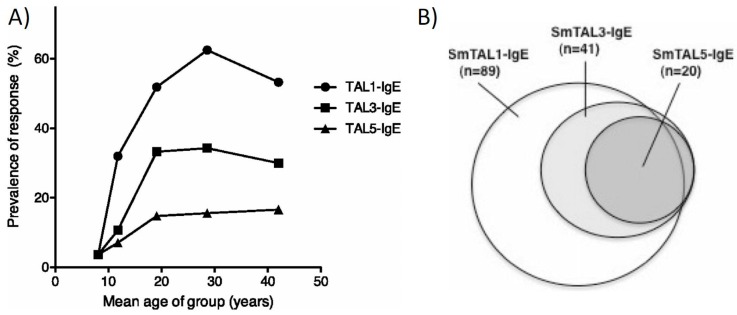
Mass drug administration (MDA) for control of schistosomiasis is likely to affect transmission dynamics through a combination of passive vaccination and reduction of local transmission intensity. This is indicated in phenomenological models of immunity and the impact of MDA, yet immunity parameters in these models are not validated by empirical data that reflects protective immunity to reinfection. There is significant empirical evidence supporting the role of IgE in acquired protective immunity. This is proposed to be a form of delayed concomitant immunity, driven at least in part by protective IgE responses to the tegument allergen-like (TAL) family of proteins. Specific questions have arisen from modeling studies regarding the strength and duration of the protective immune response. At present, field studies have not been specifically designed to address these questions. There is therefore a need for field studies that are explicitly designed to capture epidemiological effects of acquired immunity to elucidate these immunological interactions. In doing so, it is important to address the discourse between theoretical modelers and immuno-epidemiologists and develop mechanistic models that empirically define immunity parameters. This is of increasing significance in a climate of potential changing transmission dynamics following long-term implementation of MDA.
通过群体药物给药(MDA)来控制血吸虫病,可能会通过被动免疫接种和降低局部传播强度的组合来影响传播动态。这在免疫现象学模型以及MDA的影响中有所体现,然而这些模型中的免疫参数并未得到反映对再感染的保护性免疫的实证数据的验证。有大量实证证据支持IgE在获得性保护性免疫中的作用。这被认为是一种延迟伴随免疫的形式,至少部分是由对皮层过敏原样(TAL)蛋白家族的保护性IgE反应驱动的。关于保护性免疫反应的强度和持续时间,建模研究引发了一些具体问题。目前,现场研究并非专门为解决这些问题而设计。因此,需要明确设计旨在捕捉获得性免疫的流行病学效应的现场研究,以阐明这些免疫相互作用。在这样做的过程中,重要的是解决理论建模者和免疫流行病学家之间的讨论,并开发能凭经验定义免疫参数的机制模型。在长期实施MDA后潜在的传播动态变化的情况下,这一点的重要性日益凸显。