French Michael D, Churcher Thomas S, Webster Joanne P, Fleming Fiona M, Fenwick Alan, Kabatereine Narcis B, Sacko Moussa, Garba Amadou, Toure Seydou, Nyandindi Ursuline, Mwansa James, Blair Lynsey, Bosqué-Oliva Elisa, Basáñez Maria-Gloria
Schistosomiasis Control Initiative, Faculty of Medicine, Imperial College London, St. Mary's Hospital, Norfolk Place, London, W2 1PG, UK.
Department of Infectious Disease Epidemiology, School of Public Health, Faculty of Medicine, Imperial College London, Norfolk Place, London, W2 1PG, UK.
Parasit Vectors. 2015 Oct 24;8:558. doi: 10.1186/s13071-015-1138-1.
The last decade has seen an expansion of national schistosomiasis control programmes in Africa based on large-scale preventative chemotherapy. In many areas this has resulted in considerable reductions in infection and morbidity levels in treated individuals. In this paper, we quantify changes in the force of infection (FOI), defined here as the per (human) host parasite establishment rate, to ascertain the impact on transmission of some of these programmes under the umbrella of the Schistosomiasis Control Initiative (SCI).
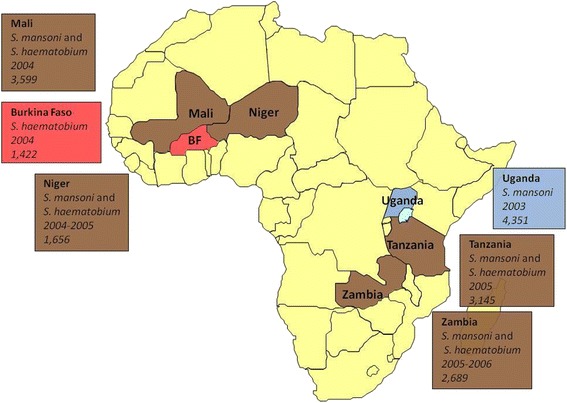
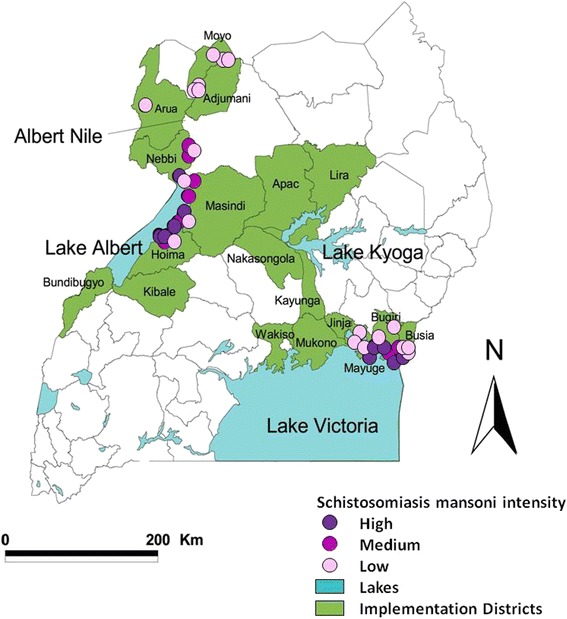
A previous model for the transmission dynamics of Schistosoma mansoni was adapted here to S. haematobium. These models were fitted to longitudinal cohort (infection intensity) monitoring and evaluation data. Changes in the FOI following up to three annual rounds of praziquantel were estimated for Burkina Faso, Mali, Niger, Tanzania, Uganda, and Zambia in sub-Saharan Africa (SSA) according to country, baseline endemicity and schistosome species. Since schistosomiasis transmission is known to be highly focal, changes in the FOI at a finer geographical scale (that of sentinel site) were also estimated for S. mansoni in Uganda.
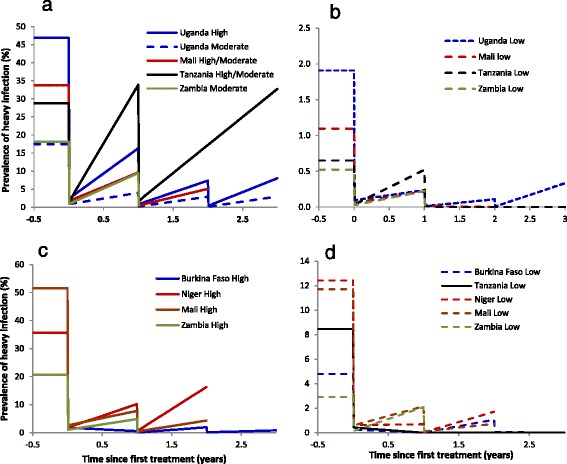
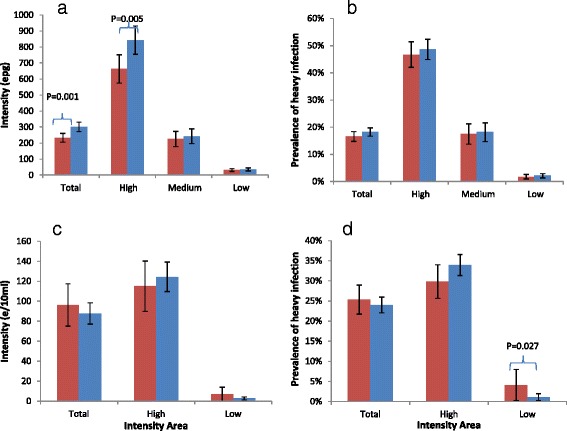
Substantial and statistically significant reductions in the FOI relative to baseline were recorded in the majority of, but not all, combinations of country, parasite species, and endemicity areas. At the finer geographical scale assessed within Uganda, marked heterogeneity in the magnitude and direction of the relative changes in FOI was observed that would not have been appreciated by a coarser-scale analysis.
Reductions in the rate at which humans acquire schistosomes have been achieved in many areas of SSA countries assisted by the SCI, while challenges in effectively reducing transmission persist in others. Understanding the underlying heterogeneity in the impact and performance of the control intervention at the level of the transmission site will become increasingly important for programmes transitioning from morbidity reduction to elimination of infection. Such analyses will require a fine-scale approach. The lack of association found between programmatic variables, such as therapeutic treatment coverage (recorded at district level) and changes in FOI (at sentinel site level) is discussed and recommendations are made.
过去十年间,非洲基于大规模预防性化疗的国家血吸虫病控制项目不断扩展。在许多地区,这已使接受治疗者的感染率和发病率大幅降低。在本文中,我们对感染力(FOI,在此定义为每(人类)宿主的寄生虫定植率)的变化进行量化,以确定在血吸虫病控制倡议(SCI)框架下其中一些项目对传播的影响。
先前关于曼氏血吸虫传播动力学的模型在此被改编用于埃及血吸虫。这些模型被拟合至纵向队列(感染强度)监测和评估数据。根据国家、基线流行程度和血吸虫种类,对撒哈拉以南非洲(SSA)的布基纳法索、马里、尼日尔、坦桑尼亚、乌干达和赞比亚在多达三轮年度吡喹酮治疗后的感染力变化进行了估计。由于已知血吸虫病传播具有高度聚集性,还对乌干达的曼氏血吸虫在更精细地理尺度(哨点所在地尺度)上的感染力变化进行了估计。
在大多数(但并非所有)国家、寄生虫种类和流行地区的组合中,相对于基线,感染力出现了大幅且具有统计学意义的降低。在乌干达评估的更精细地理尺度上,观察到感染力相对变化的幅度和方向存在显著异质性,而粗尺度分析无法察觉到这一点。
在SCI协助下,SSA国家的许多地区已实现人类感染血吸虫速率的降低,而在其他地区,有效降低传播仍面临挑战。对于从降低发病率向消除感染过渡的项目而言,了解控制干预在传播地点层面的影响和表现背后的潜在异质性将变得愈发重要。此类分析将需要采用精细尺度方法。文中讨论了在项目变量(如地区层面记录的治疗覆盖率)与感染力变化(哨点所在地层面)之间未发现关联的情况并提出了建议。